

TLDR
A portable capnograph measures exhaled CO₂ and displays a waveform to answer one question: is the patient ventilating? A multiparameter monitor tracks several vital signs (ECG, SpO₂, blood pressure, temperature, respiratory rate) to answer a broader question: is the patient’s overall condition stable? For ward monitoring, the right device depends on the clinical risk you are trying to catch. High-risk patients, especially those on opioids, sedated, intubated, or being transported, often need capnography as an added layer even when standard vitals are being watched.
When a patient leaves the operating room or ICU and arrives on a general ward, monitoring intensity drops. Vital signs are typically checked every four to six hours, sometimes every eight. Between those manual rounds, deterioration can go unnoticed. That gap is why hospitals increasingly ask whether they need a portable capnograph or multiparameter monitor for ward monitoring, and the answer is not one or the other. It depends on the risk.
This guide defines both device categories in plain language, explains when each one fits, and walks through the practical factors that matter for clinical teams, biomedical engineers, and procurement departments.
Watch a quick demo to see how a portable capnograph works in a ward or transport workflow.
What Is a Portable Capnograph?
A portable capnograph is a compact device that measures carbon dioxide in exhaled breath and displays two things: a numeric EtCO₂ value (end-tidal CO₂) and a continuous waveform called a capnogram. That waveform is the key differentiator. It shows the shape and timing of CO₂ elimination with each breath, giving clinicians real-time insight into ventilation, airway patency, and circuit integrity.
Capnography provides continuous, noninvasive information about ventilation, pulmonary perfusion, metabolism, and equipment function. The waveform can reveal airway obstruction, apnea, hypoventilation, rebreathing, and disconnection earlier or more specifically than a single number alone, according to OpenAnesthesia’s clinical reference.
Portable capnographs are designed to travel. They are small enough to carry between wards, use during transport, or deploy in procedure rooms where a full bedside monitor is unavailable or impractical. Some use mainstream sensors (placed directly in the airway circuit), while others use sidestream sampling (pulling gas through a tube to a remote analyzer). Understanding the difference between types of capnometers matters because it affects speed, accuracy, and which patients the device works for.
A portable capnograph is not a full patient monitor. It answers a focused question: is this patient ventilating, and is the airway or circuit working correctly?
What Is a Multiparameter Monitor?
A multiparameter monitor (often called a “multipara monitor” in Indian hospitals) collects, displays, and alarms on several physiological parameters simultaneously. The standard configuration includes ECG and heart rate, SpO₂ (pulse oximetry), non-invasive blood pressure (NIBP), respiratory rate, and temperature. Advanced models may add EtCO₂, invasive blood pressure, cardiac output, or anesthetic gas analysis.
These monitors are the backbone of ICU, operating room, and step-down unit surveillance. On general wards, they provide a broader picture of the patient’s hemodynamic, cardiac, respiratory, and oxygenation status. Features like trend storage, alarm management, battery backup, and central station connectivity make them suited for continuous or semi-continuous observation across multiple beds.
The important distinction: a multiparameter monitor may include capnography as an optional module, but many ward-level monitors do not have EtCO₂ installed or enabled. Buyer guides commonly list ECG, SpO₂, NIBP, respiratory rate, temperature, and optional EtCO₂ among the key purchase factors for hospital monitors, as noted in India-focused monitor comparisons.
What Does Ward Monitoring Mean?
Ward monitoring refers to patient monitoring outside critical care areas. This includes general medical and surgical wards, post-operative wards, step-down areas, day-care recovery zones, and similar lower-acuity inpatient settings.
The problem with traditional ward monitoring is timing. Standard care on most general wards is intermittent vital-sign measurement, commonly every four to eight hours. A 2024 systematic review confirmed that this interval-based approach can miss deterioration between checks, and delayed detection is linked to preventable harm. Continuous monitoring is proposed as a solution because physiologic changes, particularly respiratory depression, can develop rapidly and silently in between manual rounds.
But continuous monitoring on a ward is not the same as ICU monitoring. Ward patients are more mobile, staffing ratios are different, alarm infrastructure may not exist, and the clinical question often differs. That is exactly why the choice between a portable capnograph or multiparameter monitor for ward monitoring matters so much. The device must match the risk.
Portable Capnograph vs Multiparameter Monitor: Key Differences
The core question is not “which device is better?” It is “what risk are you trying to detect?”
Ventilation risk: If the clinical concern is hypoventilation, apnea, airway displacement, CO₂ retention, or post-sedation respiratory compromise, a portable capnograph is the more targeted tool.
General deterioration risk: If the clinical concern is overall physiologic decline (cardiac rhythm changes, blood pressure shifts, oxygen desaturation, temperature instability), a multiparameter monitor is the broader tool.
Here is how they compare across practical decision points:
Factor | Portable Capnograph | Multiparameter Monitor |
|---|---|---|
Primary question answered | Is the patient ventilating? Is the airway intact? | Are multiple vital signs stable or worsening? |
Parameters measured | EtCO₂, capnogram waveform, respiratory rate; some add FiCO₂ or SpO₂ | ECG, SpO₂, NIBP, RR, temperature; optional EtCO₂, IBP, cardiac output |
Best ward fit | Sedation recovery, opioid patients, intubated/tracheostomy care, transport, airway confirmation | General surveillance, step-down, cardiac risk, post-op vitals trending |
Unique strength | Detects hypoventilation and apnea before SpO₂ drops, especially with supplemental O₂ | Combines multiple parameters and alarms for broader hemodynamic and respiratory picture |
Key limitation | Does not replace ECG, BP, SpO₂, or full vital-sign surveillance | May lack EtCO₂ unless specifically configured; more alarm channels create fatigue risk |
Portability | Small, fast to deploy, minimal accessories | Larger, more cables and probes, often mounted; portable versions exist but are heavier |
Alarm burden | Fewer alarm channels, but sampling artifacts possible | More alarm channels; alarm fatigue is a documented implementation risk |
Practitioners on Reddit consistently emphasize that capnography is the waveform, not just the EtCO₂ number. In EMS and critical care discussions, users describe using the waveform to confirm tube placement, monitor CPR quality, and catch ventilation problems that clinical signs alone can miss.
One critical point: SpO₂ tells you about oxygenation. EtCO₂ and the capnogram tell you about ventilation and CO₂ elimination. They are not interchangeable. For a deeper look at why real-time EtCO₂ trends add value beyond blood gas, see this comparison of EtCO₂ versus PaCO₂ monitoring.
When to Use a Portable Capnograph on the Ward
A portable capnograph or multiparameter monitor for ward monitoring fills different roles depending on patient risk. Here are the situations where a portable capnograph is most useful.
Post-Operative Patients Receiving Opioids
The PRODIGY trial monitored 1,335 general-care-floor patients receiving parenteral opioids across 16 sites in seven countries. Using continuous capnography and pulse oximetry, the study found a 46% incidence of respiratory depression episodes. Almost half the patients experienced at least one event, including respiratory rates below 5 breaths per minute, EtCO₂ values above 60 mmHg, apnea lasting over 30 seconds, or SpO₂ below 85%.
These events happened on general wards, not in ICUs. Standard intermittent vital checks would have missed many of them.
Procedural Sedation and Recovery
Capnography detects hypoventilation and apnea earlier than pulse oximetry in sedated, non-intubated patients. This is because oxygen saturation can stay normal for minutes despite inadequate ventilation, especially when the patient is receiving supplemental oxygen. A capnograph catches the problem at the CO₂ level before desaturation occurs.
Intubated or Tracheostomy Patients Outside ICU
The AARC clinical practice guideline states that continuous waveform capnography is the most reliable method for confirming and monitoring correct endotracheal tube placement, in addition to clinical assessment. For intubated or tracheostomy patients managed on wards or step-down units, a capnograph provides continuous assurance that the airway is patent and the circuit is functioning.
Intra-Hospital Transport
Transport between the OR, ICU, ward, or imaging suite is a high-risk window. The AARC recommends continuous capnometry during transport of mechanically ventilated patients. A portable capnograph fits this use case because it is small, battery-powered, and fast to connect.
Emergency Airway Confirmation
The American Heart Association’s 2025 adult advanced life support guidance recommends continuous waveform capnography for confirming endotracheal tube placement in cardiac arrest. A sustained waveform is confirmation; sudden waveform loss should trigger urgent assessment for disconnection, esophageal intubation, apnea, or cardiac arrest.
Small Hospitals and Day-Care Surgery Centers
Facilities that cannot afford or justify a full bedside monitor with integrated EtCO₂ in every procedure room can use a portable capnograph as a focused respiratory monitoring layer. This gives clinicians waveform-level ventilation data without the cost and complexity of a multiparameter system. For more clinical scenarios, read about common capnography use cases.
When to Use a Multiparameter Monitor on the Ward
A multiparameter monitor is more appropriate when the ward team needs broader physiologic surveillance across multiple organ systems.
Step-down and high-dependency observation. Patients transitioning from ICU need continuous ECG, SpO₂, BP, and respiratory rate trending. A multiparameter monitor centralizes these parameters on one screen.
Cardiac-risk patients. ECG monitoring for arrhythmia detection, ST-segment changes, or heart rate trends requires a multiparameter setup. A capnograph cannot fill this role.
Post-operative patients needing vital-sign trends. When blood pressure stability, SpO₂ recovery, and temperature are the primary concerns, a multiparameter monitor covers the full picture.
Wards with central nursing-station infrastructure. Hospitals with networked central monitoring need multiparameter monitors that can transmit data to a station display. This allows one nurse to watch several beds simultaneously.
Departments needing data storage or EHR integration. Multiparameter monitors with trend storage, waveform recall, and network connectivity support documentation, audit, and quality improvement.
When Both Are Needed
For high-risk ward patients, the best setup may be multiparameter monitoring plus capnography:
SpO₂ for oxygenation
ECG and heart rate for cardiac status
Blood pressure for perfusion
Respiratory rate for breathing pattern
EtCO₂ and capnogram for ventilation, airway integrity, and CO₂ elimination
This layered approach is especially relevant for sedated patients, those receiving opioids, intubated or tracheostomy-dependent patients, patients being transported, or anyone at risk of airway obstruction. In an r/IntensiveCare discussion, one clinician framed EtCO₂ changes as an early sign that the patient’s clinical picture has changed, before other vitals move. The challenge, as several practitioners noted, is less about believing in capnography and more about equipment availability, local protocols, and training.
Does Continuous Ward Monitoring Improve Outcomes?
The evidence is promising but not settled.
A 2020 systematic review of multiparameter continuous non-invasive monitoring in non-ICU hospital wards included 14 studies and found a 39% decrease in mortality risk in pooled controlled studies compared with intermittent monitoring. There were also trends toward fewer ICU transfers and shorter hospital stays.
However, a 2024 meta-analysis restricted to randomized controlled trials (seven trials, 1,284 general-ward patients) found no statistically significant improvements in pooled hospital mortality, major complications, HDU/ICU admission, or length of stay.
What explains the gap? Monitoring alone does not save patients. The monitor detects a problem. A human must then interpret the alarm, assess the patient, and escalate appropriately. If alarm thresholds are poorly set, staff are not trained, or escalation protocols do not exist, the data goes nowhere.
This is the most important principle when choosing a portable capnograph or multiparameter monitor for ward monitoring: the device is only as good as the response system around it.
Alarm Fatigue: The Hidden Risk
Continuous monitoring creates more alarms. More alarms are not always better. A study analyzing over 150,000 hours of continuous SpO₂ and pulse-rate alarm data on general care floors found that alarm burden is a real and measurable problem.
Nursing Reddit discussions describe central monitors being routinely ignored when alarms sound constantly. One nurse wrote plainly that when everything alarms all the time, nothing alarms. A 2025 systematic review of nurses’ experiences with continuous vital-sign monitoring in general wards identified four themes: perceived safety benefits, practical disadvantages like reduced nurse-patient interaction, the importance of training, and the critical need for alarm strategies.
Before buying any monitoring device for ward use, ask these questions:
Can alarm limits be customized per patient?
Are alarms visual, audible, or centrally routed?
Can nuisance alarms be reduced without disabling safety alerts?
Who receives the alarm, and what is the escalation pathway?
Are ward nurses trained to interpret the waveform or vital-sign data?
Alarm policy matters as much as device selection.
Technical Terms Clinicians and Buyers Should Know
EtCO₂ (End-Tidal CO₂): The maximum CO₂ concentration measured at the end of expiration. Normal range is roughly 35 to 45 mmHg. In healthy individuals, EtCO₂ runs about 2 to 5 mmHg below arterial CO₂, but this gradient widens in lung disease, shock, or perfusion problems.
Capnogram: The waveform display of CO₂ concentration over time during the respiratory cycle. Reading the shape of the waveform reveals clinical information that the number alone cannot provide. Learn to interpret capnography waveforms for common patterns like bronchospasm, rebreathing, and circuit leaks.
Capnography vs Capnometry: Capnography includes both the numeric CO₂ value and the continuous waveform display. Capnometry provides only the numeric value without the waveform. For airway and ventilation troubleshooting, the waveform is where the clinical value lies.
Mainstream Capnography: The CO₂ sensor sits directly in the airway circuit. Advantages include fast response and high waveform fidelity. Limitations include added weight at the airway connection and potential condensation issues.
Sidestream Capnography: Gas is pulled through tubing to a remote sensor. Works for non-intubated patients via nasal cannula. Limitations include transport delay, moisture clogging the sampling line, and dilution from mouth breathing or loose cannula fit. Practitioners in emergency medicine forums have reported sampling lines clogging in humid conditions, which aligns with known sidestream limitations around moisture-related inaccuracy.
FiCO₂ (Fractional Inspired CO₂): The CO₂ concentration in inspired gas. Normally near zero. An elevated FiCO₂ suggests rebreathing, exhausted soda lime, or a faulty circuit valve.
Volumetric Capnography: Plots CO₂ against exhaled volume rather than time, providing information about dead space and CO₂ elimination efficiency. More commonly used in ICU ventilator management. For a fuller explanation, see time-based and volumetric capnography.
Alarm Fatigue: Desensitization caused by excessive, frequent, or non-actionable alarms. Recognized as a patient safety hazard across all forms of continuous monitoring.
Buying Checklist for Ward Monitoring Devices
Whether the decision is a portable capnograph or multiparameter monitor for ward monitoring, procurement teams in Indian hospitals should work through these steps before writing specifications.
1. Define the Clinical Use Case First
Is the device for general ward vitals? Post-op opioid monitoring? Procedural sedation? Transport? Airway confirmation? Ventilated patients? Small OT or day-care procedure rooms? The required device may be a portable capnograph, a multiparameter monitor with EtCO₂, or both. Use case drives specification.
2. Specify Required Parameters
For a portable capnograph, check EtCO₂ range and accuracy, respiratory rate accuracy, waveform display quality, apnea alarm, mainstream or sidestream technology, airway adapters or sampling cannulas, battery life, startup time, cleaning process, and calibration requirements.
For a multiparameter monitor, check ECG lead options, SpO₂ sensor compatibility, NIBP range, temperature probe type, EtCO₂ module availability (built-in, optional, or absent), alarm configuration depth, trend storage capacity, battery backup duration, data export and connectivity options, and service support.
Before purchasing either device, review the practical factors covered in this guide on what to check before buying a capnometer.
3. Check Regulatory and Standards Documentation
In India, all medical devices are regulated under the Drugs and Cosmetics Act, 1940 and Medical Devices Rules, 2017, with risk-based classification into classes A through D. For multifunction patient monitoring equipment, IEC 80601-2-49 is the relevant particular standard for safety and essential performance.
Ask vendors for documented regulatory classification, test reports, and applicable certifications. Do not accept vague “clinically certified” claims without supporting documentation.
4. Evaluate Alarm Strategy Before Rollout
Confirm that alarm limits are customizable, that alarms can be routed to the appropriate staff, and that nuisance alarms can be reduced without compromising safety. Define the escalation pathway before the device goes live on the ward.
5. Account for Consumables and Hidden Costs
Capnography consumables include airway adapters, sampling lines, nasal cannulas, water traps, and replacement sensors. Multiparameter monitor consumables include SpO₂ sensors, ECG electrodes, BP cuffs, temperature probes, and batteries. Proprietary consumables, license-gated features, and regional service gaps can significantly increase total cost of ownership.
6. Test Workflow, Not Just the Device
Before finalizing a purchase, run a ward simulation. Attach the device in a real clinical scenario. Time how long it takes from box to waveform or vital-sign display. Check alarm audibility. Test during patient movement. Confirm staff can interpret the display. Document what happens when an alarm fires. Ask biomedical staff what maintenance looks like.
Get a quote and compare portable capnography options for your ward, OT, or transport setup.
Choosing a Portable Capnograph for Ward and Transport Use
For hospitals that already have multiparameter monitors on wards but lack CO₂ monitoring, a portable capnograph adds a focused respiratory layer without replacing existing infrastructure. This is practical for several reasons:
Many ward-level multiparameter monitors are configured with ECG, SpO₂, NIBP, and temperature but do not include an EtCO₂ module.
Adding EtCO₂ modules to existing monitors can be expensive, especially with proprietary accessories.
A portable capnograph can move between patients and rooms, serving the patients who need ventilation monitoring most.
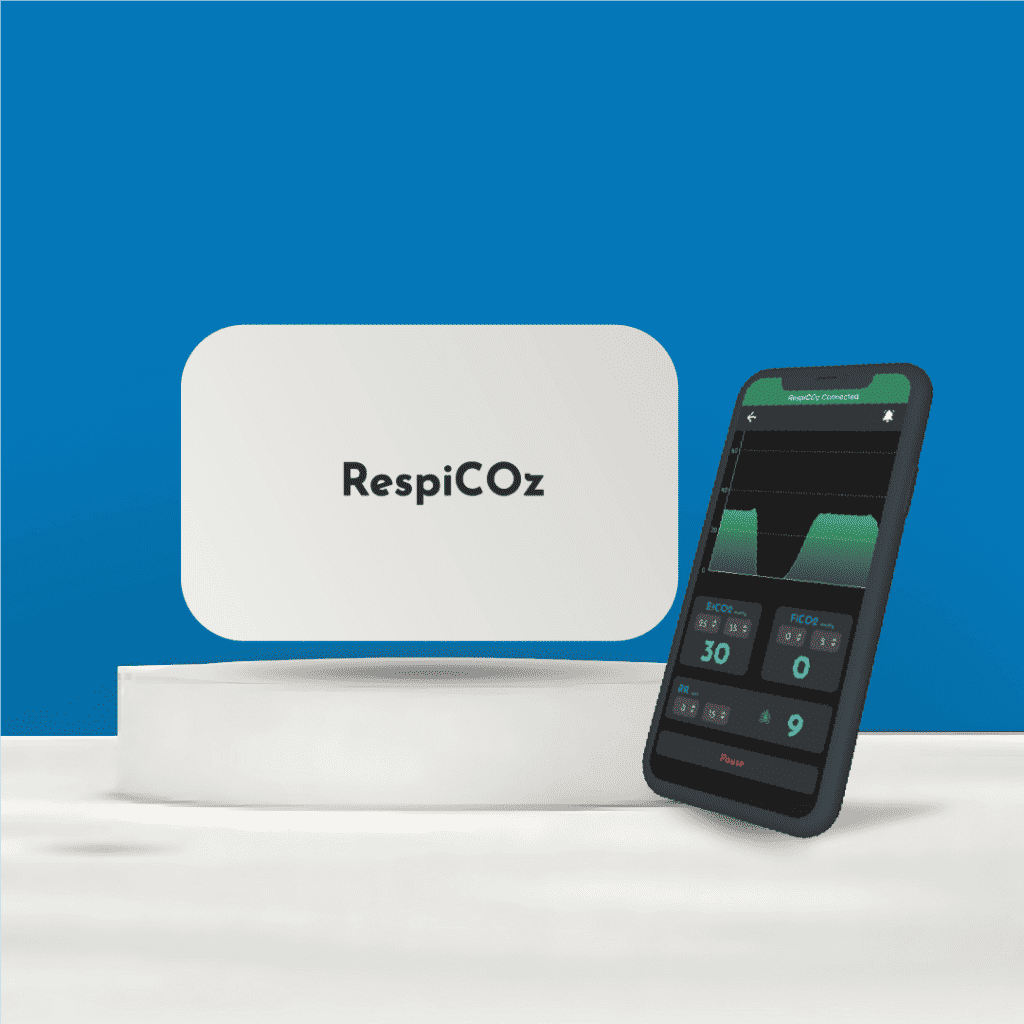
Brainiac Healthcare’s RespiCOz is a portable mainstream capnography device designed for exactly this use case. It displays capnogram waveform, EtCO₂, respiratory rate, and FiCO₂ on an Android app via Bluetooth. The waveform goes live in about 15 seconds after pairing, and the device includes no-breath (apnea) detection alarms with customizable color alert limits. The kit includes the device, mainstream sensor, airway adapter, EVA carrying case, and power adapter.
RespiCOz is not a multiparameter monitor. It is a focused respiratory monitoring layer for OT, ICU, emergency, and transport workflows where full bedside monitoring is unavailable, not configured with CO₂, or impractical to move.
Watch a quick demo to see real-time capnogram and EtCO₂ monitoring in action.
Common Confusion Points
“Does normal SpO₂ mean ventilation is fine?”
No. Oxygen saturation can remain normal for several minutes despite inadequate ventilation, particularly when supplemental oxygen is running. Capnography catches the ventilation problem at the CO₂ level before desaturation begins.
“Does EtCO₂ replace arterial blood gas?”
No. EtCO₂ can approximate PaCO₂ when ventilation and perfusion are well matched, but the gradient widens in lung disease, shock, dead space, or V/Q mismatch. ABG remains necessary when exact acid-base status or clinical uncertainty demands it.
“What does sudden waveform loss mean?”
Treat it as urgent. Possible causes include apnea, circuit disconnection, esophageal intubation, severe hypotension, cardiac arrest, pulmonary embolism, or a sensor/adapter problem. Assess the patient first, then the airway and circuit, then the device.
“Can capnography be used in non-intubated patients?”
Yes, typically via sidestream nasal or nasal-oral cannulas. Readings can be diluted by mouth breathing, loose fit, or high supplemental oxygen flow. Sampling lines are also vulnerable to moisture and secretions.
“Is continuous ward monitoring always better?”
Not automatically. Observational data looks promising, but the best available RCT evidence shows no statistically significant pooled outcome improvement. The implementation model (risk selection, alarm thresholds, response workflows, staff training) determines whether monitoring data translates into patient benefit.
Frequently Asked Questions
Is a portable capnograph the same as a multiparameter monitor?
No. A portable capnograph is a focused respiratory monitor that measures exhaled CO₂ and displays EtCO₂ with a capnogram waveform. A multiparameter monitor tracks several vital signs (ECG, SpO₂, NIBP, respiratory rate, temperature) and sometimes includes EtCO₂ as an optional module. They answer different clinical questions and are often complementary rather than interchangeable.
Does every multiparameter monitor include EtCO₂?
No. Many ward-level multiparameter monitors are configured with basic parameters only. EtCO₂ is often an optional or add-on module that must be specified and purchased separately. Always confirm whether capnography is included, optional, or unavailable before procurement.
Which is better for post-op opioid patients on a ward?
Capnography plus pulse oximetry is the strongest combination for detecting opioid-related respiratory depression. The PRODIGY trial found respiratory depression episodes in 46% of general-care-floor patients receiving parenteral opioids under continuous monitoring. A portable capnograph or multiparameter monitor for ward monitoring can serve this role, but capnography specifically catches hypoventilation and apnea that SpO₂ alone may miss.
What is the difference between capnography and capnometry?
Capnography provides both a numeric EtCO₂ value and a continuous waveform. Capnometry provides only the numeric value. For clinical troubleshooting of airway, ventilation, and circuit problems, the waveform carries the most useful information.
What alarms matter most in capnography?
The most critical alarms are apnea (no breath detected), high EtCO₂ (hypoventilation or rebreathing), and low EtCO₂ (hyperventilation, disconnection, or loss of pulmonary perfusion). Customizable alarm limits allow clinicians to set thresholds appropriate for each patient.
What should Indian hospitals check before buying a ward monitoring device?
Start with the clinical use case. Then verify required parameters, regulatory documentation under India’s Medical Devices Rules 2017, applicable standards (IEC 80601-2-49 for multiparameter monitors), alarm customization, consumable costs, service and spares availability, and total cost of ownership. Test the device in a real ward workflow before committing.
Can a portable capnograph be used during intra-hospital transport?
Yes. This is one of the strongest use cases. The AARC recommends continuous capnometry during transport of mechanically ventilated patients. A portable capnograph is battery-powered, compact, and fast to connect, making it well suited for movement between OR, ICU, ward, and imaging.
Does EtCO₂ monitoring replace SpO₂?
No. Practitioners on respiratory therapy forums push back firmly against this idea. SpO₂ monitors oxygenation. EtCO₂ monitors ventilation and CO₂ elimination. They answer different physiologic questions and are complementary. Using both provides the most complete respiratory picture.
For clinical teams evaluating portable capnography for ward, OT, emergency, or transport use, contact Brainiac Healthcare to discuss your setup and requirements.


7 thoughts on “Portable Capnograph or Multiparameter Monitor: Wards 2026”
Pingback: Capnography For Endotracheal Tube Confirmation (2026 Guide)
Pingback: Capnography Vs Pulse Oximetry: Proven To Spot Danger Early
Pingback: Handheld Vs Benchtop Capnography: A Smart, Clear Guide
Pingback: Capnography For Small Clinics: An Essential Safety Net
Pingback: 5 Devices Every Intensivist Must Have - Brainiac Healthcare - The World's First Smart Capnometer
Pingback: Essential Equipment For Intensivists: 5 Safe Buys
Pingback: Operation Theatre Equipment List: What Every OT Needs - Brainiac Healthcare - The World's First Smart Capnometer