

Capnography vs pulse oximetry is one of the most misread comparisons in monitoring. The two are often treated as interchangeable safety nets. They are not.
One measures oxygen in the blood. The other measures breathing itself. When a patient stops ventilating, only one of them tells you straight away. Get the difference wrong and you can watch a normal number on the screen while the patient slides into trouble.
This guide explains what each monitor measures, why the pulse oximeter is often late, and how to use both so nothing is missed.
Key takeaways
- Pulse oximetry measures oxygenation. Capnography measures ventilation. They answer different questions.
- SpO₂ is a lagging signal. On supplemental oxygen it can stay normal for two to three minutes after breathing has failed.
- Capnography detects apnoea and hypoventilation within seconds, before oxygen desaturation appears.
- This is not either or. The two are strongest used together.
- The gap matters most in sedation, recovery, opioid monitoring and transport, where only a pulse oximeter is often present.
What each monitor actually measures
Start with the physiology, because the whole comparison rests on it.
A pulse oximeter measures the oxygen saturation of haemoglobin, shown as SpO₂. It answers one question. How much oxygen is the blood carrying right now.
A capnograph measures carbon dioxide in exhaled breath, shown as EtCO₂, and displays it as a waveform. It answers a different question. Is the patient moving air, breath by breath.
Oxygenation and ventilation are linked, but they are not the same thing. A patient can be ventilating poorly and still show a normal SpO₂ for a while. That gap between the two signals is where the danger sits. For the fuller picture of what EtCO₂ adds over a blood gas, see our guide to EtCO₂ over PaCO₂.
Capnography vs pulse oximetry at a glance
| Pulse oximetry (SpO₂) | Capnography (EtCO₂) | |
|---|---|---|
| Measures | Oxygen in the blood | Breathing, breath by breath |
| Tells you about | Oxygenation | Ventilation |
| Speed of warning | Delayed, often minutes | Immediate, seconds |
| Effect of supplemental oxygen | Masks early deterioration | Unaffected, still shows apnoea |
| Blind spot | Slow to flag apnoea and hypoventilation | Not a direct measure of oxygen |
The dangerous lag
Here is the problem the table hides.
When a patient stops breathing, CO₂ changes at once. The waveform flattens. The respiratory rate falls. Capnography shows it on the next breath, or the next missing breath.
Oxygen behaves differently. The lungs and blood hold a reserve of oxygen. That reserve keeps SpO₂ looking normal for a while after ventilation has already failed. Add supplemental oxygen and the reserve grows. The pulse oximeter can then read a comfortable 98 percent while the patient has not taken a proper breath in over a minute.
A 2017 systematic review in Anesthesia & Analgesia found that capnography heralded respiratory depression before oxygen desaturation, especially when supplemental oxygen was given. By the time the pulse oximeter alarms, you have lost your early warning.
What the evidence says about capnography vs pulse oximetry
The comparison is not opinion. It has been measured.
A 2025 study of paediatric procedural sedation monitored children on both methods at once. Capnography detected every apnoea episode and around three quarters of the hypoventilation episodes that pulse oximetry missed. The authors noted that pulse oximetry reflects desaturation with a delay of up to two to three minutes, and does not monitor ventilation at all.
Pooled evidence points the same way. A meta-analysis of thirteen randomised trials found that adding capnography to pulse oximetry and visual assessment during sedation reduced both mild and severe oxygen desaturation, and cut the need for assisted ventilation.
This is why the American Society of Anesthesiologists calls for monitoring ventilation, not just oxygenation, during moderate and deep sedation and general anaesthesia. Pulse oximetry alone does not meet that bar.
Where pulse oximetry still matters
An honest comparison does not throw out the pulse oximeter. It is the right tool for the question it answers.
Some problems are problems of oxygenation, not ventilation. Pneumonia, a shunt, a low inspired oxygen level or a ventilation-perfusion mismatch can drop SpO₂ even when breathing looks fine. Capnography will not tell you about those directly. The pulse oximeter will.
So the goal is not to replace one with the other. It is to stop relying on oxygenation alone to catch a ventilation problem. Use both, and you cover both failure modes.
Where the gap bites in real practice
The theory becomes urgent in the places where only a pulse oximeter is usually clipped on.
- Procedural sedation. Endoscopy, dental and short day-case procedures. Sedatives blunt the drive to breathe, and supplemental oxygen hides the early fall.
- Recovery and the ward. Patients on opioids after surgery can slip into respiratory depression quietly. Oxygen therapy can keep SpO₂ reassuring until it is late.
- Transport and transfer. Tubes and breathing effort change when a patient is moved, and a pulse oximeter alone will not flag it fast.
In every one of these, capnography adds the signal a pulse oximeter cannot give. For where a focused monitor fits against a full ward monitor, see portable capnograph or multiparameter monitor. For the wider list of clinical uses, see our five capnography use cases.
Where RespiCOz fits
Most wards, recovery bays and ambulances already have a pulse oximeter. What they often lack is the ventilation signal beside it.
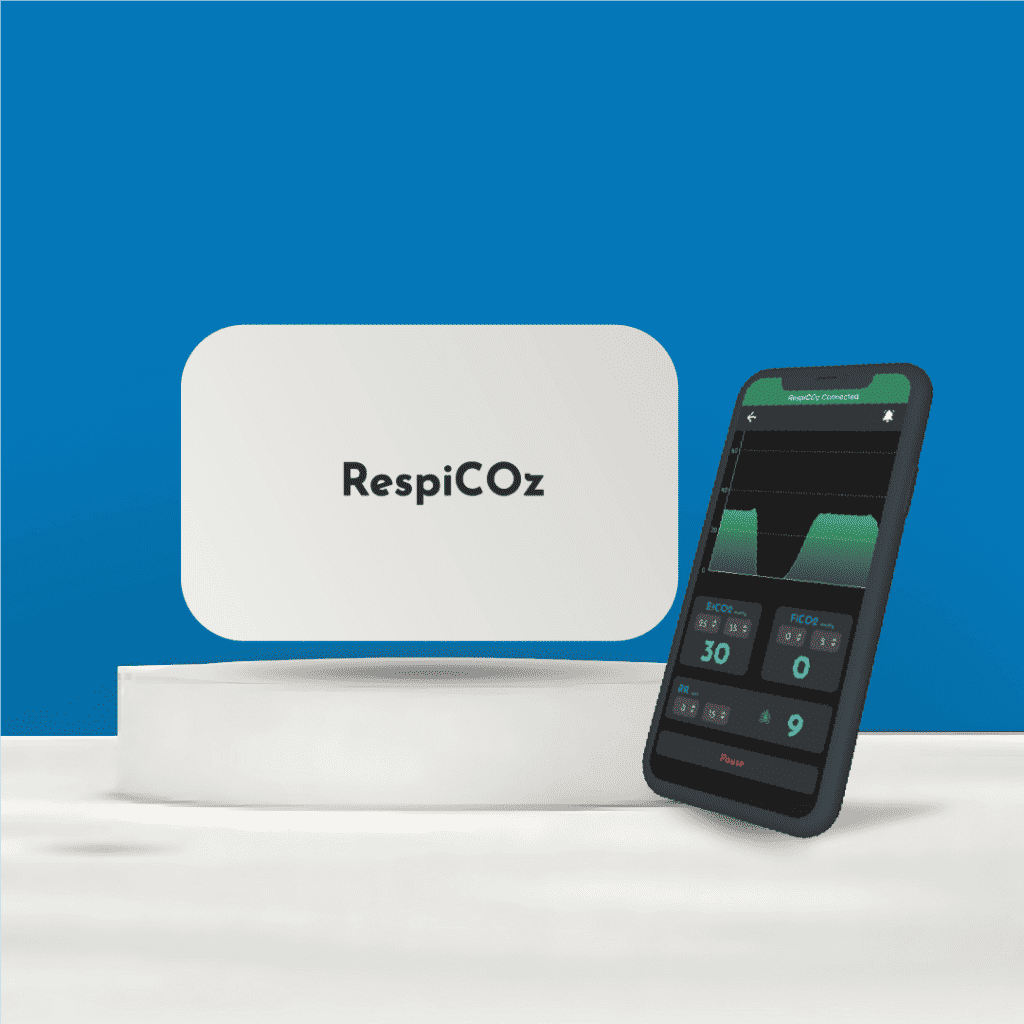
RespiCOz is a portable mainstream capnograph built to close that gap. The sensor sits at the airway, so the reading is fast and there is no sampling line to block or fill with water. It is light enough to stay with the patient from the procedure room to recovery to the ambulance, which is exactly where the pulse oximeter tends to travel alone.
To be clear about what it is, RespiCOz is not a replacement for pulse oximetry, and it is not a multiparameter monitor. It is a focused respiratory layer that adds real-time ventilation monitoring wherever the patient goes. It is CDSCO-approved, made in India, and it pairs with a companion app so the waveform sits on a screen you already carry.
If your monitoring stops at SpO₂ in the places that matter most, you can see the device here.
Frequently asked questions
What is the difference between capnography and pulse oximetry? Pulse oximetry measures oxygen in the blood, so it tracks oxygenation. Capnography measures exhaled carbon dioxide, so it tracks ventilation, breath by breath. They monitor two different things.
Why does pulse oximetry miss respiratory depression? Oxygen is stored in a reserve in the lungs and blood. That reserve keeps SpO₂ normal for a while after breathing has failed, and supplemental oxygen makes the delay longer. Capnography has no such lag.
Does capnography replace pulse oximetry? No. They answer different questions and work best together. Use pulse oximetry for oxygenation and capnography for ventilation.
Why does supplemental oxygen make pulse oximetry less reliable as a warning? Extra oxygen enlarges the reserve that keeps SpO₂ looking normal. A patient can be barely breathing while the pulse oximeter still reads high. Capnography is not affected by this.
Which monitor is better for sedation? For catching early respiratory depression during sedation, capnography is more sensitive and faster. Guidelines call for monitoring ventilation during moderate and deep sedation, alongside pulse oximetry.
Conclusion
Capnography vs pulse oximetry is not a contest. It is a pairing.
Pulse oximetry tells you about oxygen in the blood. Capnography tells you about the breath that puts it there. One is slow to warn, the other is fast. Rely on oxygenation alone and you will sometimes see the problem too late.
Use both, and you close the gap. Add capnography in the places where only a pulse oximeter is clipped on, and the quiet failures stop being quiet.
To understand the waveform you will be reading, see our guide to capnography waveforms.
References
- Saab R, et al. Continuous Pulse Oximetry and Capnography Monitoring for Postoperative Respiratory Depression and Adverse Events. Anesthesia & Analgesia. 2017. journals.lww.com
- Non-Invasive Capnography Versus Pulse Oximetry for Early Detection of Respiratory Depression During Pediatric Procedural Sedation: A Prospective Observational Study. 2025. pubmed.ncbi.nlm.nih.gov
- American Society of Anesthesiologists. Practice Guidelines for Moderate Procedural Sedation and Analgesia. Monitoring of ventilation.


6 thoughts on “Capnography vs Pulse Oximetry: Why SpO₂ Is Not Enough”
Pingback: Normal EtCO2 Range: What The Numbers Mean - Brainiac Healthcare - The World's First Smart Capnometer
Pingback: Post-Operative Capnography: The Essential, Safe Monitor
Pingback: Capnography In Procedural Sedation: Proven To Cut Risk
Pingback: Essential Equipment For Intensivists: 5 Safe Buys
Pingback: Essential Equipment For Anaesthesiologists: 3 Safe Buys
Pingback: Capnography Myths: The Simple Truth Behind 12 Errors