

Capnography response time is how quickly the monitor reflects a real change in the patient’s breath. It sounds like a technical detail. In practice it decides whether the waveform you see is accurate, and how fast you learn that something has gone wrong.
A slow response blunts the waveform and can understate the reading, especially when a patient breathes fast. A fast response gives you the true picture, breath by breath. This guide explains what response time is, and why it matters more than most buyers realise.
Key takeaways
- Response time is how fast a capnograph reflects a change in CO₂.
- It has two parts: the delay for the sample to reach the sensor, and the sensor’s own rise time.
- Slow response matters most at high breathing rates, where it can understate EtCO₂.
- A fast response gives an accurate waveform and catches apnoea and disconnection sooner.
- Mainstream sensors are fastest, because they measure right at the airway.
What is capnography response time
Response time is the time a capnograph takes to show a change in CO₂ after that change actually happens at the patient.
If a patient stops breathing, or a tube disconnects, the CO₂ changes instantly at the airway. The question is how long the monitor takes to show it. A fast device shows it almost at once. A slow device lags, and a lagging monitor is a slower warning. On a device whose job is early warning, speed is not a luxury.
The two parts of response time
Response time is made of two separate delays.
Transit time. In a sidestream device, the gas sample has to travel down a tube from the airway to the sensor inside the monitor. That journey takes time, usually a second or two, and longer if the line is long or partly blocked. A mainstream device has no tube, so it has no transit time.
Rise time. This is how fast the sensor itself responds once the gas reaches it, usually measured as the time to move from 10% to 90% of a change. A faster rise time tracks a sharp waveform more faithfully.
Together these make the total system response time, the number that actually matters at the bedside.
Why response time matters
A fast response does three things.
It gives an accurate waveform. The shape of a capnogram, its phases and angles, only reads true if the device can keep up with the breath. It gives an accurate number, because a slow device may not have time to reach the true end-tidal value before the next breath begins. And it gives a faster warning of apnoea, disconnection and the return of circulation, where seconds count. For the waveform detail, see capnography waveforms.
Response time at high breathing rates
This is where response time matters most, and it is easy to miss.
When a patient breathes fast, each breath is short. If the device responds slowly, the reading does not have time to reach the true end-tidal value before the next breath starts. The plateau is cut off, the peaks blunt and merge, and the displayed EtCO₂ reads lower than it really is. The faster the breathing, the bigger the error.
This is a real problem in children and neonates, who breathe quickly by nature, and in any adult who is tachypnoeic. In these patients, a slow-responding device can understate the EtCO₂ and hide the true trend. A fast device holds up. For the values it should reach, see the normal EtCO₂ range.
Mainstream versus sidestream response time
The two designs differ exactly here.
A mainstream sensor sits at the airway, so there is no transit time at all. The reading is effectively real time, which makes it the reference technique and the better performer at high breathing rates. A sidestream sensor adds the transit delay of the sampling line, and that delay can grow if moisture or secretions partly block the line. For the full comparison, see mainstream vs sidestream capnography, and for the sensor itself, see how NDIR capnography sensors work.
What the standard says
Response time is important enough that the international standard for capnographs, ISO 80601-2-55, requires manufacturers to state the total system response time. That lets a buyer compare devices on a like-for-like basis rather than trusting a vague claim of being fast. When you evaluate a capnograph, ask for that number, and ask how it holds up at high respiratory rates.
Where RespiCOz fits
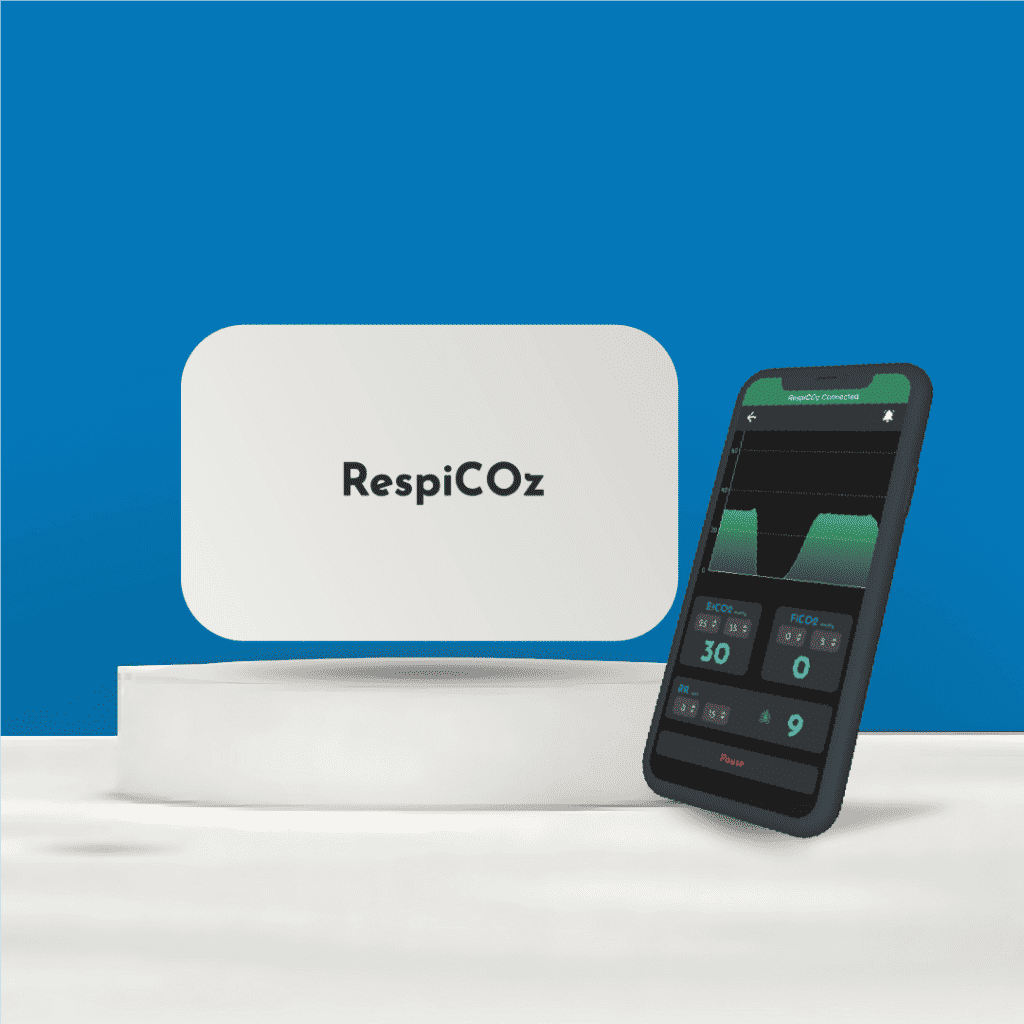
RespiCOz is a mainstream capnograph, which puts it on the fast side of this by design.
The sensor sits at the airway, so there is no sampling line and no transit delay. The reading appears quickly, with no warm-up, and holds up when breathing is fast, which matters in paediatric and emergency use. There is also no line to fill with moisture and slow down over a case. It is a focused mainstream monitor with FiCO₂, CDSCO approval and a value price. For how it compares with other portable units, see the best handheld EtCO₂ monitor.
Ready to buy? Request a quote for your hospital here.
Frequently asked questions
What is capnography response time? It is how quickly a capnograph shows a real change in CO₂ after it happens at the patient. It is made of the transit delay to reach the sensor, plus the sensor’s own rise time.
Why does response time matter? A slow response blunts the waveform, can understate the reading, and warns you later of events like apnoea or disconnection. A fast response gives an accurate picture and an earlier warning.
Why does response time matter more at high breathing rates? Fast breaths are short. A slow device cannot reach the true end-tidal value before the next breath, so the plateau is cut off and the EtCO₂ reads low. This affects children, neonates and tachypnoeic patients most.
Which is faster, mainstream or sidestream? Mainstream. It measures at the airway with no sampling line, so there is no transit delay. Sidestream adds the time for the sample to travel, which can grow if the line is partly blocked.
How do I compare response time between devices? Ask for the total system response time, which the ISO 80601-2-55 standard requires manufacturers to state, and ask how the device performs at high respiratory rates.
Conclusion
Capnography response time decides whether the waveform and number you see are true, and how fast you learn that something has changed. It is the transit delay plus the sensor’s rise time, and it matters most when a patient breathes fast.
Favour a fast device, ask for the stated total system response time, and remember that a mainstream sensor, measuring right at the airway, has speed built in.
To see how the sensor itself achieves this, read how NDIR capnography sensors work.
To order RespiCOz or ask for a quote for your setting, get a quote here.
References
- Response Time of the Analyzer. Capnography.com, Bhavani Shankar Kodali. Transit time and rise time in capnography. capnography.com
- Relationships between capnogram parameters by mainstream and sidestream techniques at different breathing frequencies. Scientific Reports. 2024. nature.com


2 thoughts on “Capnography Response Time and Why It Matters”
Pingback: Paediatric Capnography: A Safe, Proven Guide
Pingback: Capnography Troubleshooting: Simple Fixes For Bad Readings