
What is EtCO2? In simple terms, it is the level of carbon dioxide at the end of a breath out, and it is one of the most useful numbers in patient monitoring. Every time a patient exhales, they breathe out carbon dioxide. The amount left at the end of that breath is the EtCO2.
That single number says a great deal about how a patient is breathing, and even about their circulation. This guide explains what EtCO2 is, how it is measured, and what your reading is actually telling you.
Key takeaways
- EtCO2 means end-tidal carbon dioxide, the CO2 measured at the end of a breath out.
- It is normally 35 to 45 mmHg in a healthy adult.
- It reflects three things: ventilation, circulation and metabolism.
- It confirms the airway and gives an early warning long before oxygen falls.
- Capnography is how EtCO2 is measured and shown as a waveform.
What is EtCO2, exactly
EtCO2 is short for end-tidal carbon dioxide. “End-tidal” means the end of a breath, so EtCO2 is the carbon dioxide level at the very end of exhalation.
That point matters. At the end of a breath, the gas coming out is the gas that has been deepest in the lungs, where it exchanges with the blood. So the EtCO2 is a close reflection of the carbon dioxide in the blood, measured without a single needle. It is usually shown in millimetres of mercury, mmHg, and in a healthy adult it sits between 35 and 45. For the full picture of the values, see the normal EtCO2 range.
EtCO2, capnography and capnometry
Three terms get used together, and it helps to separate them.
EtCO2 is the number, the carbon dioxide at the end of the breath. Capnography is the technique that measures carbon dioxide continuously and displays it as a waveform over time. Capnometry is measuring the number without the waveform. The waveform itself is called a capnogram. In short, capnography gives you the EtCO2 number and the shape behind it. To read that shape, see capnography waveforms.
What your EtCO2 reading tells you
This is the part that makes EtCO2 so powerful. The reading depends on three things working together.
- Ventilation. How well the patient is moving air and clearing carbon dioxide. This is the main thing EtCO2 measures. Slow or shallow breathing raises it. Fast breathing lowers it.
- Circulation. Carbon dioxide has to be carried by blood to the lungs to be breathed out. If blood flow falls, as in cardiac arrest or a pulmonary embolism, EtCO2 falls too.
- Metabolism. The body’s production of carbon dioxide. Fever and sepsis raise it. A low body temperature lowers it.
Because a change in any one of these moves the number, EtCO2 is an early, sensitive signal. It also confirms the airway and flags a disconnection or a blocked tube at once. For what makes it rise or fall, see what causes a rising or falling EtCO2 trend.
What the numbers mean
A quick orientation, with the detail in the linked guide.
A normal EtCO2 is 35 to 45 mmHg. Above 45 is high, often from slow breathing, and below 35 is low, often from fast breathing or reduced blood flow to the lungs. The value is a clue to be read with the patient and the waveform, not a diagnosis on its own. The normal EtCO2 range guide covers the bands and the causes in full.
How EtCO2 is measured
EtCO2 is measured by capnography, using infrared light.
Carbon dioxide absorbs infrared light at a specific wavelength. A capnograph shines infrared light through the breath and measures how much is absorbed, which gives the CO2 level. This is done either right at the airway, called mainstream, or by drawing a sample to the monitor, called sidestream. For how the sensor works, see how NDIR capnography sensors work.
Why EtCO2 matters
EtCO2 earns its place because it warns you early, and about the right thing.
It measures breathing directly, so it catches trouble before oxygen levels fall, unlike a pulse oximeter. It confirms an airway is correctly placed. And it works across every setting, from theatre to the ward to the ambulance. See capnography vs pulse oximetry for why both are needed, and the five capnography use cases for where it is used.
Where RespiCOz fits
Once you know what EtCO2 is, the next question is how to see it at the bedside.
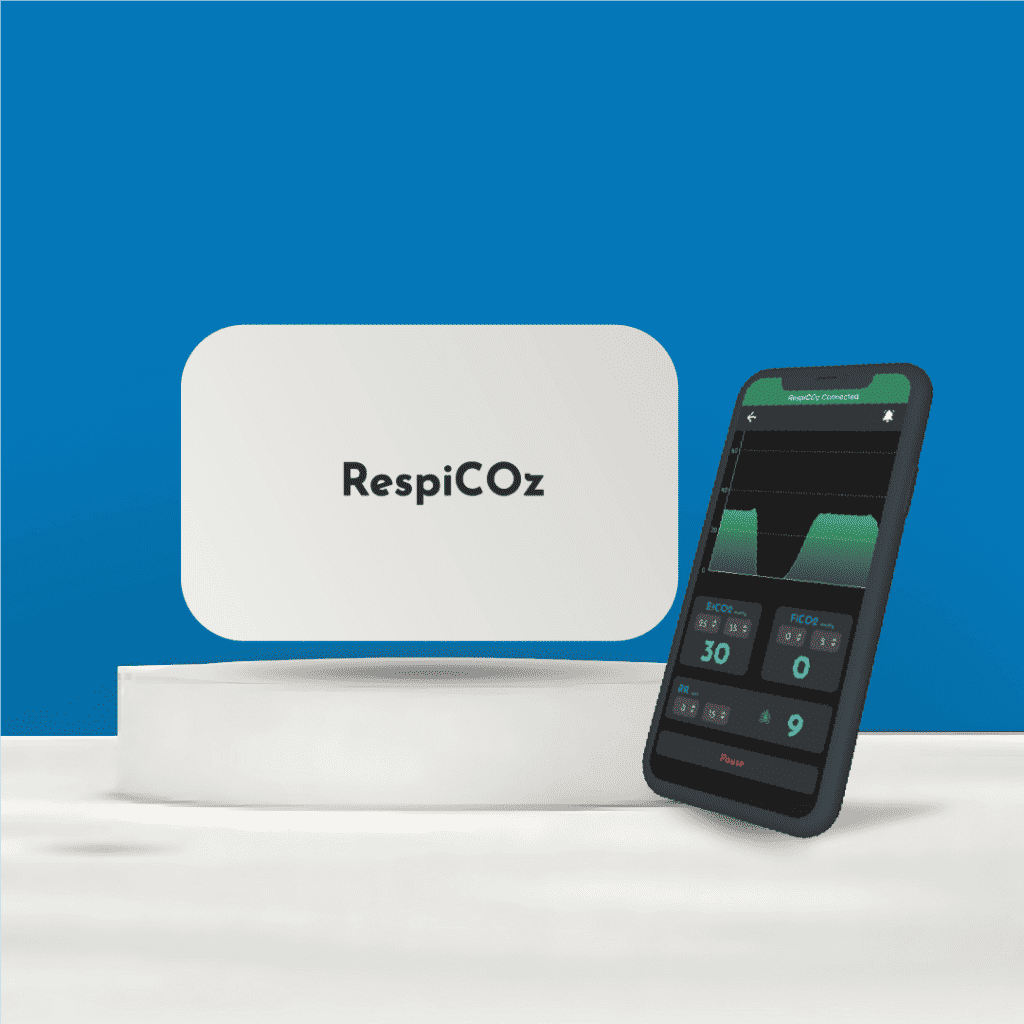
RespiCOz is a portable capnograph that shows the live EtCO2 value and the waveform, wherever the patient is. The mainstream sensor sits at the airway for a fast reading with no sampling line. It is CDSCO-approved, made in India, and priced in the value middle. For a fuller look, see the best handheld EtCO2 monitor guide.
Want to know more? Request a quote for your hospital here.
Frequently asked questions
What does EtCO2 stand for? End-tidal carbon dioxide. It is the level of carbon dioxide measured at the end of a breath out.
What is a normal EtCO2 level? In a healthy adult at rest it is 35 to 45 mmHg. Above 45 is high, and below 35 is low.
What does EtCO2 measure? It measures how well a patient is breathing, and it reflects three things: ventilation, circulation and metabolism. A change in any of them changes the reading.
What is the difference between EtCO2 and capnography? EtCO2 is the number, the carbon dioxide at the end of the breath. Capnography is the technique that measures it continuously and shows it as a waveform.
Why is EtCO2 better than a pulse oximeter for breathing? EtCO2 measures ventilation directly, so it detects slow or stopped breathing before oxygen levels fall. A pulse oximeter is a slower warning, especially on supplemental oxygen.
Conclusion
What is EtCO2? It is the carbon dioxide at the end of a breath, and it is one of the fastest, most honest signals in monitoring. It reflects ventilation, circulation and metabolism at once, confirms the airway, and warns you early.
Learn to read it, watch the trend, and pair it with the waveform, and a single number becomes a window into how a patient is really doing.
To go deeper, start with the normal EtCO2 range.
To order RespiCOz or ask for a quote for your setting, get a quote here.
References
- Capnography. StatPearls, NCBI Bookshelf. Definition and clinical role of EtCO2. ncbi.nlm.nih.gov
- Capnography. OpenAnesthesia. What EtCO2 reflects and how it is measured. openanesthesia.org