

Post-operative capnography protects the patient during one of the most dangerous transitions in their care: waking up from anaesthesia. In theatre, every breath is watched. In the recovery room and on the ward, monitoring gets lighter, just as the effects of anaesthesia, opioids and muscle relaxants are wearing off unevenly.
That gap is where quiet respiratory trouble hides. This guide explains the risks of the recovery period, and how capnography catches them before they become emergencies.
Key takeaways
- Recovery is a high-risk time. Anaesthesia, opioids and muscle relaxants all still linger.
- Residual paralysis is common on arrival in recovery, and it drives respiratory events.
- Supplemental oxygen hides the fall in oxygen, so capnography becomes the key warning.
- Capnography detects hypoventilation, apnoea and airway obstruction early.
- The risk continues onto the ward, so monitoring should follow the at-risk patient.
Why recovery is a high-risk time
Waking from general anaesthesia is not a clean switch. The drugs wear off at different rates, and the patient is briefly caught between states.
Anaesthetic agents may still depress breathing. Opioids given for pain do the same. Muscle relaxants may not have fully worn off, leaving the patient weak. And the airway reflexes that protect against obstruction are not yet fully back. All of this happens in a setting where one nurse watches several patients, not the one-to-one attention of theatre. The result is a window of real risk.
The respiratory risks in recovery
Several problems cluster in the recovery period.
- Residual paralysis, where muscle relaxants have not fully worn off, causing weak breathing and airway collapse.
- Residual sedation, from anaesthetic agents and opioids, causing slow, shallow breathing.
- Airway obstruction, from the tongue or from laryngospasm, especially before the patient is fully awake.
- Delayed emergence, where the patient is slow to wake and breathe adequately.
Each of these shows first as a breathing problem, which is exactly what capnography measures.
Why residual paralysis is the hidden risk
Residual neuromuscular blockade deserves special attention, because it is common and easily missed.
Even when muscle relaxants are reversed in theatre, many patients arrive in recovery with residual weakness. Studies have found roughly a third of patients have measurable residual blockade on arrival in the recovery unit, and those patients are far more likely to suffer critical respiratory events. In one study, patients with residual blockade had several times the rate of respiratory complications, and nearly all those needing airway support had it. The weakness is invisible to the eye but visible in the breathing, which capnography tracks.
Why pulse oximetry is not enough in recovery
Most recovery patients are on supplemental oxygen, and that is exactly when a pulse oximeter is slowest to warn.
Oxygen therapy keeps the saturation looking normal for minutes after breathing has started to fail. A patient can be hypoventilating, or briefly obstructing, while the pulse oximeter still reads high. Capnography has no such lag. It shows slow breathing and apnoea as they happen. For the full mechanism, see capnography vs pulse oximetry.
How capnography helps in recovery
Capnography turns the recovery period’s quiet risks into visible signals.
It detects hypoventilation as a falling respiratory rate or changing waveform. It flags apnoea the moment breathing stops. And it reveals airway obstruction through the shape of the trace. A blinded trial in the recovery unit found that continuous capnography detected respiratory adverse events that standard monitoring missed, confirming its value for catching early respiratory compromise after anaesthesia. For the values behind the trace, see the normal EtCO₂ range.
From recovery to the ward
The risk does not end when the patient leaves the recovery unit.
On the post-operative ward, opioids for pain continue to depress breathing, and monitoring is lighter still. Respiratory depression can develop hours later, often at night. For at-risk patients, the monitoring that started in recovery should follow them. See opioid-induced respiratory depression on the ward for that stage, and EtCO₂ monitoring during transport for the journey between them.
What the standards say
Monitoring guidance already extends into recovery. The Association of Anaesthetists recommends that anaesthetic monitoring, including capnography, continue from theatre through transfer and into recovery, until the airway device is removed and the patient is responsive. In other words, capnography should not stop the moment the patient leaves theatre. It should continue through the risky transition. See capnography during anaesthesia.
Where RespiCOz fits
The recovery period needs a monitor that travels with the patient, from theatre to recovery to the ward.
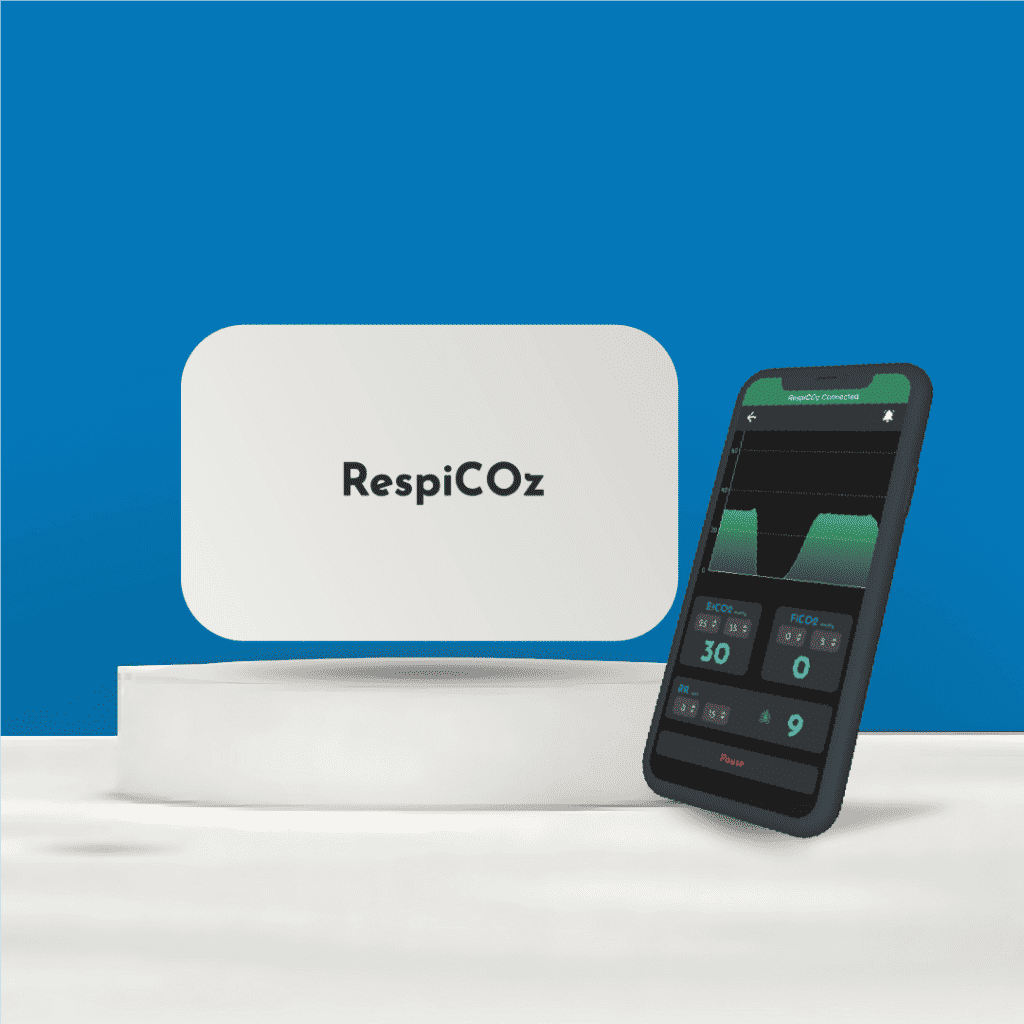
RespiCOz is a portable capnograph built to do exactly that. Its mainstream sensor sits at the airway, which suits patients who are still intubated or newly extubated, and it stays with them through the transition rather than being left behind in theatre. It runs on battery, shows a live waveform, and is light to carry. It is CDSCO-approved, made in India, and priced in the value middle.
To be clear, once a patient is fully awake and breathing on their own through a nasal cannula, sidestream or microstream sampling is the usual method. RespiCOz is at its best across the intubated and early-recovery phase and the monitored transition. For that choice, see mainstream vs sidestream capnography.
Ready to buy? Request a quote for your hospital here.
Frequently asked questions
Why is capnography useful in the recovery room? Because recovery is a high-risk time when anaesthesia, opioids and muscle relaxants still linger. Capnography detects hypoventilation, apnoea and airway obstruction early, before oxygen levels fall.
What is residual neuromuscular blockade? It is leftover muscle weakness from anaesthetic muscle relaxants that have not fully worn off. It is common on arrival in recovery and is strongly linked to critical respiratory events.
Why is pulse oximetry not enough after surgery? Most recovery patients are on supplemental oxygen, which keeps the oxygen reading normal for minutes after breathing has started to fail. Capnography detects the problem first.
Should capnography continue onto the ward? For at-risk patients, yes. Opioid-related respiratory depression can develop hours after surgery, so monitoring that started in recovery should follow the patient.
When can capnography monitoring stop after surgery? Guidance recommends it continue until the airway device is removed and the patient is responsive, and longer for patients at risk of respiratory depression on the ward.
Conclusion
Post-operative capnography guards the patient through the uneven, risky business of waking up. Residual paralysis, lingering sedation and airway obstruction all show first in the breathing, and all can hide behind a reassuring oxygen reading.
Keep capnography running through recovery, follow the at-risk patient onto the ward, and the quiet respiratory events of the post-operative period stop being quiet.
To order RespiCOz or ask for a quote for your setting, get a quote here.
References
- Characterization of respiratory compromise and the potential clinical utility of capnography in the post-anesthesia care unit: a blinded observational trial. Journal of Clinical Monitoring and Computing. 2019. link.springer.com
- Residual Neuromuscular Blockade and Postoperative Pulmonary Complications in the Post-anesthesia Care Unit: A Prospective Observational Study. NCBI PMC. pmc.ncbi.nlm.nih.gov


2 thoughts on “Capnography in the Recovery Room and Post-Operative Ward”
Pingback: Essential Equipment For Anaesthesiologists: 3 Safe Buys
Pingback: Operation Theatre Equipment List: What Every OT Needs - Brainiac Healthcare - The World's First Smart Capnometer