


A high EtCO2 means carbon dioxide is building up faster than the patient is clearing it. The number sits above 45 mmHg, and something in the balance between production, clearance and rebreathing has shifted.
That is the useful way to think about it. There are only three reasons carbon dioxide rises: the patient is clearing too little, producing too much, or breathing it back in. Work out which, and you have the cause. This guide walks through all three, and covers the one situation where a high reading is deliberate.
Key takeaways
- High EtCO2, or hypercapnia, is a reading above 45 mmHg in an adult.
- There are only three mechanisms: clearing too little, producing too much, or rebreathing.
- Hypoventilation from sedation and opioids is by far the commonest cause.
- A rising EtCO2 that outpaces ventilation is an early sign of malignant hyperthermia.
- Sometimes a high reading is deliberate, as in lung-protective ventilation.
What counts as a high EtCO2
In a healthy adult at rest, EtCO2 sits between 35 and 45 mmHg. Above 45 mmHg is hypercapnia, a high reading.
The number alone is a starting point, not a verdict. A reading of 48 in a slowly waking post-operative patient means something different from a reading of 48 climbing steeply during anaesthesia. Read the value, then read the trend and the waveform with it. For the full bands, see the normal EtCO2 range.
What causes high EtCO2
Every cause falls into one of three mechanisms. This is the fastest way to reason at the bedside.
| Mechanism | What is happening | Common causes |
|---|---|---|
| Clearing too little | Ventilation is inadequate | Sedation, opioids, residual anaesthesia, fatigue, airway obstruction, COPD, bronchospasm, low ventilator settings |
| Producing too much | Metabolism is raised | Fever, sepsis, shivering, thyroid storm, malignant hyperthermia |
| Breathing it back in | Exhaled CO2 is re-inhaled | Exhausted soda lime, a failed valve, inadequate fresh gas flow |
1. Clearing too little (hypoventilation)
This is the commonest cause, and usually the first thing to check.
When breathing slows or becomes shallow, carbon dioxide is not blown off, and it accumulates. Sedatives, opioids and residual anaesthetic agents all depress the drive to breathe. Fatigue does the same in a tiring patient. Airway obstruction, bronchospasm and COPD all trap CO2 by limiting airflow, and each changes the shape of the waveform as well as the number. On a ventilated patient, settings that deliver too little minute ventilation will do it too.
Opioid-related hypoventilation on the ward deserves particular vigilance, because it develops quietly. See opioid-induced respiratory depression.
2. Producing too much (raised metabolism)
The body makes carbon dioxide. Make more, and more must be breathed out.
Fever, sepsis and shivering all raise carbon dioxide production. So does a thyroid storm. And in anaesthesia, a rising EtCO2 that keeps climbing despite adequate ventilation is one of the earliest and most sensitive signs of malignant hyperthermia, a true emergency. In laparoscopic surgery, carbon dioxide insufflated into the abdomen is absorbed into the blood and raises EtCO2 too, which is expected rather than alarming.
3. Breathing it back in (rebreathing)
This one is specific to a breathing circuit, and it is often missed.
If the soda lime that absorbs carbon dioxide is exhausted, or a one-way valve fails, or the fresh gas flow is too low, the patient inhales their own exhaled CO2. The tell-tale sign is not the EtCO2 alone but the baseline: the waveform no longer returns to zero between breaths. A monitor that measures FiCO2, the inspired carbon dioxide, catches this directly, because FiCO2 should be near zero and rises when rebreathing occurs. See how soda lime affects the capnograph.
The emergencies to recognise
Two causes of a high EtCO2 need immediate action.
Malignant hyperthermia. A steadily rising EtCO2 during anaesthesia that does not respond to increased ventilation. It often appears before the temperature rises, which is why capnography is the early warning. See capnography during anaesthesia.
Rebreathing. A rising baseline and a rising FiCO2, most often from exhausted soda lime. It is easily fixed once seen, and harmful if missed.
When a high EtCO2 is expected
Not every high reading is a problem. Sometimes it is a deliberate choice.
In lung-protective ventilation, particularly in ARDS, clinicians use low tidal volumes to avoid injuring the lungs with excessive pressure and volume. The trade-off is that carbon dioxide rises. This is accepted on purpose, and is called permissive hypercapnia. In practice a raised CO2 is tolerated as long as the pH stays acceptable, commonly around 7.2 or above, and the patient’s perfusion and oxygenation hold. The goal is not a perfect CO2 at any cost. It is to avoid ventilator-induced lung injury.
There are limits. Permissive hypercapnia is used with caution or avoided where a raised CO2 is dangerous in itself, such as in raised intracranial pressure or in pregnancy.
There are other benign explanations too. CO2 absorbed during laparoscopy, or a rise after bicarbonate is given, or the surge in EtCO2 that signals the return of circulation after cardiac arrest. Context decides.
Read the number with the waveform
The waveform frequently names the cause the number only hints at.
A baseline that does not return to zero is rebreathing. A sloping, shark-fin shape points to airway obstruction such as bronchospasm or COPD. A normal shape with a slowly climbing value points to hypoventilation or rising CO2 production. So read them together. See capnography waveforms, and for the speed of change, what causes a rising or falling EtCO2 trend.
What to do about a high EtCO2
A short, practical sequence.
- Look at the patient, not just the monitor. Are they breathing adequately, and is the airway clear.
- Check the baseline. If it does not return to zero, suspect rebreathing and check the soda lime and valves.
- Check ventilation. If the patient is ventilated, are the settings delivering enough minute ventilation.
- Check for causes of raised production. Fever, sepsis, shivering, and in anaesthesia, malignant hyperthermia.
- Ask whether it is intended. In lung-protective ventilation, a raised CO2 may be deliberate.
- Read the waveform for obstruction, and treat what you find.
Where RespiCOz fits
Finding the cause of a high EtCO2 needs more than a number.
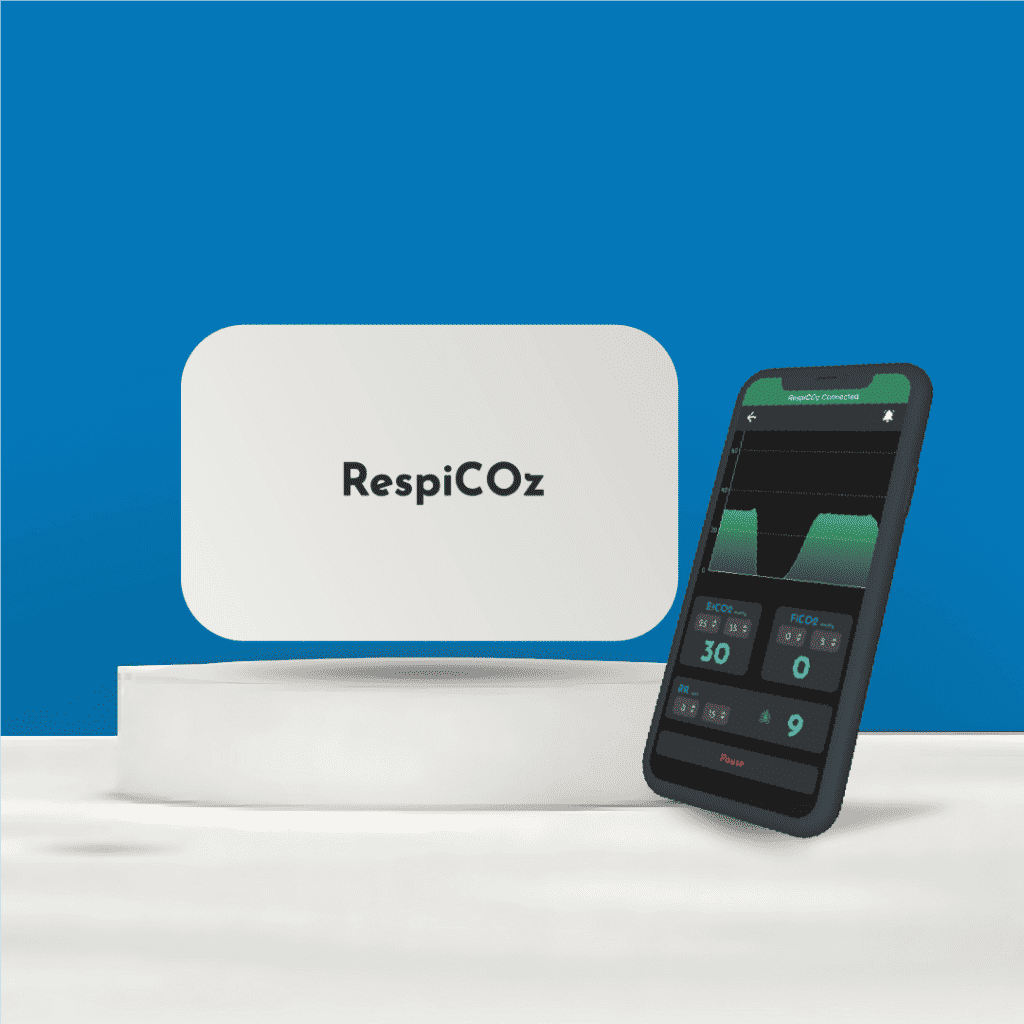
RespiCOz shows the live EtCO2 value, the waveform and the trend, so a climbing reading and a changing shape are both visible as they happen. It also monitors FiCO2, the inspired carbon dioxide, which is what catches rebreathing directly, whether from exhausted soda lime or a failed valve. Many portable monitors do not measure it. The mainstream sensor sits at the airway for a fast, direct reading with no sampling line to block.
It is a focused mainstream monitor for airway-secured patients, CDSCO-approved, made in India, and priced in the value middle at ₹60,000 to ₹1,00,000. For how it compares, see the best handheld EtCO2 monitor guide.
Ready to buy? Request a quote for your hospital here.
Frequently asked questions
What does a high EtCO2 mean? It means carbon dioxide is accumulating. Either the patient is clearing too little through inadequate ventilation, producing too much through raised metabolism, or breathing exhaled CO2 back in.
What EtCO2 is considered high? Above 45 mmHg in an adult at rest. The normal range is 35 to 45 mmHg, and above that is called hypercapnia.
What is the commonest cause of high EtCO2? Hypoventilation, most often from sedation, opioids or residual anaesthesia. Slow or shallow breathing fails to clear carbon dioxide, and it builds up.
Can a high EtCO2 be a sign of malignant hyperthermia? Yes. A rising EtCO2 during anaesthesia that keeps climbing despite adequate ventilation is one of the earliest signs of malignant hyperthermia, often appearing before the temperature rises.
Is a high EtCO2 always dangerous? No. In lung-protective ventilation, especially in ARDS, a raised carbon dioxide is deliberately tolerated to avoid injuring the lungs. This is called permissive hypercapnia. Context decides whether a high reading is a problem.
Conclusion
A high EtCO2 is not a diagnosis. It is a signal that the balance of carbon dioxide has shifted, and there are only three ways that can happen: too little clearance, too much production, or rebreathing.
Work through those three, read the waveform alongside the number, and check the baseline for rebreathing. Recognise the two emergencies, malignant hyperthermia and a failed absorber. And remember that in lung-protective ventilation, a raised reading may be exactly what was intended.
Read it that way, and a high number stops being a worry and becomes a direction.
To see the full range of values, start with the normal EtCO2 range.
References
- Permissive hypercapnia: Is there any upper limit? NCBI PMC. Tolerated PaCO2 and pH in lung-protective ventilation. pmc.ncbi.nlm.nih.gov
- Capnography. StatPearls, NCBI Bookshelf. Causes of raised end-tidal carbon dioxide. ncbi.nlm.nih.gov




6 thoughts on “What Does High EtCO2 Mean?”
Pingback: Low EtCO2: Essential Causes And Dangerous Drops
Pingback: 5 Devices Every Intensivist Must Have - Brainiac Healthcare - The World's First Smart Capnometer
Pingback: Essential Equipment For Intensivists: 5 Safe Buys
Pingback: Capnography Myths: The Simple Truth Behind 12 Errors
Pingback: Capnography Waveform Chart: 12 Patterns And What They Mean - Brainiac Healthcare - The World's First Smart Capnometer
Pingback: Capnography Waveform Chart: A Simple & Clear Field Card