


EtCO2 in sepsis behaves in a way that surprises people the first time they see it. The patient is infected, feverish and breathing hard, and the carbon dioxide reading is low.
That low number is the point. It is the capnograph reporting, in real time and without a needle, that the tissues are not being perfused. As lactate climbs, EtCO2 falls, and the relationship is close enough that capnography can screen for severe sepsis before a blood result comes back.
This guide explains the mechanism, the numbers, and the one thing capnography in sepsis should not be used for.
Key takeaways
- In sepsis, EtCO2 and lactate move in opposite directions. As lactate rises, EtCO2 falls.
- An EtCO2 at or below 25 mmHg is strongly associated with a lactate above 4 mmol/L.
- Combined with SIRS criteria, EtCO2 works as a fast, non-invasive screening tool.
- Abnormal EtCO2 is among the strongest predictors of mortality in suspected sepsis.
- It is a screening tool, not a resuscitation endpoint. Do not use it to guide fluid therapy.
Why sepsis lowers EtCO2
Two mechanisms push the reading down at the same time, which is why the effect is so pronounced.
Poor perfusion. Septic shock is fundamentally a failure of tissue perfusion. Less blood reaches the lungs, so less carbon dioxide is delivered to be exhaled. The EtCO2 falls even though the lungs themselves may be working perfectly.
Respiratory compensation. Hypoperfused tissues switch to anaerobic metabolism, lactate accumulates, and a metabolic acidosis develops. The body’s automatic response is to breathe faster and deeper to blow off carbon dioxide and buffer the acid. That hyperventilation lowers EtCO2 further.
So the septic patient has both less CO2 arriving at the lungs and more of it being blown off. The number drops on both counts. See what does low EtCO2 mean.
The inverse relationship with lactate
This is the finding that makes capnography interesting in sepsis.
A prospective study of emergency department patients with suspected sepsis found a significant inverse relationship between EtCO2 and lactate across every level of severity, with correlation coefficients of roughly −0.42 in sepsis, −0.60 in severe sepsis and −0.48 in septic shock. As lactate went up, EtCO2 went down.
The same study found EtCO2 was associated with in-hospital mortality, and that its ability to predict death improved as the disease got worse: an area under the curve of 0.60 in sepsis, 0.67 in severe sepsis and 0.78 in septic shock.
Most tellingly, when the researchers looked for the strongest independent predictors of death, only three emerged: the use of vasopressors, the need for mechanical ventilation, and an abnormal EtCO2.
The screening threshold
The practical application is triage.
Studies have found that an EtCO2 at or below 25 mmHg is strongly associated with a serum lactate above 4 mmol/L, the threshold that defines severe metabolic distress in sepsis. Prehospital screening protocols have been built on exactly this: a suspicion of infection, two or more SIRS criteria, and an EtCO2 of 25 mmHg or less.
The appeal is obvious. A lactate needs a blood draw, a device and time. Capnography is instant, continuous, non-invasive and already on the trolley. In a busy emergency department or an ambulance, that difference decides whether the patient is recognised early or late.
| EtCO2 | What it suggests in suspected sepsis |
|---|---|
| Normal, 35 to 45 mmHg | Less likely to be severely hypoperfused, but does not exclude sepsis |
| Below 35 mmHg | Concerning. May correlate with raised lactate and organ dysfunction |
| At or below 25 mmHg | Strongly associated with lactate above 4 mmol/L and higher mortality |
| Abnormally high | Also associated with increased mortality. See below |
Both extremes are dangerous
It is not only the low readings that matter.
In the same body of work, both abnormally low and abnormally high EtCO2 values were associated with increased mortality. The logic is the same as in obstructive disease. A low value means hypoperfusion and hard compensatory breathing. A high value means the patient can no longer sustain that work and is tiring into respiratory failure.
A septic patient whose low EtCO2 starts drifting up towards normal is not necessarily improving. They may be exhausting. Read it with the patient, the respiratory rate and the trend. See what does high EtCO2 mean.
The honest limit: screening, not resuscitation
This is the part that keeps you out of trouble, and most articles leave it out.
Capnography has performed well as a screening and triage tool in sepsis. It has not performed well as a resuscitation endpoint.
A study following patients with severe sepsis and septic shock found no correlation between changes in EtCO2 and changes in serum lactate or central venous oxygen saturation over six hours of treatment. The baseline relationship was there, but the trend during resuscitation was not. The authors concluded that EtCO2 had no utility as a clinical endpoint for resuscitation, though it may have real value as a screening tool.
Other work has found the sensitivity of EtCO2 for predicting a raised lactate or organ dysfunction to be moderate at best, around 0.60 to 0.73. Good enough to raise the alarm. Not good enough to replace a lactate.
So the rule is clean. Use EtCO2 to find the septic patient. Use lactate and clinical assessment to treat them. Do not titrate fluids to a capnograph.
Sepsis in children
The same relationship holds in paediatrics.
A study of children presenting to a paediatric emergency department with suspected sepsis, monitored by nasal capnography, examined EtCO2 against serum lactate and disease severity. It found EtCO2 useful for predicting a raised lactate and for identifying severe sepsis and septic shock, supporting the same screening role in children as in adults.
Where RespiCOz fits
It is worth being straightforward about where a mainstream device belongs in sepsis.
Most of the sepsis-screening evidence above comes from awake, non-intubated patients monitored through a nasal cannula, which is sidestream or microstream sampling. A mainstream capnograph is not the right tool for triaging a spontaneously breathing patient in the waiting room. See mainstream vs sidestream capnography.
Where RespiCOz belongs is the next stage: the septic patient who has been intubated and ventilated. Once an airway is in place, in the intensive care unit, the high-dependency bed, or during transfer, mainstream is the correct method, and continuous EtCO2 remains valuable for confirming the tube, guiding ventilation and tracking the trend.
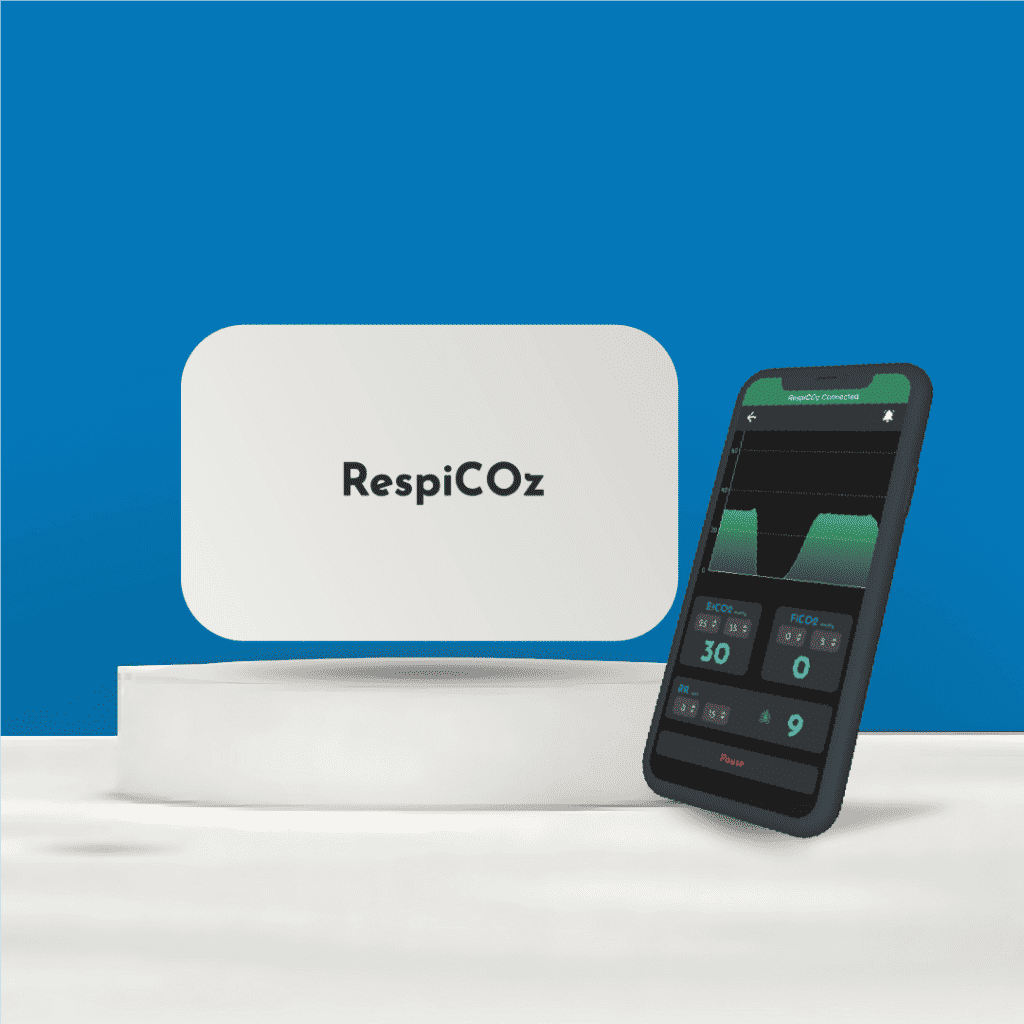
RespiCOz gives a fast, direct reading at the airway with no sampling line to block, shows the value, the waveform and FiCO2 together, runs on battery so it travels with the patient, and is CDSCO-approved and made in India with a two-year warranty. It is priced in the value middle at ₹60,000 to ₹1,00,000. For how it compares, see the best handheld EtCO2 monitor guide.
Ready to buy? Request a quote for your hospital here.
Frequently asked questions
Why is EtCO2 low in sepsis? For two reasons at once. Poor tissue perfusion means less carbon dioxide reaches the lungs, and the metabolic acidosis from rising lactate drives the patient to hyperventilate, blowing off more CO2. Both lower the reading.
What is the relationship between EtCO2 and lactate? It is inverse. As lactate rises, EtCO2 falls. Studies in suspected sepsis have shown a significant inverse correlation across sepsis, severe sepsis and septic shock.
What EtCO2 level suggests severe sepsis? An EtCO2 at or below 25 mmHg is strongly associated with a serum lactate above 4 mmol/L and with higher mortality. Prehospital screening protocols have used this threshold alongside SIRS criteria.
Can capnography replace a lactate measurement in sepsis? No. It is a useful screening and triage tool, but its sensitivity is only moderate, and changes in EtCO2 during treatment do not track changes in lactate. Use it to find the septic patient, not to guide their resuscitation.
Can a high EtCO2 be dangerous in sepsis? Yes. Both abnormally low and abnormally high readings are associated with increased mortality. A rising EtCO2 in a septic patient who was previously hyperventilating may mean they are tiring into respiratory failure.
Conclusion
EtCO2 in sepsis is a window onto perfusion, and it opens fast. As tissues starve and lactate climbs, the carbon dioxide reaching the lungs falls, and the patient’s own compensatory breathing drives it lower still. A reading at or below 25 mmHg should make you think of severe sepsis before any blood result arrives.
But know its boundary. Capnography is excellent at raising the alarm and poor at guiding the treatment that follows. Screen with it. Resuscitate with lactate, clinical judgement and everything else you have.
Used that way, a falling number becomes one of the earliest signs that an infection has become an emergency.
For the full picture of a low reading, see what does low EtCO2 mean.
References
- End-tidal carbon dioxide is associated with mortality and lactate in patients with suspected sepsis. American Journal of Emergency Medicine. Inverse EtCO2-lactate relationship and mortality prediction. sciencedirect.com | pubmed.ncbi.nlm.nih.gov
- A prehospital screening tool utilizing end-tidal carbon dioxide predicts sepsis and severe sepsis. American Journal of Emergency Medicine. SIRS plus EtCO2 ≤ 25 mmHg screening protocol. sciencedirect.com
- Exhaled end-tidal carbon dioxide as a predictor of lactate and pediatric sepsis. American Journal of Emergency Medicine. Nasal capnography in children with suspected sepsis. sciencedirect.com






1 thought on “EtCO2 in Sepsis: The Link to Lactate”
Pingback: Capnography Myths: The Simple Truth Behind 12 Errors