

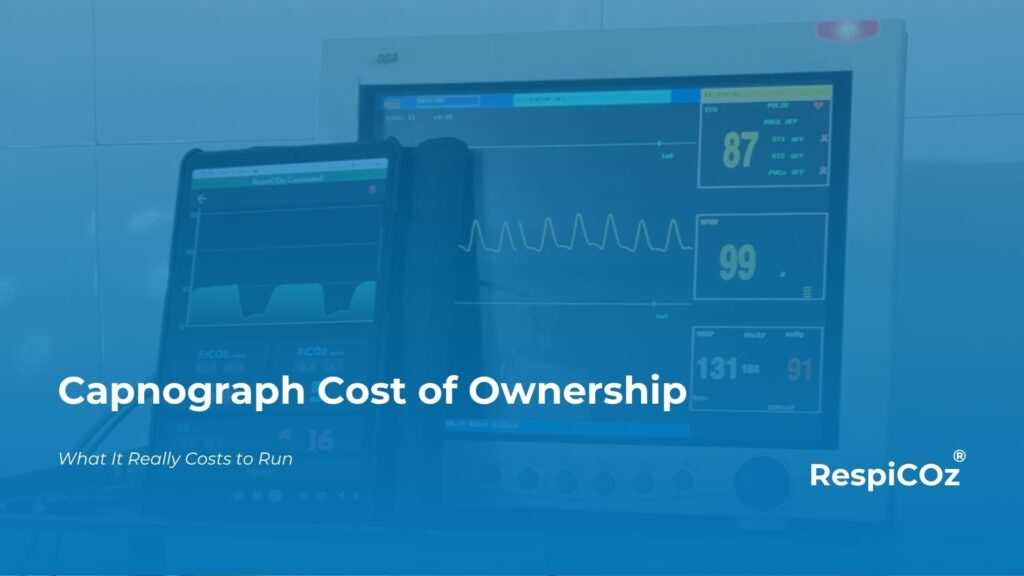
Capnograph cost of ownership is the number that should drive a purchase decision, and it is almost never the number people compare. They compare the quote. Then they buy the cheapest device and pay for it every year afterwards.
A capnograph is not a one-time purchase. It is a device with a running cost, and for some designs that running cost quietly exceeds the price of the device itself. This guide shows you how to work out the real figure, and how to compare two quotes properly.
Key takeaways
- The purchase price is only one of four costs. Consumables, service and downtime are the others.
- Disposable sampling lines are the biggest hidden cost, and they repeat with every patient.
- A mainstream device has no sampling line or water trap, so its running cost is far lower.
- Downtime is a cost too, and it is worse when spares must be imported.
- Capnography also saves money, by preventing the events that cost far more than the device.
The purchase price is the smallest part
Ask a vendor for a price and you get one number. That number answers one question: what does it cost to buy.
The question that actually matters is: what will this cost me over the next five years. And that is a different sum entirely, because a capnograph keeps costing money every time you use it.
The four components of cost of ownership
| Component | What it is | How it behaves |
|---|---|---|
| Purchase price | The device itself | One-off |
| Consumables | Sampling lines, water traps, airway adapters | Repeats with every patient |
| Service and maintenance | Calibration checks, repairs, spare parts | Recurring, unpredictable |
| Downtime | The cost of the device not working | Hidden, and worse when spares are imported |
The trap is that vendors compete on the first row and stay quiet about the second.
Consumables: the cost that repeats
This is where the money actually goes.
Sidestream and microstream devices need a disposable sampling line for every patient, plus water traps and filter lines. Published figures put disposable CO2 sampling lines at roughly $2.50 to $10 per patient, which is broadly ₹200 to ₹850 at current rates, though Indian prices vary by brand and volume. Multiply that by every monitored patient, every year.
Mainstream devices need an airway adapter. Adapters are far cheaper than sampling lines, and some are reusable. There is no sampling line to buy, no water trap to replace, and no filter line.
That is the whole argument, and it compounds. See mainstream vs sidestream capnography.
A worked example
Here is the sum, made concrete. These figures are illustrative. Plug in your own patient numbers and your own quoted consumable prices.
Take a small hospital monitoring 500 patients a year, over a five-year device life. That is 2,500 monitored patients.
| Sidestream device | Mainstream device | |
|---|---|---|
| Purchase price | Say ₹80,000 | Say ₹80,000 |
| Consumable per patient | Say ₹250 (sampling line) | Adapter, far lower or reusable |
| Consumables over 5 years | 2,500 × ₹250 = ₹6,25,000 | A small fraction of that |
| Water traps and filters | Additional | None |
| Five-year cost | Well over ₹7,00,000 | Close to the purchase price |
Read that again. On these assumptions, the consumables cost more than seven times the device. Two units with an identical sticker price can differ by lakhs over their working life.
This is why “which is cheaper” is a meaningless question until you ask “cheaper to buy, or cheaper to own.”
Service, downtime and spares
The second hidden cost is what happens when something fails.
A device that is out of service is not saving you anything. If a spare part must be imported, the wait can run to weeks, during which you are either monitoring without it or renting a substitute. An imported device also carries duty and currency cost inside every spare part, not just the original purchase.
A locally made and locally serviced device is repaired faster and more cheaply. Warranty length matters here too: six months, one year and two years of cover are very different levels of protection against this cost. See warranty, service and support for medical devices in India and capnograph maintenance.
The other side of the ledger
Cost of ownership is not only a bill. Capnography also prevents costs.
A health technology assessment of capnography monitoring found that adding capnography during moderate sedation for gastrointestinal endoscopy reduced the proportion of patients experiencing an acute event by 18%, including apnoea, aspiration, bradycardia, desaturation and respiratory compromise, and produced a net cost saving per procedure. The same review reported a substantial median annual cost avoidance with routine capnography monitoring compared with standard monitoring.
Those are figures from a different health system, so the rupee amounts do not transfer directly to India. But the direction does. A prevented respiratory event means no rescue drug, no emergency transfer, no extended stay, no claim. Against those, the device is cheap. See capnography for small clinics.
How to compare two quotes properly
Ask every vendor these five questions, and put the answers side by side.
- What is the consumable cost per patient? Not per box. Per patient.
- What consumables does the device need at all? Sampling line, water trap, filter, adapter. Which are reusable?
- How long is the warranty, on the device and on the sensor separately?
- Where are the spares held, and what is the typical repair turnaround?
- What calibration or service is required, how often, and at what cost?
Then multiply the consumable cost by your annual patient numbers and by five. That figure, added to the quote, is the real price. For the wider buying checklist, see what to look for when buying a portable capnograph.
Where RespiCOz fits
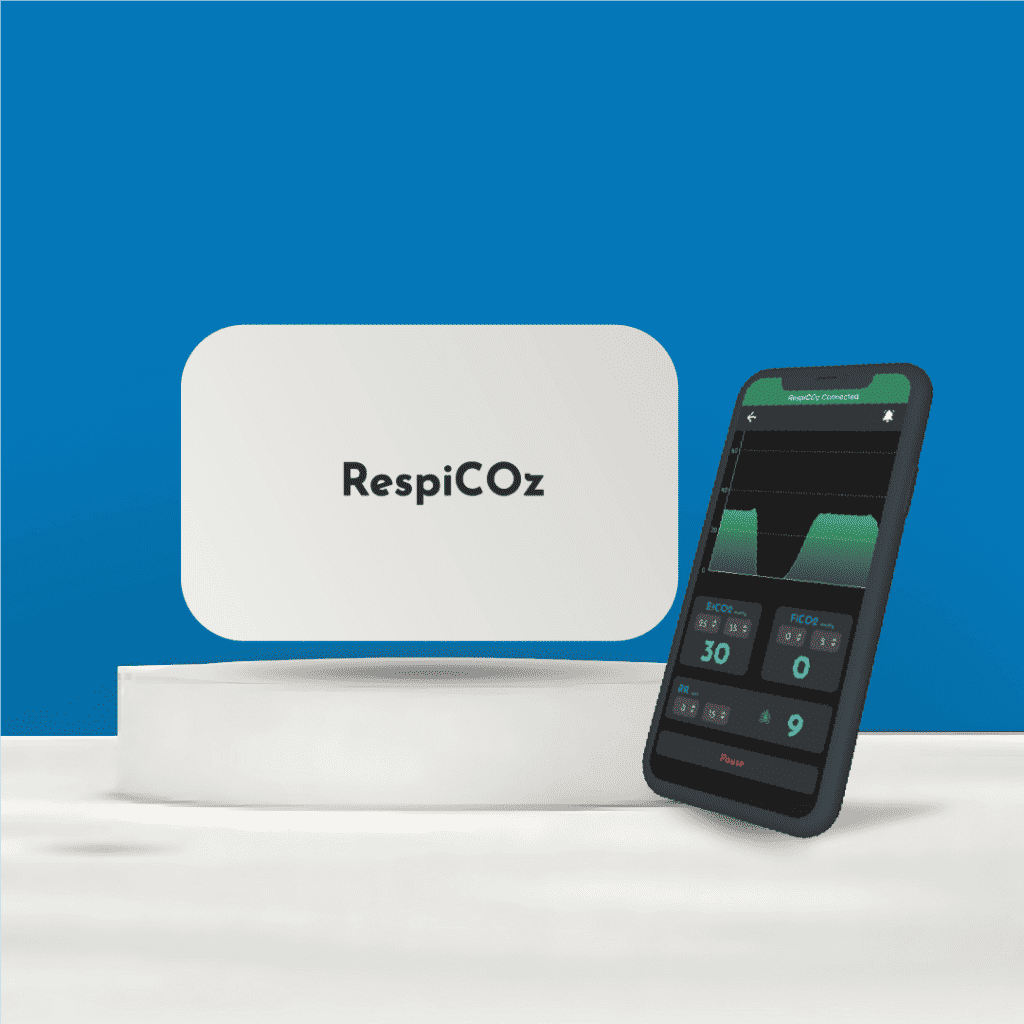
Run RespiCOz through the same four-part sum and the reason for its design becomes clear.
Purchase price: ₹60,000 to ₹1,00,000, in the value middle, below the imported portable units. See capnograph price in India.
Consumables: it is a mainstream device. No sampling line. No water trap. No filter line. The entire recurring cost that dominates the worked example above simply does not arise.
Service: made in India, with a dedicated technical team and local spares, so a repair does not mean an import wait. A two-year device warranty and a one-year sensor warranty cover the early years.
Downtime: lower, because there is less to fail. Blocked lines and full water traps are the commonest everyday faults on a sidestream device, and RespiCOz has neither.
It is honest to name the limit: a mainstream device is for airway-secured patients. If you mainly monitor awake, free-breathing patients on a nasal cannula, you need sidestream, and you will carry its consumable cost. Within its intended use, RespiCOz is built to be cheap to own, not just cheap to buy.
Ready to buy? Request a quote for your hospital here.
Frequently asked questions
What is the total cost of ownership of a capnograph? It is the purchase price plus consumables, service and maintenance, and the cost of downtime, over the working life of the device. For many devices, consumables are the largest of these.
How much do capnography sampling lines cost? Published figures put disposable CO2 sampling lines at roughly $2.50 to $10 per patient, with Indian prices varying by brand and volume. They are needed for every patient on a sidestream or microstream device.
Which capnograph has the lowest running cost? A mainstream device, generally. It has no sampling line, water trap or filter line to replace, and its airway adapter is cheaper, with reusable options.
Is a cheaper capnograph always cheaper? No. A low purchase price with expensive per-patient consumables can cost far more over five years than a slightly dearer device with almost no running cost. Always calculate the five-year figure.
Does capnography save money as well as cost money? Yes. Evidence from sedation monitoring shows capnography reduces acute respiratory events and can produce a net cost saving per procedure, because a prevented emergency costs far more than the monitoring.
Conclusion
Capnograph cost of ownership is the honest number, and it is rarely the one on the quote. The device is bought once. The consumables are bought for every patient, for years.
Work out your own five-year figure. Take the quoted price, add the consumable cost per patient multiplied by your annual patients and by five, add service and warranty, and allow for downtime. Then compare. On that basis, the cheapest device to buy is frequently the most expensive to own.
Ask the consumable question before you sign anything, and the right choice usually becomes obvious.
To start with the sticker price, see capnograph price in India.
Costs in this guide are illustrative and vary by brand, volume and supplier. They are for general guidance and not a quotation.
References
- Capnography for Monitoring End-Tidal CO2 in Hospital and Pre-hospital Settings: A Health Technology Assessment. Economic Review. CADTH, NCBI Bookshelf. Reduction in acute events and cost saving per procedure. ncbi.nlm.nih.gov
- Capnography. StatPearls, NCBI Bookshelf. Device types and consumables. ncbi.nlm.nih.gov
- Disposable CO2 sampling line cost range ($2.50 to $10 per patient), published industry figure. Prices vary by market, brand and volume.


4 thoughts on “Capnograph Cost of Ownership: What It Really Costs to Run”
Pingback: Essential Equipment For Intensivists: 5 Safe Buys
Pingback: Operation Theatre Equipment List: The Complete, Safe Guide
Pingback: RespiCOz Vs Masimo EMMA: The Honest Guide
Pingback: Hospital Equipment List India: The Safe, Essential Guide