

The NDIR capnography sensor is the technology behind almost every modern capnograph. It is what turns a breath into a number and a waveform, reliably, thousands of times a day.
The principle is elegant and simple. Carbon dioxide absorbs infrared light at a very specific wavelength, and if you measure how much light it absorbs, you know how much CO₂ is present. This guide explains how that works, part by part, and why it is the standard for capnography.
Key takeaways
- NDIR means Non-Dispersive InfraRed. It is the standard way to measure CO₂ in the breath.
- CO₂ absorbs infrared light at a specific wavelength, 4.26 microns. NDIR measures that absorption.
- More CO₂ means more absorption and less light at the detector, which gives the reading.
- It is accurate, stable and selective, and needs no chemical reagents.
- In a mainstream sensor, the measurement happens right at the airway, for a fast reading.
What NDIR stands for
NDIR is short for Non-Dispersive InfraRed. It is the most common technology for measuring carbon dioxide, used far beyond medicine, in air quality and industry too.
The idea rests on a simple fact of physics. Every gas absorbs infrared light at its own characteristic wavelengths. For carbon dioxide, the strongest and most specific absorption sits at 4.26 microns. Almost no other gas absorbs there, so that wavelength is a fingerprint for CO₂. Measure the absorption at 4.26 microns, and you are measuring CO₂ and little else.
How an NDIR capnography sensor works, step by step
The sensor is a small optical bench that does the same thing on every breath.
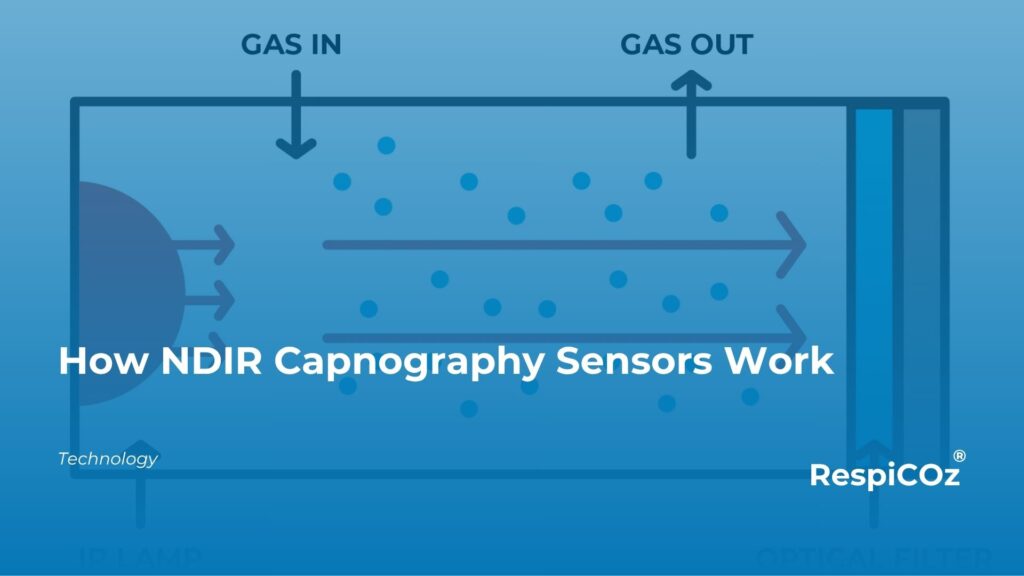
- An infrared source emits infrared light across a band of wavelengths.
- The light passes through a sample cell that holds the exhaled breath.
- The CO₂ in the breath absorbs light at 4.26 microns, letting other wavelengths pass.
- An optical filter in front of the detector allows only the 4.26 micron wavelength through.
- The detector measures how much of that light remains.
The logic is then straightforward. The more CO₂ in the breath, the more light is absorbed, and the less reaches the detector. The sensor converts that drop in light into a CO₂ value, and plots it over time as the waveform. To read that waveform, see capnography waveforms, and for the values, the normal EtCO₂ range.
Why it is called non-dispersive
The name describes what the sensor does not do.
A dispersive instrument splits light into its full spectrum, using a prism or a grating, then reads each wavelength. An NDIR sensor does not disperse the light that way. Instead it uses a fixed optical filter to pick out the one wavelength it cares about, 4.26 microns for CO₂. That makes the sensor simpler, smaller, more robust and cheaper, which is exactly what a bedside monitor needs.
The parts of an NDIR capnography sensor
Five parts do the work.
| Part | Its job |
|---|---|
| Infrared source | Emits infrared light across a band of wavelengths |
| Gas sample cell | Holds the breath sample in the light path |
| Optical bandpass filter | Selects the 4.26 micron CO₂ wavelength |
| Infrared detector | Measures the light that reaches it |
| Reference channel | Reads a non-absorbed wavelength for a stable baseline |
The reference channel and why it matters
The reference channel is the quiet hero of a good NDIR sensor.
Over time an infrared source ages and its output drifts. Dust and moisture can also change how much light gets through. A reference channel reads a nearby wavelength, often around 3.9 microns, that CO₂ does not absorb. Because that channel should not change with CO₂, any change in it must come from the source or the optics. The sensor uses it to correct the main reading, keeping the measurement accurate as the device ages. It is a large part of why a well-made NDIR sensor stays reliable for years.
Mainstream versus sidestream NDIR
The same NDIR principle is used two ways, and the difference is where the sample cell sits.
In a mainstream sensor, the sample cell is the airway adapter itself, so the measurement happens right at the patient. That means no transit delay, a fast reading, and no sampling line or water trap. In a sidestream sensor, a pump draws a gas sample down a tube to a sample cell inside the monitor, which adds a short delay and needs a water trap. For the full comparison, see mainstream vs sidestream capnography.
Why NDIR is the standard for capnography
NDIR won out because it fits clinical needs almost perfectly.
It is accurate and highly selective for CO₂, so other gases barely interfere. It is stable over years, especially with a reference channel. It uses no chemical reagents and no consumable other than the airway interface, so running costs stay low. And it is fast, which matters for a breath-by-breath waveform. For how it sits among device types, see types of capnometers.
What can affect an NDIR reading
No sensor is perfect, and knowing the limits helps you trust the number.
Condensation and secretions on the optical windows can disturb the reading, which is one reason mainstream sensors, with no sampling line, are simpler to keep clean in transit. The sensor also needs an adequate optical path length, which sets a limit on how small it can be. And large mechanical or thermal stress on the sample cell can affect accuracy. Good sensor design, and the reference channel, manage most of this.
Where RespiCOz fits
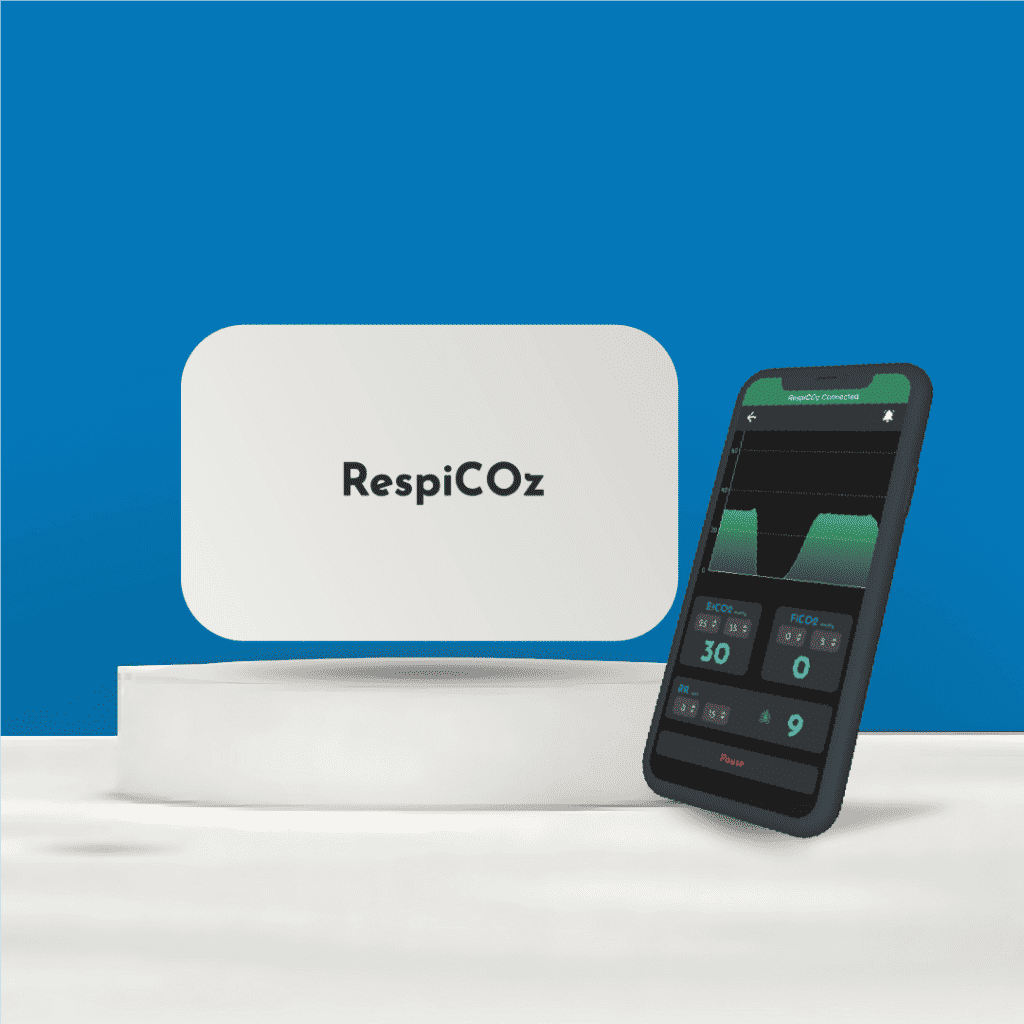
RespiCOz is a mainstream NDIR capnograph, built on exactly this technology.
The NDIR sensor sits at the airway, so the reading is fast and direct, with no sampling line to block and no water trap to fill. It is the proven, reliable core of capnography, in a portable device. RespiCOz pairs it with FiCO₂ monitoring, a companion app for the waveform, CDSCO approval and a value price. For how it compares with other portable units, see the best handheld EtCO₂ monitor.
Want to know more? Request a quote for your hospital here.
Frequently asked questions
What does NDIR stand for? Non-Dispersive InfraRed. It is the most common technology for measuring carbon dioxide, and the standard used in capnography.
How does an NDIR sensor measure CO₂? It shines infrared light through the breath. CO₂ absorbs light at 4.26 microns, so the more CO₂ is present, the less light reaches the detector. The sensor converts that into a CO₂ value.
Why is 4.26 microns important? It is the wavelength where carbon dioxide absorbs infrared light strongly, and where almost no other gas absorbs. That makes it a specific fingerprint for CO₂, with little interference.
What is the reference channel for? It reads a wavelength that CO₂ does not absorb, giving a stable baseline. The sensor uses it to correct for source ageing and dirt, which keeps the reading accurate over time.
Is NDIR accurate for capnography? Yes. It is accurate, highly selective for CO₂ and stable over years, which is why it is the standard technology in capnographs.
Conclusion
An NDIR capnography sensor works on one clean idea: CO₂ absorbs infrared light at 4.26 microns, so measuring that absorption measures the CO₂. A source, a sample cell, a filter, a detector and a reference channel are all it takes to turn a breath into a reliable number.
It is accurate, selective, stable and low-maintenance, which is why it sits at the heart of modern capnography. In a mainstream design, it does all of this right at the airway.
To order RespiCOz or ask for a quote for your setting, get a quote here.
References
- Capnography. StatPearls, NCBI Bookshelf. Infrared absorption and capnography measurement. ncbi.nlm.nih.gov
- How Does an NDIR CO₂ Sensor Work. Dexter Research Center. NDIR components and the reference channel. dexterresearch.com


2 thoughts on “How NDIR Capnography Sensors Work”
Pingback: Capnograph Maintenance: Essential Steps For Safe Accuracy
Pingback: 5 Types Of Capnometers You Should Know - Brainiac Healthcare - The World's First Smart Capnometer