

Colorimetric vs waveform capnography is a choice between a yes-or-no answer and a continuous picture. A colorimetric detector is a small disposable device that changes colour when it meets carbon dioxide. A portable capnometer measures the CO2 and shows it as a number and a waveform, breath after breath.
Both confirm that CO2 is present. Only one keeps watching. This guide sets out what each can and cannot tell you, and when the cheaper option is a false economy.
Key takeaways
- A colorimetric detector is qualitative. It answers one question, once: is CO2 there.
- A portable capnometer is quantitative. It gives a number, a waveform and a continuous trend.
- Colorimetric is cheap, needs no power, and works as a quick check or a backup.
- It can be fooled by stomach acid, adrenaline and vomitus, and moisture disables it within minutes.
- For any patient monitored beyond the first minute, waveform capnography is the standard.
What a colorimetric detector actually does
A colorimetric detector is a small plastic housing holding a pH-sensitive paper or foam indicator. Exhaled gas passes over it, and the indicator changes colour.
The colour scale runs roughly from purple, meaning little CO2, to gold or yellow, meaning more CO2. That is the entire output. There is no number, no waveform, no trend and no alarm.
It is worth being precise about what this means. The indicator responds to acidity, not to carbon dioxide directly, which is why it is technically not capnography at all. It tells you CO2 is probably present. It does not tell you how much, or what is happening to it.
What a portable capnometer does
A portable capnometer measures the carbon dioxide in the breath using infrared light, and displays it as an EtCO2 value with a waveform over time.
That gives you three things a colour change cannot. A number, so you know how much CO2 there is and whether it is normal. A waveform, whose shape reveals obstruction, rebreathing and ventilation quality. And a continuous trend, so you see change as it happens, with alarms when it matters. For the values, see the normal EtCO2 range, and for the shapes, capnography waveforms.
Colorimetric vs waveform capnography at a glance
| Colorimetric detector | Portable capnometer | |
|---|---|---|
| What it gives you | A colour change | A number and a waveform |
| Type of answer | Qualitative, yes or no | Quantitative and continuous |
| Monitors over time | No | Yes |
| Shows the waveform | No | Yes |
| Alarms | No | Yes |
| Power needed | None | Battery |
| Cost | Very low, disposable | Higher, reusable |
| Lifespan in use | Minutes, then unreliable | Continuous |
| Best for | A quick check, a backup | Confirming and then monitoring |
Where colorimetric detectors genuinely win
An honest comparison gives the cheap device its due. It has real strengths.
It is very cheap and disposable. It needs no power and no warm-up, so it works anywhere, straight from the packet. It is light and takes no training to read. And for a quick check of a tracheal tube, the evidence is that it performs comparably to infrared devices at confirming correct placement.
So it earns its place in an ambulance kit, a crash bag, a low-resource setting, or as a backup when electronic monitoring is unavailable.
Where colorimetric detectors fail
The limits are specific, documented and important.
It can be fooled. Acidic contents in the stomach can turn the indicator, giving a false positive that suggests the tube is in the airway when it is not. Adrenaline solution, surfactant and atropine can do the same. Carbonated drinks and vigorous bag-mask ventilation can also put CO2 in the stomach, producing a brief false reading. Notably, in one review of delayed recognition of oesophageal intubation leading to cardiac arrest, every case had used colorimetry.
Moisture disables it. Vomitus, secretions, pulmonary oedema fluid and simple humidity all render the paper ineffective. Excess humidity can make it unreliable within about fifteen to twenty minutes.
It cannot monitor. Once the colour has changed, it is finished. It cannot tell you the tube has since moved, the circuit has disconnected, the patient has stopped breathing, or ventilation is failing. It gives you a snapshot, not a watch.
It is limited in some patients. It is not suitable for infants below about one kilogram, and its airflow resistance makes it unsuited to spontaneously breathing patients.
It fails silently in low blood flow. In cardiac arrest, little CO2 reaches the lungs, so the colour may not change even with a correctly placed tube. A waveform device shows the same problem, but at least shows it with a trace you can interpret. See capnography in cardiac arrest.
The decisive difference: one moment versus every moment
This is the heart of the comparison.
A colorimetric detector answers the question at the moment of intubation. A capnometer answers it at the moment of intubation, and then again on every breath afterwards.
That matters because a tube does not only fail at the moment it is placed. It fails when the patient is moved, turned, transferred or transported. It fails when a circuit is knocked. Guidance on confirming a tube calls for sustained exhaled CO2 over several breaths, and for continuous monitoring thereafter, precisely because a single confirmation is not enough. A colour change cannot give you sustained. See endotracheal tube confirmation.
Which should you choose
Match the tool to the job.
- Choose a colorimetric detector as a cheap backup, in a crash bag or ambulance kit, or where no powered device is available, for a one-time check.
- Choose a portable capnometer for any patient who will be ventilated, moved or monitored for more than a moment, which is almost all of them. It confirms the tube, then keeps watching.
- Many services carry both, with colorimetric as the fallback and a capnometer as the working monitor.
The false economy is using a colorimetric detector where continuous monitoring is what the patient actually needs. For the full device landscape, see types of capnometers.
Where RespiCOz fits
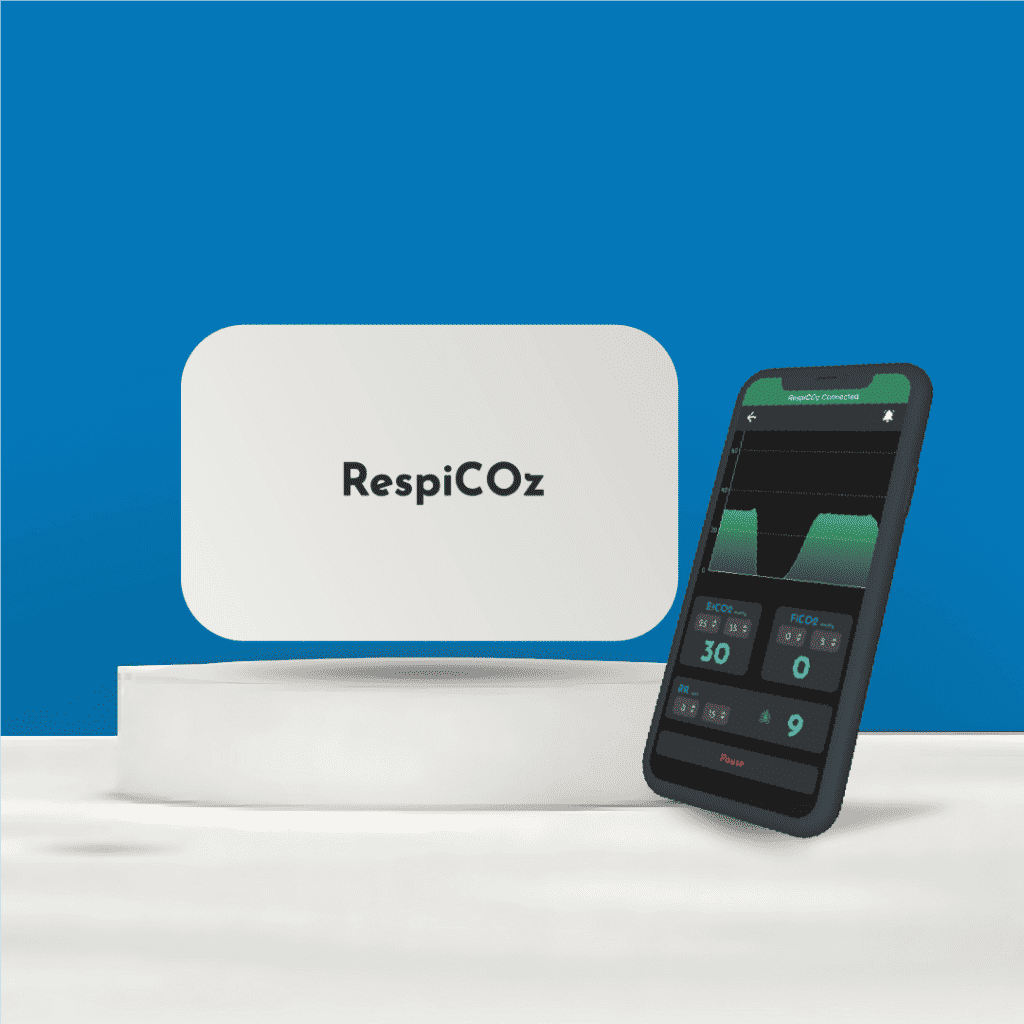
RespiCOz is a portable capnometer built for exactly the job a colorimetric detector cannot do.
It confirms the airway with a sustained waveform, then keeps monitoring, breath by breath, through theatre, recovery, the ward and transport. The mainstream sensor sits at the airway for a fast reading with no sampling line to block. It shows the EtCO2 value, the waveform and the trend, monitors FiCO2 for rebreathing, and alarms when something changes. It runs on battery, so it goes where the patient goes.
It is a focused mainstream monitor for airway-secured patients, CDSCO-approved, made in India, and priced in the value middle at ₹60,000 to ₹1,00,000. For how it compares with other portable devices, see the best handheld EtCO2 monitor guide.
Ready to buy? Request a quote for your hospital here.
Frequently asked questions
What is the difference between a colorimetric detector and a capnometer? A colorimetric detector changes colour to show that CO2 is present, giving a one-time yes-or-no answer. A capnometer measures the CO2 and displays a number and a waveform continuously, so it keeps monitoring.
Is a colorimetric CO2 detector reliable? It is reasonably reliable for a quick check of tube placement, but it can be fooled by stomach acid, adrenaline and vomitus, and moisture disables it within minutes. It cannot monitor over time.
Can a colorimetric detector replace waveform capnography? No. It gives no number, no waveform, no trend and no alarms. For any patient who will be ventilated, moved or monitored beyond the first minute, waveform capnography is the standard.
Why does a colorimetric detector give false positives? Because it responds to acidity, not carbon dioxide directly. Stomach acid, adrenaline solution, surfactant and atropine can all turn the indicator even when the tube is misplaced.
When is a colorimetric detector still useful? As a cheap, powerless backup for a one-time tube check, in a crash bag, an ambulance kit or a low-resource setting where no electronic monitor is available.
Conclusion
Colorimetric vs waveform capnography comes down to one moment against every moment. A colour change tells you CO2 was there when you looked. A capnometer tells you it is still there, how much, and what is changing.
The colorimetric detector is cheap, powerless and useful as a backup, and it deserves its place in the kit. But it can be fooled, it dies in moisture, and it cannot watch. For a patient who will be ventilated, moved or monitored, the portable capnometer is not the expensive option. It is the one that keeps answering.
To choose the right device, start with what to look for when buying a portable capnograph.
References
- Nowicki T, Jamal Z, London S. Carbon Dioxide Detector. StatPearls, NCBI Bookshelf. Qualitative versus quantitative detectors and their pitfalls. ncbi.nlm.nih.gov
- Capnography and CO2 Detectors. Life in the Fast Lane (LITFL). False positive and false negative CO2 detection. litfl.com
- End-tidal capnometry. Deranged Physiology. Colorimetric colour change responds to pH, not CO2 directly. derangedphysiology.com




3 thoughts on “Portable Capnometer vs Colorimetric: Which Should You Choose?”
Pingback: 12 Capnography Myths That Still Get Patients Hurt - Brainiac Healthcare - The World's First Smart Capnometer
Pingback: Drugs That Affect EtCO2: Essential Facts And Danger Signs
Pingback: Essential Equipment For Emergency Physicians: 5 Safe Buys