Drugs that affect EtCO2 fall into two very different groups, and confusing them is how clinicians get misled.
Some medications genuinely change the patient’s carbon dioxide, by slowing their breathing, speeding up their metabolism, or releasing CO2 into the blood. Others do not change the patient at all. They interfere with the measurement, so the monitor reports a number that was never true.
Knowing which is which is the difference between treating a patient and chasing an artefact. This guide covers both.
Key takeaways
- Opioids and sedatives raise EtCO2 by depressing breathing. This is the commonest drug effect.
- A sudden, unexplained rise during anaesthesia can mean malignant hyperthermia. It is the earliest sign.
- Sodium bicarbonate causes an immediate rise, because it releases carbon dioxide directly.
- Nitrous oxide can interfere with infrared measurement and give falsely high readings.
- Adrenaline, atropine and gastric acid can cause a false colour change on a colorimetric detector.
Two ways a drug changes the reading
Hold this distinction throughout.
The drug changes the patient. Opioids slow breathing, so CO2 accumulates and the reading rises. That number is real. It is telling you something true about the patient, and you should act on it.
The drug changes the measurement. Nitrous oxide absorbs infrared light near the wavelength the sensor uses for CO2, so an uncompensated device can read high even though the patient’s CO2 has not moved. That number is false. Acting on it would be a mistake.
Most guides list drugs. Few make this distinction, and it is the one that matters.
Part 1: Drugs that change the patient
Drugs that raise EtCO2
Opioids. Morphine, fentanyl, pethidine and the rest depress the drive to breathe. Breathing slows and shallows, carbon dioxide is not cleared, and EtCO2 climbs. This is the single commonest drug effect on EtCO2, and it is why capnography matters on the ward. See opioid-induced respiratory depression.
Sedatives and anaesthetic agents. Benzodiazepines such as midazolam, propofol, and residual volatile anaesthetics all do the same thing. During sedation, this is precisely the harm capnography is there to catch. See capnography in procedural sedation.
Sodium bicarbonate. This one is chemical, not respiratory. Bicarbonate reacts with acid in the blood and liberates carbon dioxide, which is carried to the lungs and blown off. The result is a sudden rise in EtCO2 within moments of administration. Expect it, and do not mistake it for deterioration.
Malignant hyperthermia triggers. Covered in its own section below, because it is an emergency.
For the full picture of a rising reading, see what does high EtCO2 mean.
Drugs that lower EtCO2
Stimulants. Cocaine and amphetamines can drive hyperventilation, which blows off carbon dioxide and lowers EtCO2.
Anything that drops cardiac output. A drug causing significant hypotension reduces blood flow to the lungs, so less CO2 arrives to be exhaled and the reading falls. This is a perfusion effect, not a ventilation one, and it can be the first sign that a patient is deteriorating haemodynamically.
Dantrolene, by treating malignant hyperthermia, brings a soaring EtCO2 back down. A falling EtCO2 after dantrolene is a sign the treatment is working.
Drugs that abolish or restore the waveform
Muscle relaxants. A paralysed patient who is not being ventilated stops breathing entirely, and the waveform disappears. In a ventilated patient the trace continues normally, because the ventilator is doing the work.
As a non-depolarising relaxant wears off, the patient starts making small spontaneous efforts against the ventilator, producing a notch in the expiratory plateau known as the curare cleft. It is a useful clinical sign, not a fault. See capnography waveforms.
Reversal agents. Naloxone reverses opioid respiratory depression, flumazenil reverses benzodiazepines, and neostigmine or sugammadex reverse neuromuscular blockade. In each case, breathing returns and the capnogram normalises. Capnography is one of the fastest ways to confirm the reversal has worked.
Drugs that change the waveform shape
Bronchodilators. In bronchospasm, asthma or COPD, obstructed airflow produces the sloping “shark fin” waveform. Give a bronchodilator such as salbutamol, and if it is working, the shark fin straightens back towards a normal square shape.
This is one of the most useful things capnography does. It shows you whether a treatment is working, in real time, without waiting for a blood gas.
Part 2: Drugs that fool the monitor
These do not change the patient. They change what the device sees.
Nitrous oxide
Capnography works by measuring how much infrared light carbon dioxide absorbs. Other gases that absorb infrared near the same wavelength can interfere.
Nitrous oxide is the classic example, and it is common in theatre. In a device that does not compensate for it, high levels of nitrous oxide can produce a falsely high CO2 reading. Most modern monitors have nitrous oxide compensation, but it must be enabled and set correctly for the gas mixture in use. If your readings look unexpectedly high during a nitrous case, check the compensation setting before you change the ventilation. See how NDIR capnography sensors work.
Drugs that fool a colorimetric detector
A colorimetric CO2 detector is not really measuring CO2. It is a pH indicator that changes colour in the presence of an acidic gas. So anything acidic that touches it can turn it.
Adrenaline solution, atropine and surfactant given down the tube can all produce a false positive colour change, suggesting CO2 is present when the tube may be misplaced. Gastric acid does the same.
This is a real safety issue, and it is one of the strongest arguments for waveform capnography over a colour change. A waveform device is not fooled by acidity. See colorimetric vs waveform capnography.
The drug emergency: malignant hyperthermia
This deserves its own section, because capnography is how you catch it.
Malignant hyperthermia is a rare, life-threatening reaction in genetically susceptible patients. It is triggered by volatile inhalational anaesthetics (sevoflurane, desflurane, isoflurane, halothane) and by succinylcholine, the depolarising muscle relaxant.
The earliest hallmark is a sudden, unexplained rise in EtCO2, out of proportion to ventilation. It appears alongside unexplained tachycardia and muscle rigidity, and sometimes masseter spasm after succinylcholine. Crucially, hyperthermia is a late sign. If you wait for the temperature to rise, you have lost time.
Management is immediate: stop the triggering agents, give dantrolene, and hyperventilate to bring the EtCO2 down. A falling EtCO2 afterwards indicates the treatment is working.
Notably, the intravenous agents are safe in susceptible patients. Propofol, opioids, benzodiazepines, ketamine, nitrous oxide and non-depolarising muscle relaxants are all non-triggering.
Capnography is the monitor that gives you the warning. See capnography during anaesthesia.
Quick reference
| Drug or agent | Effect on EtCO2 | Mechanism |
|---|---|---|
| Opioids | Rises | Hypoventilation |
| Benzodiazepines, propofol, volatiles | Rises | Hypoventilation |
| Sodium bicarbonate | Sudden rise | CO2 released chemically |
| Volatile agents, succinylcholine | Sudden steep rise | Malignant hyperthermia |
| Stimulants (cocaine, amphetamines) | Falls | Hyperventilation |
| Drugs causing hypotension | Falls | Reduced pulmonary blood flow |
| Dantrolene | Falls (in MH) | Treating the cause |
| Muscle relaxants | Waveform lost if unventilated | Apnoea |
| Naloxone, flumazenil, sugammadex | Normalises | Reversal of depression |
| Bronchodilators | Waveform straightens | Relief of obstruction |
| Nitrous oxide | Falsely high | Infrared interference, not real |
| Adrenaline, atropine, surfactant | False positive on colorimetric | Acidity, not CO2 |
Where RespiCOz fits
Every drug effect above is a change over time. You cannot see a change with a spot check. You need a monitor that is watching.
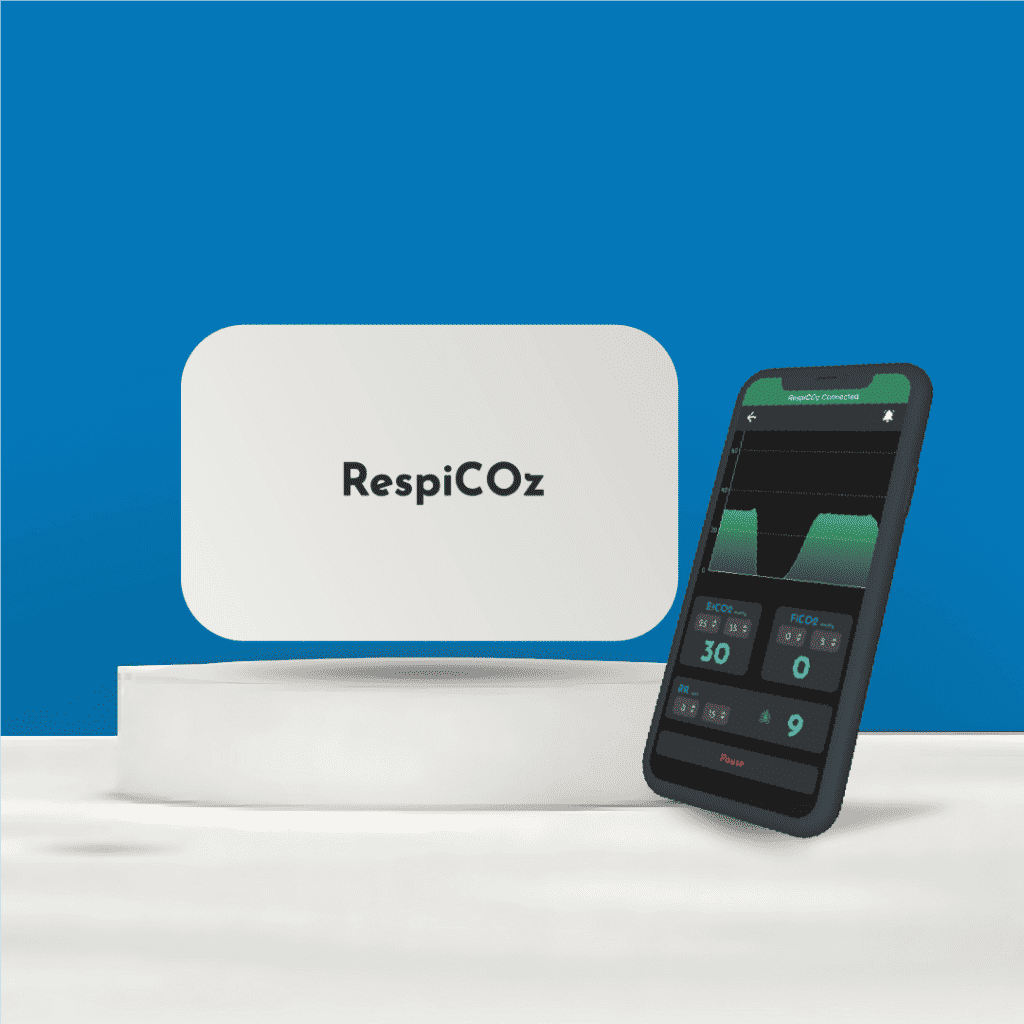
RespiCOz is a portable mainstream capnograph that shows the live EtCO2 value, the waveform and the trend together, so a rise after an opioid, a bicarbonate spike, a shark fin straightening after a bronchodilator, or the steep unexplained climb of malignant hyperthermia are all visible as they happen. It also monitors FiCO2, which distinguishes a rise from rebreathing from a rise from the patient. And as a waveform device, it is not fooled by acidity the way a colorimetric detector is.
It is a focused mainstream monitor for airway-secured patients, CDSCO-approved, made in India, with a two-year warranty, priced in the value middle at ₹60,000 to ₹1,00,000. For how it compares, see the best handheld EtCO2 monitor guide.
Ready to buy? Request a quote for your hospital here.
Frequently asked questions
Which drugs raise EtCO2? Opioids, benzodiazepines, propofol and volatile anaesthetics raise it by depressing breathing. Sodium bicarbonate raises it chemically by releasing carbon dioxide. Volatile agents and succinylcholine can raise it steeply through malignant hyperthermia.
Why does sodium bicarbonate increase EtCO2? Because bicarbonate reacts with acid in the blood and liberates carbon dioxide, which is carried to the lungs and exhaled. The rise appears within moments and is expected, not a sign of deterioration.
Can nitrous oxide affect a capnography reading? Yes. Nitrous oxide absorbs infrared light near the wavelength used to measure CO2, so an uncompensated device can read falsely high. Most modern monitors compensate for it, but the setting must be correct.
Which drugs cause a false reading on a colorimetric CO2 detector? Adrenaline solution, atropine, surfactant and gastric acid can all turn the indicator, because it responds to acidity rather than to carbon dioxide directly. This can falsely suggest a correctly placed tube.
What is the earliest sign of malignant hyperthermia? A sudden, unexplained rise in EtCO2 that is out of proportion to ventilation, alongside tachycardia and muscle rigidity. Hyperthermia is a late sign, so capnography is the early warning.
Conclusion
Drugs that affect EtCO2 do so in two ways, and the distinction decides how you respond.
When a drug changes the patient, the number is telling you the truth. An opioid raising EtCO2 means the patient is hypoventilating. A bicarbonate spike means CO2 has been released. A steep, unexplained climb under a volatile agent means malignant hyperthermia until proven otherwise.
When a drug changes the measurement, the number is lying. Nitrous oxide can inflate an uncompensated reading. Adrenaline and atropine can turn a colorimetric detector regardless of where the tube is.
Learn which is which, watch the trend rather than a single value, and the monitor becomes a drug-safety tool in its own right.
For what a rising or falling reading means more broadly, see what causes a rising or falling EtCO2 trend.
References
- Top Ten Facts You Need to Know About the Perioperative Management of Malignant Hyperthermia. Journal of the Mississippi State Medical Association. Triggering agents, EtCO2 as earliest sign, non-triggering drugs. jmsma.scholasticahq.com
- A Discussion on Malignant Hyperthermia. American Association of Critical-Care Nurses (AACN). Signs, triggers and management. aacn.org
- Capnography and CO2 Detectors. Life in the Fast Lane (LITFL). Nitrous oxide interference and colorimetric false positives from acidic drugs. litfl.com