Capnography is the continuous measurement of carbon dioxide in a patient’s breath, shown as a number (EtCO2) and as a waveform called a capnogram. It tells you, breath by breath, whether a patient is ventilating, whether the airway is in the right place and how well blood is reaching the lungs.
Pulse oximetry tells you about oxygenation. Capnography tells you about ventilation, and it often shows a problem first. This guide explains how capnography works, where it is used, what the guidelines say and how to choose a device.
Key takeaways
- Capnography shows exhaled CO2 as a number and a waveform. Capnometry shows the number only [1].
- Most devices measure CO2 by how much infrared light it absorbs, at about 4.26 µm [2].
- Normal EtCO2 is about 35 to 45 mmHg. The waveform often warns earlier than the number [3].
- Capnography is part of minimum monitoring for general anaesthesia, and is recommended for sedation and CPR [4][5][6].
- With supplemental oxygen, pulse oximetry can miss hypoventilation. Capnography does not [7].
Capnography at a glance
| Question | Short answer | Read more |
|---|---|---|
| What does it measure? | CO2 in each breath, as EtCO2 and a waveform | What is EtCO2? |
| What is normal? | About 35 to 45 mmHg | Normal EtCO2 range |
| How is it measured? | Infrared absorption, mainstream or sidestream | Mainstream vs sidestream |
| What do the shapes mean? | Each pattern points to a cause | Capnography waveforms |
| Which device types exist? | Mainstream, sidestream, microstream, colorimetric, transcutaneous | Types of capnometers |
| What does a device cost? | Portable units listed at about ₹30,000 to ₹1,05,000 in India (Nov 2026) | Capnograph price in India |
Capnography vs capnometry
Capnometry means measuring CO2 alone, without a waveform. Capnography adds the continuous waveform [1]. The waveform matters because its shape often gives earlier and more specific information than the number alone [3]. A shark-fin shape points to bronchospasm. A raised baseline points to rebreathing. A number can’t show either.
How does capnography work?
CO2 absorbs infrared light most strongly at a wavelength of about 4.26 µm [2]. A capnograph shines infrared light through the breath sample and measures how much reaches the detector on the other side. The more CO2 in the breath, the less light gets through. This is called non-dispersive infrared (NDIR) sensing. See our guide to the NDIR capnography sensor.
Where the sensor sits gives two designs:
- Mainstream: the sensor sits on an adapter at the airway. It responds fast and needs no sampling line, and is used mainly with intubated patients.
- Sidestream: a pump draws a sample through a thin tube to the monitor. It works with a nasal cannula, so it suits non-intubated patients [3].
Reading the capnogram
A normal capnogram has four phases: the inspiratory baseline, the expiratory upstroke, the alveolar plateau and the inspiratory downstroke [8]. The value at the end of the plateau is the EtCO2.
When the shape changes, it tells you something. The common abnormal patterns are on our free capnography waveform cheat sheet, with likely causes and first checks.
Where is capnography used?
| Setting | Why it is used | Read more |
|---|---|---|
| Operating theatre | Confirms tube placement and monitors ventilation throughout anaesthesia | Capnography during anaesthesia |
| Procedural sedation and endoscopy | Detects hypoventilation and apnoea early | EtCO2 in non-intubated patients |
| ICU | Trends ventilation in ventilated patients | Capnography in asthma and COPD |
| CPR | Confirms tube placement, guides compression quality, signals ROSC | Capnography in cardiac arrest |
| Ambulance and transport | Watches for tube displacement on the move | EtCO2 during transport |
| Recovery and wards | Catches opioid-related breathing problems | Post-operative capnography |
What do the guidelines say?
- General anaesthesia. The Association of Anaesthetists’ 2021 standards list capnography among the minimum monitors for general anaesthesia, to be continued through transfer and recovery [4]. In India, the Indian Society of Anaesthesiologists’ recommended perioperative monitors are treated as the national standard [9].
- Sedation. The American Society of Anesthesiologists’ 2018 guidelines say to monitor ventilation continually with capnography during moderate sedation, unless the patient, procedure or equipment prevents it [5].
- CPR. The American Heart Association recommends waveform capnography to confirm and monitor tube placement, check CPR quality and detect ROSC [6].
Our capnography guidelines summary covers these in more detail.
Capnography vs pulse oximetry
Pulse oximetry measures oxygenation. Capnography measures ventilation. When patients breathe supplemental oxygen, a falling breathing rate may not show up on the pulse oximeter for a long time. In one study, desaturation during hypoventilation was four times more common in patients breathing room air than in those on supplemental oxygen [7]. The oxygen hid the problem from the oximeter, but not from capnography. See capnography vs pulse oximetry.
Choosing a capnography device
Start with your patients. Intubated patients suit mainstream devices. Non-intubated patients need sidestream or microstream sampling through a nasal cannula. Then compare the waveform display, response time, consumables, CDSCO approval, warranty and service in your city. Our types of capnometers guide compares each type, and the capnograph price guide covers costs.
Where RespiCOz fits
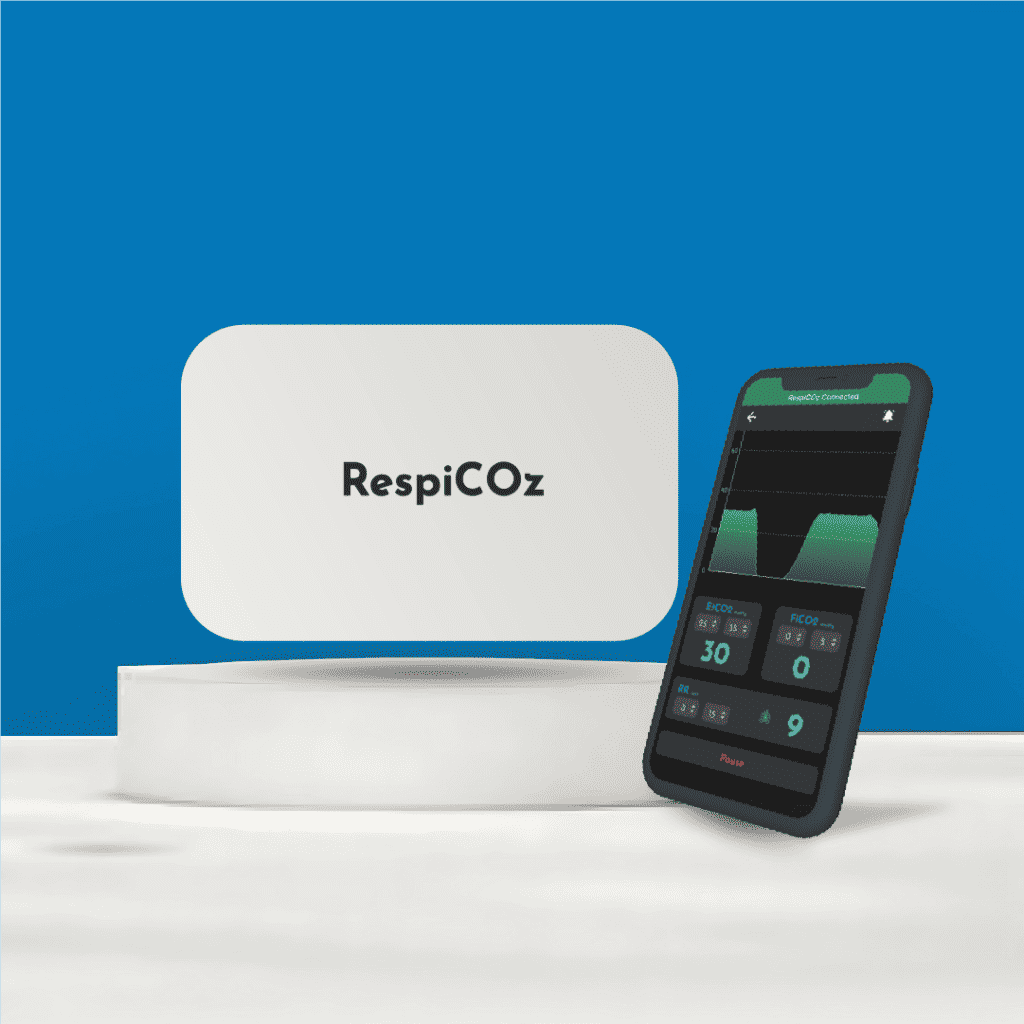
RespiCOz is a portable mainstream capnograph made in India by Brainiac Healthcare, the publisher of this guide. It shows live EtCO2, FiCO2, respiratory rate and the capnogram on your Android phone over Bluetooth. It is CDSCO approved and costs ₹99,990 including GST.
It suits intubated patients in the OT, ICU, ambulance and during CPR. It is not designed for nasal cannula monitoring of non-intubated patients; for sedation suites, choose a sidestream monitor.
See RespiCOz · Get the price on WhatsApp
Frequently asked questions
What is capnography used for? To monitor ventilation, confirm and watch endotracheal tube position, check CPR quality and detect breathing problems during sedation.
What is the difference between capnography and capnometry? Capnometry gives a CO2 number. Capnography gives the number and a continuous waveform.
What is a normal capnography reading? EtCO2 is normally about 35 to 45 mmHg. See our normal EtCO2 range guide.
Is capnography mandatory during anaesthesia in India? The Indian Society of Anaesthesiologists’ recommended monitors are treated as the national standard [9]. Check the current ISA recommendations and your hospital policy for the exact requirement in your setting.
Can capnography be used on patients who aren’t intubated? Yes, with a sidestream or microstream monitor and a CO2-sampling nasal cannula.
Conclusion
Capnography is the simplest way to see, breath by breath, whether a patient is ventilating. It confirms tube placement, warns of hypoventilation before oxygen saturation falls, and guides resuscitation. Choose a device that matches your patients, and learn the waveform as well as the number.
Ask for RespiCOz pricing on WhatsApp or request a quote.
References
- American Association for Respiratory Care. Capnography/capnometry during mechanical ventilation: 2011. Respiratory Care. 2011;56(4):503–9.
- Dolenska S. Capnography. In: Basic Science for Anaesthetists. Cambridge University Press.
- OpenAnesthesia. Capnography.
- Klein AA, et al. Recommendations for standards of monitoring during anaesthesia and recovery 2021. Anaesthesia. 2021.
- American Society of Anesthesiologists. Practice guidelines for moderate procedural sedation and analgesia 2018 (summary).
- Respiratory Therapy. New AHA guidelines: is your code team equipped with capnography?
- Fu ES, et al. Supplemental oxygen impairs detection of hypoventilation by pulse oximetry. Chest. 2004;126(5):1552–8.
- Life in the Fast Lane. Capnography waveform interpretation.
- Indian Journal of Anaesthesia article on perioperative monitoring standards (PMC4353146).