

Handheld vs benchtop capnography is a choice about form, not function. Both measure the same thing and both can give you an accurate EtCO2 reading and waveform. The difference is where each one lives and how it moves.
One is small enough to travel with the patient. The other is a fixed fixture in a single room. That single distinction shapes the cost, the flexibility and the settings each one suits. This guide lays out the differences so you buy the shape that fits your hospital.
Key takeaways
- Both handheld and benchtop capnographs measure EtCO2 accurately. The choice is about form.
- Handheld is portable and battery-powered. It goes to the patient.
- Benchtop is larger and fixed. It suits a single high-use room.
- Handheld is cheaper and more flexible. Benchtop offers a bigger display and continuous fixed use.
- Many hospitals need both, one fixed in theatre and a handheld that travels.
What is a handheld capnograph?
A handheld capnograph is a small, battery-powered device that you carry to the patient.
It is built for the point of care. It moves from the bedside to the trolley to the ambulance, and it works where no fixed monitor is installed. Its strengths are portability, quick set-up and a low price. The trade-off is a smaller screen and, in some cases, fewer extra functions than a large fixed unit. For where it sits among device types, see types of capnometers.
What is a benchtop capnograph?
A benchtop capnograph is a larger unit that sits in one place and usually runs on mains power.
It is built for a fixed, high-use setting such as a specific theatre or intensive care bay. Its strengths are a large display, continuous use without worrying about battery, and often a fuller set of features. The trade-off is that it does not travel, it costs more, and it serves one location. When the patient leaves that room, the monitor stays behind.
Handheld vs benchtop capnography at a glance
| Handheld | Benchtop | |
|---|---|---|
| Size and weight | Small, portable | Larger, fixed |
| Power | Battery | Mains, sometimes with backup |
| Moves with the patient | Yes | No |
| Best setting | Bedside, transport, clinics, EMS, many rooms | One fixed high-use room |
| Display | Compact, often via app | Larger built-in screen |
| Cost | Lower | Higher |
The differences that matter
Four things decide the choice in practice.
Portability. A handheld device travels with the patient, which matters for transport, recovery and any hospital where monitoring needs to move. A benchtop unit is anchored to its room. See EtCO2 monitoring during transport for where portability is essential.
Power. Handheld runs on battery, so it works anywhere, including during a transfer or a power interruption. Benchtop relies on mains power.
Flexibility. One handheld can cover several rooms and roles across a week. A benchtop unit covers one location. For a hospital with capnography needs spread across wards, clinics and transport, several handhelds often beat one fixed monitor.
Cost. Handheld devices cost less to buy, and one flexible unit can do the work of several fixed ones. For the full picture of what drives price, see capnograph price in India.
Which one for which setting
Match the shape to the need.
- Choose handheld for transport, recovery, the ward, day-care, clinics, emergency medicine and any hospital where the monitor must move or cover several rooms.
- Choose benchtop for a fixed, high-volume location such as a dedicated theatre or intensive care bay where the device never needs to leave.
- Many hospitals need both. A fixed monitor in theatre, and one or more handhelds that follow the patient everywhere else.
If you are weighing a portable device against a full fixed monitor with many parameters, see portable capnograph or multiparameter monitor.
Where RespiCOz fits
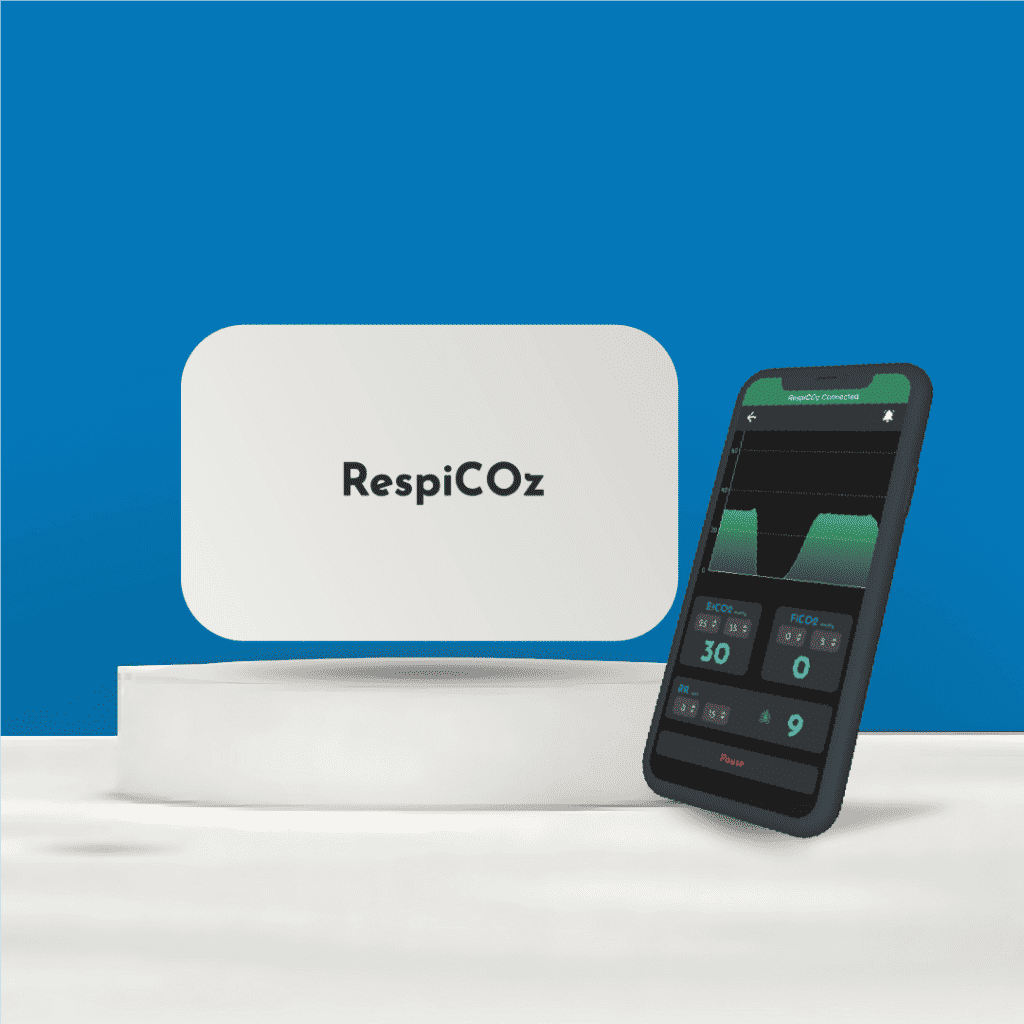
RespiCOz is a handheld capnograph, built for the settings where monitoring has to travel.
It is portable and battery-powered, so it goes from the bedside to the trolley to the ambulance without missing a beat. As a mainstream device, the sensor sits at the airway for a fast reading with no sampling line to block, which suits intubated and ventilated patients in theatre, intensive care, resuscitation and transport. It shows the waveform through a companion app, so you are not tied to a large fixed screen. It is CDSCO-approved, made in India, and priced in the value middle at ₹60,000 to ₹1,00,000, which makes it realistic to equip several rooms rather than one.
To be clear, RespiCOz is a focused handheld mainstream monitor for airway-secured patients, not a fixed benchtop unit and not a nasal-cannula device for free-breathing patients. For that decision, see mainstream vs sidestream capnography.
Ready to buy? Request a quote for your hospital here.
Frequently asked questions
What is the difference between a handheld and a benchtop capnograph? A handheld capnograph is small, battery-powered and portable, so it travels with the patient. A benchtop capnograph is larger, mains-powered and fixed in one room.
Is a handheld capnograph as accurate as a benchtop one? Yes. Both measure EtCO2 and display a waveform accurately. The difference is portability, display size and cost, not the accuracy of the reading.
Which is better for a small hospital or clinic? Usually a handheld. It is cheaper, it covers several rooms, and it moves with the patient. A benchtop unit only makes sense for a fixed, high-use location.
Which is cheaper, handheld or benchtop? Handheld devices cost less to buy, and one flexible unit can do the work of several fixed monitors, which lowers the total spend.
Do I need both? Many hospitals do. A fixed benchtop monitor in theatre or intensive care, and one or more handhelds that follow the patient to recovery, the ward and transport.
Conclusion
Handheld vs benchtop capnography is a decision about where the reading needs to be. Both are accurate. Handheld travels, costs less and covers many rooms. Benchtop stays put and suits one high-use location.
Start with where your patients are monitored, and how often the monitor must move. For most hospitals, that points to a handheld, with a fixed unit only where the volume justifies it.
To order RespiCOz or ask for a quote for your setting, get a quote here.
References
- Capnography. StatPearls, NCBI Bookshelf. Clinical role and types of capnography devices. ncbi.nlm.nih.gov
- Central Drugs Standard Control Organisation (CDSCO), Government of India. Medical device approvals. cdsco.gov.in


2 thoughts on “Handheld vs Benchtop Capnography Monitors: How to Choose”
Pingback: Best Capnography Device In India: A Smart Buyer's Guide
Pingback: Capnography For Small Clinics: An Essential Safety Net