A hospital equipment list is almost always written department by department. The theatre has its list, the intensive care unit has its own, the emergency department has another.
That is how budgets work, and it is a reasonable way to plan. But it creates a specific blind spot, and it is worth naming at the start: patients do not stay in departments. They move between them, and the equipment lists stop at the door.
This guide covers what each area of an Indian hospital needs, briefly, with links to the detailed list for each. Then it covers the part no departmental list covers: the seams.
Key takeaways
- Every department has its own equipment list, and most Indian hospitals get these broadly right.
- Every device should be CDSCO-approved under the Medical Devices Rules, 2017.
- NABH expects equipment to be maintained, calibrated and labelled with calibration status.
- The gaps are rarely inside departments. They are at the handovers between them.
- Monitoring that belongs to a room stops at the door. Monitoring that belongs to the patient does not.
The operation theatre
Six systems: the operating table and shadowless lights, the anaesthesia workstation with ventilator and gas supply, patient monitoring, electrosurgical and suction equipment, airway and emergency equipment, and sterilisation with air handling.
Monitoring is the least negotiable part. Continuous capnography, ECG, pulse oximetry and blood pressure are minimum standards for every patient under general anaesthesia, and a quantitative neuromuscular monitor is now recommended to confirm recovery before extubation.
Full list: operation theatre equipment list. For the clinician’s view of the same room, see 3 products every anaesthesiologist must have.
The intensive care unit
Five devices carry the unit: a mechanical ventilator, a multiparameter monitor, a capnograph, infusion and syringe pumps, and point-of-care ultrasound.
The Indian Society of Critical Care Medicine sets out unit-level requirements in its consensus statement on ICU planning and designing, guidance adopted across India and by NABH. Beyond the devices, it covers bed space, power backup, air handling and staffing ratios, all of which shape what equipment you can actually run.
Full list: 5 devices every intensivist must have.
The emergency department
Five devices cover the first hour: a video laryngoscope, a capnograph, a defibrillator with monitor, an intraosseous access device, and point-of-care ultrasound.
The emergency department has the least predictable case mix in the hospital, so equipment here is judged on how fast it can be brought to bear rather than on sophistication. A defined, checked difficult airway trolley matters more than an impressive one.
Full list: 5 devices every emergency physician must have.
Recovery and post-anaesthesia care
Continuous pulse oximetry, blood pressure and ECG monitoring, oxygen and suction at every bay, warming equipment, and immediate access to airway and resuscitation equipment.
Recovery is monitored more lightly than theatre while the effects of anaesthesia, opioids and muscle relaxants are all still wearing off unevenly. Residual paralysis is common on arrival and is strongly associated with critical respiratory events. See post-operative capnography.
Wards and step-down units
Vital signs monitoring, oxygen delivery, suction, infusion pumps, and a resuscitation trolley per floor with defined checking.
The ward risk that is most often underestimated is opioid-related respiratory depression after surgery, which develops quietly between observation rounds. See opioid-induced respiratory depression on the ward.
Ambulance and patient transport
A transport ventilator, a defibrillator with monitor, a capnograph, oxygen and portable suction, and syringe pumps, all battery-powered and secured against vibration.
India regulates this through AIS-125, the National Ambulance Code, which sets design and medical equipment standards by ambulance category.
Full list: ambulance equipment list India.
Diagnostics and support services
Laboratory: biochemistry, haematology and microbiology analysers, plus a blood gas analyser sited for critical care access rather than convenience.
Imaging: X-ray with portable capability, ultrasound, and CT according to the hospital’s scope. Portable capability matters more than most planners expect, because it determines how often unstable patients have to travel.
CSSD and sterilisation: autoclave capacity matched to the case load, with tracking and validation.
Blood bank, pharmacy and biomedical waste handling per applicable regulations.
What applies everywhere: CDSCO and NABH
Two requirements cut across every department.
CDSCO approval. Every medical device sold and used in India should be approved under the Medical Devices Rules, 2017. Since all devices were brought under regulation, this applies to monitors, pumps and capnographs as much as to anything else. Ask for the licence number rather than accepting a claim. See is your capnograph CDSCO approved and the CDSCO portal.
Calibration and maintenance. NABH expects equipment to be maintained and calibrated, with calibration date and status labelled. Plan for this at purchase, not at the accreditation assessment. Ask what calibration each device requires, how often, and at what cost. See capnograph maintenance.
And judge every quote on total cost rather than purchase price: consumables per patient per year, warranty on device and parts separately, spare-part availability and repair turnaround, and whether an AMC and training are included. See capnograph cost of ownership and warranty, service and support for medical devices in India.
The part no departmental list covers: the seams
Here is the argument this guide exists to make.
Every list above is a list for a room. But a surgical patient’s actual path is: theatre, recovery, ward. A trauma patient’s path is: emergency department, CT, theatre, intensive care. A referral patient’s path is: referring hospital, ambulance, your emergency department, your intensive care unit.
At every one of those arrows, the patient leaves a room and its equipment behind.
That matters because the arrows are not quiet periods. They are the highest-risk moments in the journey. Movement is what displaces endotracheal tubes and disconnects circuits. Transfers are when a patient is lifted, tilted, hand-bagged and handed from one team to another. Audit work into airway deaths outside the operating theatre found capnography frequently absent where it would have helped, and much of that occurred outside the theatre precisely because the theatre’s monitoring stayed in the theatre.
So the honest question for a hospital, as opposed to a department, is not “does each area have what it needs?” It is: “what monitoring travels with the patient?”
Common seams where it breaks:
| Handover | What is usually lost |
|---|---|
| Theatre to recovery | Capnography, as the workstation stays behind |
| ICU to CT or MRI | The bedside monitor does not travel |
| Emergency department to theatre or ICU | Resus bay monitoring stays in the bay |
| Ambulance to emergency department | Monitoring interrupted during the swap |
| Main theatre to day-care or remote sites | The standard met in the main OT is not met elsewhere |
Guidance is consistent that monitoring should be continuous throughout a transfer for a ventilated patient, with the display visible to the team. A monitor bolted to a bed space cannot meet that. See EtCO2 monitoring during transport.
Where RespiCOz fits
RespiCOz is not a replacement for anything on the departmental lists above. It is not a multiparameter monitor and not an anaesthesia workstation. It exists for the seams.
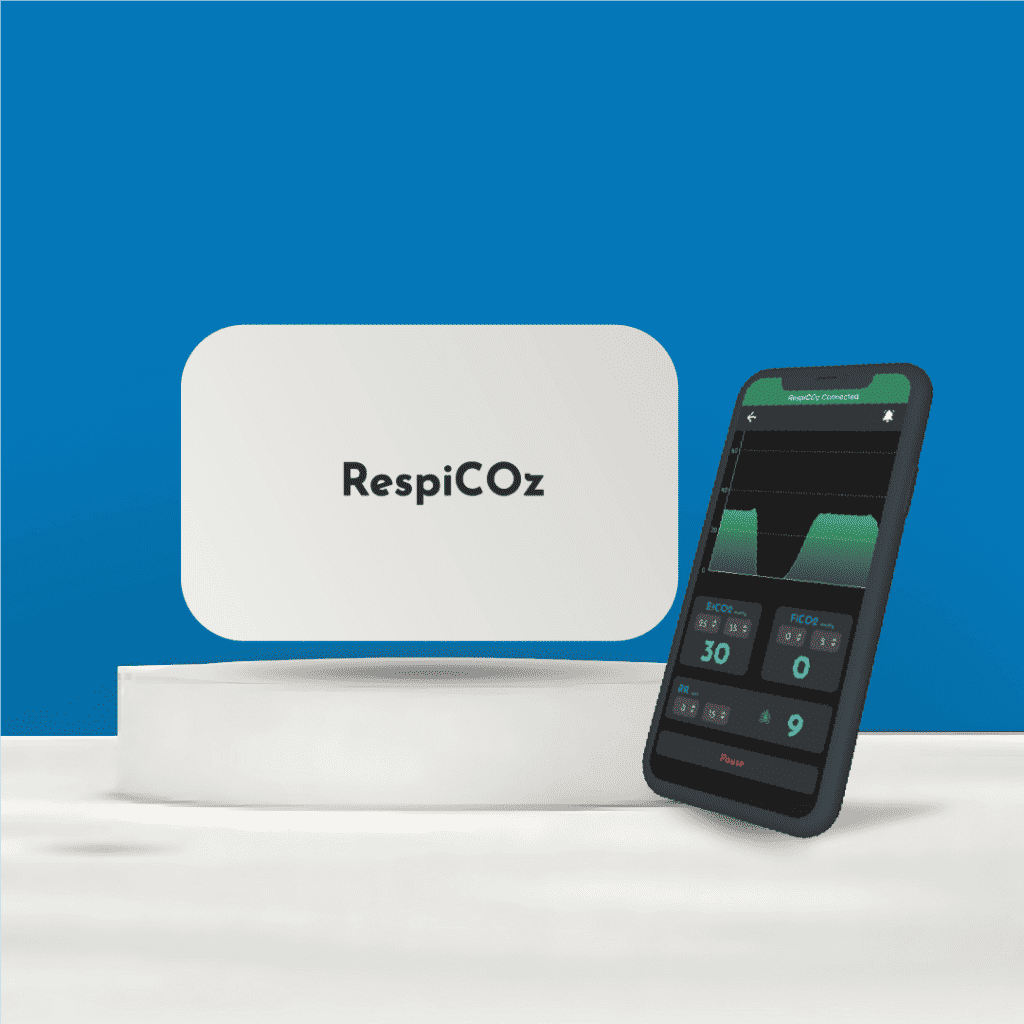
It is a portable mainstream capnograph. The sensor sits at the airway adapter, which is correct for the intubated or ventilated patient, and the reading is immediate with no sampling line to block and no water trap to fill. It shows the EtCO2 value, the waveform and FiCO2 together, so rebreathing in a circuit is caught directly.
For a hospital, the value shows up in two places. Coverage, because one portable unit brings the monitoring standard to a day-care theatre, an imaging suite or a procedure room without the cost of a second workstation. And continuity, because it travels with the patient from theatre to recovery, from intensive care to CT, and from the ambulance into the emergency department, so the airway is never unconfirmed during a handover.
On the procurement criteria above it is CDSCO-approved and made in India, so service and spares are local rather than imported. It carries a two-year device warranty with a dedicated technical team, and is priced in the value middle at ₹60,000 to ₹1,00,000, which makes it realistic to place several across a hospital rather than one. Because it is a mainstream device, there are no sampling lines or water traps to buy again.
To be clear about scope: it is a focused monitor for airway-secured patients. A spontaneously breathing patient on a nasal cannula needs sidestream or microstream sampling instead. For smaller hospitals weighing the case, see do small clinics really need capnography, and for a comparison with other portable units, the best handheld EtCO2 monitor guide.
Equipping a hospital? Request a quote here.
Frequently asked questions
What equipment must every hospital have? It varies by department. Theatres need an anaesthesia workstation and full monitoring, intensive care needs ventilators, monitors and pumps, emergency needs airway and resuscitation equipment, and every area needs oxygen, suction and a resuscitation trolley. All devices should be CDSCO-approved.
Does hospital equipment need CDSCO approval in India? Yes. Medical devices sold and used in India should be approved under the Medical Devices Rules, 2017. Ask for the licence number, since accreditation and tenders will require it.
What does NABH expect for hospital equipment? Beyond having the right equipment, NABH expects it to be maintained and calibrated, with calibration date and status labelled. Standards are revised periodically, so consult the current version.
Where do hospitals usually have equipment gaps? Not inside departments, but between them. Monitoring built into a bed space or a workstation stays behind when the patient moves to recovery, imaging, theatre or another unit, which are the highest-risk moments in the journey.
How should a hospital compare equipment quotes? On total cost rather than purchase price: consumables per patient per year, warranty on the device and parts separately, spare-part availability and repair turnaround, calibration requirements, and whether an AMC and training are included.
Conclusion
Equipment every hospital must have is usually planned room by room, and that is a sensible way to build a budget. Theatres, intensive care, emergency, recovery, wards and transport each have a list, and most Indian hospitals get those broadly right.
What departmental planning misses is that patients travel. The riskiest minutes of a hospital stay are frequently the ones spent between departments, when a patient is being moved and the monitoring that was watching them a moment ago is still plugged in three rooms away.
So equip the rooms properly, then ask the second question. What follows the patient out of the door.
To go deeper on any single area, start with the operation theatre equipment list or the ICU list.
This guide is general and not a substitute for current NABH, CDSCO or state regulatory documentation. Verify requirements directly before procurement.
References
- Central Drugs Standard Control Organisation (CDSCO), Government of India. Medical Devices Rules, 2017 and device approvals. cdsco.gov.in
- International Standards for a Safe Practice of Anesthesia. World Health Organization and World Federation of Societies of Anaesthesiologists. Monitoring standards including continuous waveform capnography. wfsahq.org
- Indian Society of Critical Care Medicine Experts Committee Consensus Statement on ICU Planning and Designing, 2020. Indian Journal of Critical Care Medicine. pubmed.ncbi.nlm.nih.gov