

An operation theatre equipment list looks, at first, like a procurement exercise. It is not. It is a safety system with a budget attached.
Every item below exists because something can go wrong without it, and the accreditation and regulatory requirements that surround an Indian operation theatre exist for the same reason. This guide sets out what a working OT needs, grouped by function, and then covers the questions worth asking before you sign a quote.
It is written for the person approving the purchase rather than the person using the device.
Key takeaways
- Equipment falls into six systems: the surgical field, anaesthesia, monitoring, energy and suction, airway and emergency, and sterilisation.
- Capnography is not optional. It is a minimum monitoring standard for every patient under general anaesthesia.
- Every device should be CDSCO-approved, and NABH expects equipment to be calibrated and labelled with its calibration status.
- Judge a quote on total cost, warranty and local service, not the purchase price alone.
- Monitoring coverage usually breaks down at remote sites and during transfer to recovery.
1. The surgical field
Operating table. Height, tilt, lateral tilt and Trendelenburg adjustment, with radiolucent sections where imaging is used. Specialty attachments for orthopaedics, obstetrics or neurosurgery as required.
Shadowless surgical lights. Ceiling-mounted, with adjustable intensity and focus, plus a satellite light. A backup light source matters more than most buyers expect during a power interruption.
Ancillary furniture. Instrument trolleys, Mayo stands, kick buckets, step stools and a surgeon’s stool.
2. Anaesthesia delivery
Anaesthesia workstation with ventilator. The core of the theatre. It delivers a controlled mixture of gases and volatile agent, ventilates the patient, and carries its own alarms and safety interlocks. Modern workstations integrate the ventilator, the vaporisers and the gas monitoring in one unit.
Medical gas supply. Central pipeline for oxygen, nitrous oxide and medical air, with a vacuum line, plus backup cylinders and clear changeover procedures. Scavenging for waste anaesthetic gases.
Carbon dioxide absorber. Soda lime in a circle system, with a clear replacement protocol. An exhausted absorber causes rebreathing, and the first sign is usually on the capnograph.
3. Patient monitoring
This is where regulatory and clinical requirements are least negotiable.
Multiparameter monitor. ECG, pulse oximetry, non-invasive blood pressure and temperature at minimum, with invasive pressure channels for major cases.
Capnography. Continuous monitoring of exhaled carbon dioxide is a minimum standard for every patient under general anaesthesia, alongside ECG, pulse oximetry and blood pressure. The WHO and the World Federation of Societies of Anaesthesiologists, in their International Standards for a Safe Practice of Anesthesia, make continuous waveform capnography highly recommended, which is their term for essential. It should run from before induction until the patient is awake and the airway device is removed. See capnography during anaesthesia.
Anaesthetic agent and oxygen analysis. Inspired oxygen concentration and agent monitoring, usually built into the workstation.
Neuromuscular monitoring. A quantitative train-of-four monitor, to confirm recovery from muscle relaxants before extubation. See 3 products every anaesthesiologist must have.
Temperature monitoring and warming. Forced-air warming and fluid warmers, since perioperative hypothermia is common and preventable.
4. Energy and suction
Electrosurgical unit. Monopolar and bipolar diathermy with return-electrode monitoring. Vessel-sealing and ultrasonic devices for specific specialties.
Suction apparatus. Central pipeline suction plus an independent portable unit. The portable one matters precisely when the pipeline fails.
Specialty equipment. Laparoscopic stack, microscope, C-arm, tourniquet system and arthroscopy equipment according to the surgical mix.
5. Airway management and emergency
Airway trolley. Laryngoscopes with a full blade range, endotracheal tubes, supraglottic airways, bougies, stylets, oral and nasal airways, and a self-inflating bag.
Difficult airway cart. A video laryngoscope, alternative supraglottic devices, a fibreoptic scope where available, and front-of-neck access equipment. This should be a defined, checked cart, not a drawer.
Defibrillator and crash cart. Immediately accessible, checked daily, with emergency drugs including dantrolene where triggering agents are used.
Emergency backup power. Uninterrupted supply to the workstation, monitors and lights.
6. Sterilisation and infection control
Autoclave and CSSD access. Sterilisation capacity matched to the case load, with a flash steriliser or direct CSSD connection for rapid turnaround.
HVAC and air handling. NABH publishes detailed guidance on air-conditioning and design for operation theatres. Consult the current NABH documentation directly for the applicable technical specifications, since these are revised periodically.
Scrub stations, PPE and biomedical waste segregation with defined movement routes.
What NABH and CDSCO expect
Two compliance layers sit over the whole list.
CDSCO. Every medical device sold and used in India should be CDSCO-approved under the Medical Devices Rules, 2017. Since all devices were brought under regulation, this applies to monitors and capnographs as much as to anything else. Ask for the licence number, do not accept a claim. See is your capnograph CDSCO approved and the CDSCO portal.
NABH. The National Accreditation Board for Hospitals and Healthcare Providers, a constituent board of the Quality Council of India, sets the accreditation standards most Indian hospitals work towards. Its expectations for theatres cover infrastructure, infection control, documentation and equipment. One requirement worth planning for early: all equipment in the OT should be calibrated, and labelled with its calibration date and status. NABH also classifies operation theatres by type, with different expectations for super-specialty theatres than for general and day-care theatres.
NABH standards are revised on a cycle, so verify the current version rather than relying on any secondary summary, including this one.
How to judge a quote
The mistake administrators make is comparing purchase prices. Compare these instead.
| What to ask | Why it matters |
|---|---|
| Is it CDSCO-approved? What is the licence number? | Legal to use, and required for accreditation and tenders |
| What are the consumables, and what do they cost per patient per year? | Often exceeds the purchase price over the device life |
| What is the warranty, on the device and on parts separately? | Six months, one year and two years are very different |
| Where are spares held, and what is the repair turnaround? | Imported spares can mean weeks of downtime |
| What calibration is required, how often, at what cost? | NABH expects calibration records |
| Is an AMC or CMC included, and what does it cover? | The recurring cost you will carry for years |
| Is training on installation included? | Equipment used wrongly is equipment wasted |
For the full reasoning on running costs, see capnograph cost of ownership and warranty, service and support for medical devices in India.
The two gaps that show up after commissioning
Most theatres are equipped properly on day one. Two gaps appear later, and both are monitoring gaps.
Remote and secondary sites. Anaesthesia does not only happen in the main theatre. It happens in day-care theatres, endoscopy suites, imaging, the cath lab and minor procedure rooms. The monitoring standard is identical in all of them, but the budget rarely stretches to a full workstation in each. This is where hospitals quietly fall short of the standard they meet in the main OT.
The journey to recovery. Monitoring should continue until the airway device is out and the patient is responsive. In practice, the theatre monitor stays in theatre, and the patient is wheeled to recovery through the exact window in which residual anaesthesia, residual paralysis and opioids are all still active. See post-operative capnography.
Both gaps have the same solution: monitoring that belongs to the patient rather than to the room.
Where RespiCOz fits
RespiCOz is not a replacement for the anaesthesia workstation or the theatre monitor. It closes the two gaps above.
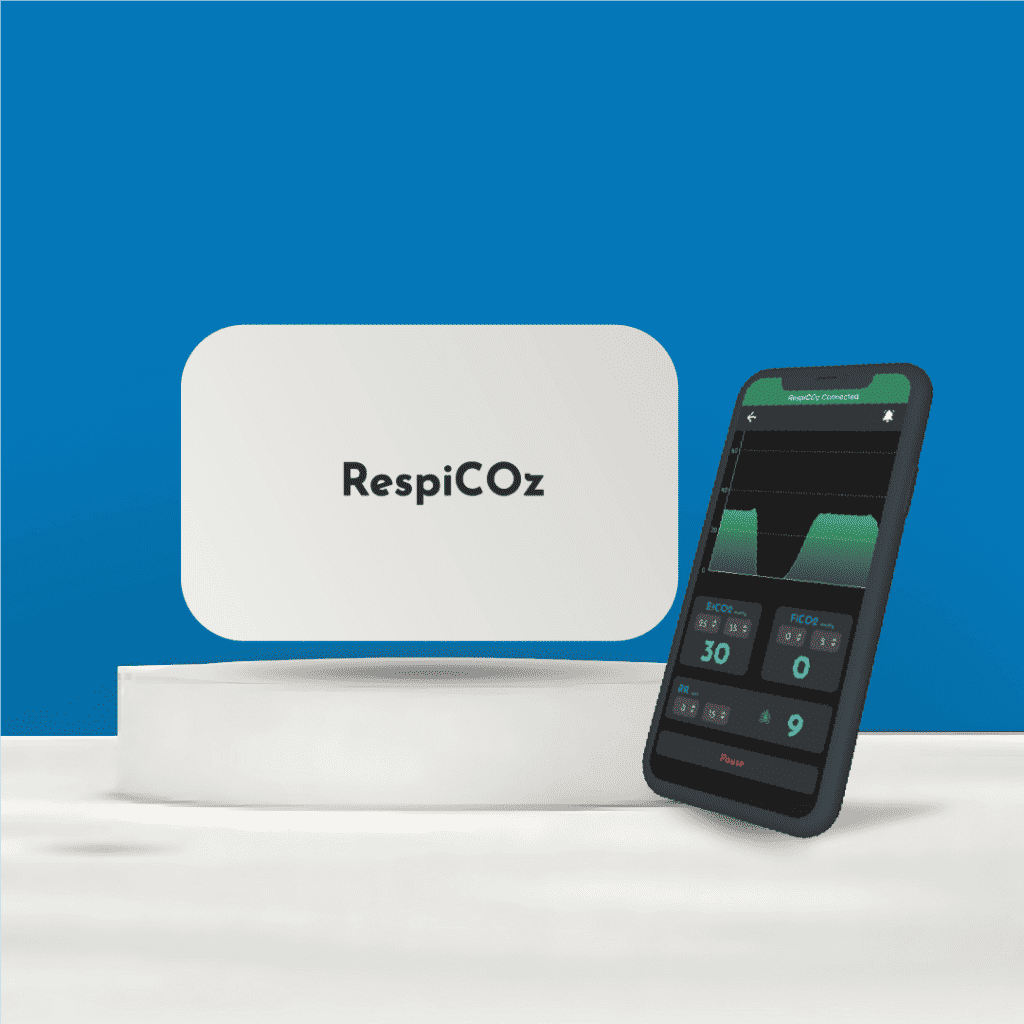
It is a portable mainstream capnograph. The sensor sits at the airway adapter in the circuit, which is correct for the intubated or ventilated patient, and the reading is immediate with no sampling line to block and no water trap to fill. It shows the EtCO2 value, the waveform and FiCO2 together, so rebreathing from an exhausted soda lime absorber is caught directly.
For a hospital, the practical value is coverage. One portable unit can bring the monitoring standard to a day-care theatre, an imaging suite or a procedure room without the cost of a second workstation, and it travels with the patient from theatre to recovery so monitoring is not interrupted at the door. For that comparison, see portable capnograph or multiparameter monitor.
On the procurement criteria above, it is CDSCO-approved, made in India, carries a two-year device warranty with a dedicated technical team and local spares, and is priced in the value middle at ₹60,000 to ₹1,00,000. Because it is a mainstream device, there are no sampling lines or water traps to buy again, which keeps the running cost low.
To be clear about scope: it is a focused monitor for airway-secured patients. A spontaneously breathing sedation patient on a nasal cannula needs sidestream or microstream sampling.
For how it compares with other portable units, see the best handheld EtCO2 monitor guide.
Ready to buy? Request a quote for your hospital here.
Frequently asked questions
What equipment is essential in an operation theatre? Six systems: the operating table and lights, the anaesthesia workstation and gas supply, patient monitoring including capnography, electrosurgical and suction equipment, airway and emergency equipment including a defibrillator, and sterilisation and air handling.
Is capnography mandatory in an operation theatre? For general anaesthesia, yes. Continuous monitoring of exhaled carbon dioxide is a minimum monitoring standard alongside ECG, pulse oximetry and blood pressure, and international standards make continuous waveform capnography essential practice.
Does OT equipment need CDSCO approval? Yes. Medical devices sold and used in India should be CDSCO-approved under the Medical Devices Rules, 2017. Ask for the licence number rather than accepting a claim, since accreditation and tenders will require it.
What does NABH expect for operation theatre equipment? Beyond having the right equipment, NABH expects it to be maintained and calibrated, with calibration date and status labelled. It also sets expectations for OT infrastructure, air handling, infection control and documentation. Consult the current NABH standards, as they are revised periodically.
How should a hospital compare equipment quotes? On total cost, not purchase price. Ask for consumable cost per patient per year, warranty on device and parts, spare-part availability and repair turnaround, calibration requirements, AMC coverage and whether training is included.
Conclusion
An operation theatre equipment list is a safety system priced out line by line. The table and lights make the surgery possible. The workstation and gas supply make anaesthesia possible. The monitors make it safe. The energy, airway, emergency and sterilisation equipment cover what happens when something goes wrong.
Two things separate a well-equipped theatre from a compliant one. Everything should be CDSCO-approved, calibrated and documented. And the monitoring standard you meet in the main theatre should follow the patient to the day-care room, the imaging suite and into recovery, because that is where it usually lapses.
Equip for the whole journey, not just the room.
This guide is general and not a substitute for current NABH, CDSCO or state regulatory documentation. Verify requirements directly before commissioning.
References
- International Standards for a Safe Practice of Anesthesia. World Health Organization and World Federation of Societies of Anaesthesiologists (WHO-WFSA). Monitoring standards including continuous waveform capnography. wfsahq.org
- Central Drugs Standard Control Organisation (CDSCO), Government of India. Medical Devices Rules, 2017 and device approvals. cdsco.gov.in
- Capnography. StatPearls, NCBI Bookshelf. Clinical role of capnography in anaesthesia. ncbi.nlm.nih.gov



2 thoughts on “Operation Theatre Equipment List: What Every OT Needs”
Pingback: Equipment Every Hospital Must Have: A Room-by-Room Guide - Brainiac Healthcare - The World's First Smart Capnometer
Pingback: Hospital Equipment List India: The Safe, Essential Guide