RespiCOz vs Contec CA10M is a comparison worth making carefully, because the two devices are genuinely similar in what they do and genuinely different in price. Both are mainstream capnographs. Both put the sensor at the airway. But the Contec CA10M sits at the budget end of the market, and RespiCOz sits in the middle, so the real question is what the price difference buys you.
We make one of them, so read this page with that in mind. It is written to be accurate rather than flattering, including where the CA10M is the better choice. A comparison that gives a competitor no strengths is not worth reading.
Key takeaways
- Both are mainstream capnographs that read CO2 at the airway, with no sampling line.
- The CA10M is self-contained, runs on AAA batteries, and is significantly cheaper.
- RespiCOz adds FiCO2 monitoring, CDSCO approval, a stated two-year warranty and local service.
- The CA10M’s published accuracy is range-dependent; above 40 mmHg it is a percentage of reading.
- The decision is price against features, approval and support.
What the two have in common
It is fair to start with the overlap, because it is real.
Both are mainstream devices. The sensor reads the exhaled breath directly at the airway adapter, so neither needs a sampling line or a water trap, and both are intended for intubated or ventilated patients rather than free-breathing patients on a nasal cannula. Both measure EtCO2 and respiratory rate, both display a waveform, and both are portable. See mainstream vs sidestream capnography.
So the core function is shared. The differences are in features, accuracy specification, approval, warranty, service and price.
RespiCOz vs Contec CA10M at a glance
Contec CA10M figures are from Contec’s own published specifications and Indian reseller listings. Specifications and prices are indicative and change. Verify with each supplier before purchase.
| RespiCOz | Contec CA10M | |
|---|---|---|
| Technology | Mainstream NDIR | Mainstream |
| Parameters | EtCO2, FiCO2, RR, apnoea | EtCO2, RR |
| FiCO2 monitoring | Included | Not listed |
| Display | Companion app | Onboard LCD |
| EtCO2 accuracy | ±2 mmHg | ±2 mmHg (0–40 mmHg); ±5% to ±10% of reading above 40 mmHg |
| RR accuracy | ±1 bpm | ±1 rpm |
| Power | Rechargeable battery | Two AAA batteries |
| Warranty | 2 years device, 1 year sensor | Not stated |
| Regulatory | CDSCO approved | Confirm with supplier |
| Made in | India | China |
| Indicative price (India) | ₹99,990 | ~₹30,000 |
Where the Contec CA10M is strong
Three things genuinely favour the CA10M, and they matter to some buyers.
It is self-contained. The CA10M has an onboard LCD screen, so it shows the EtCO2 value, respiratory rate and waveform on the device itself, with no phone or tablet needed. In a setting where a companion device is impractical, that independence is a real advantage.
Standard AAA batteries. It runs on two AAA cells, which anyone can replace anywhere without a charger. For remote or occasional use, that is a genuinely convenient design.
Price. At around ₹30,000, it is significantly cheaper than most portable capnographs, including RespiCOz. If the lowest possible purchase price is the single deciding factor, the CA10M is hard to beat on that number alone, and we would say so.
If you need a basic, self-contained mainstream capnograph at the lowest upfront cost, and you have confirmed its approval and support for your setting, the CA10M is a reasonable choice.
Where RespiCOz is strong
Four differences run the other way, and they are what the higher price buys.
FiCO2 monitoring. RespiCOz measures the fraction of inspired carbon dioxide as well as the end-tidal value. FiCO2 should be near zero, and a rise indicates the patient is rebreathing exhaled CO2, most often because a soda lime absorber is exhausted or a valve has failed. The CA10M’s published parameters do not list FiCO2. This is a circuit-level safety signal that a device measuring EtCO2 and respiratory rate alone cannot give directly. See how soda lime affects the capnograph.
Accuracy across the range. Both devices state ±2 mmHg at low CO2. Contec’s own published specification for the CA10M then widens to ±5% of reading from 41 to 70 mmHg, ±8% from 71 to 100, and ±10% from 101 to 150 mmHg. In plain terms, its stated accuracy becomes a percentage of the reading at higher CO2 levels. RespiCOz states ±2 mmHg. For a hypercapnic or deteriorating patient, where the reading is high, that difference in specification is worth understanding.
Approval, warranty and service. RespiCOz is CDSCO approved, carries a stated two-year device warranty and one-year sensor warranty, and is backed by a dedicated technical team in India with local spares. Contec’s published material for the CA10M does not state a warranty, and you should confirm its regulatory approval and service arrangement for your setting before buying. For an accredited hospital, stated approval and warranty are not optional. See is your capnograph CDSCO approved and warranty, service and support for medical devices in India.
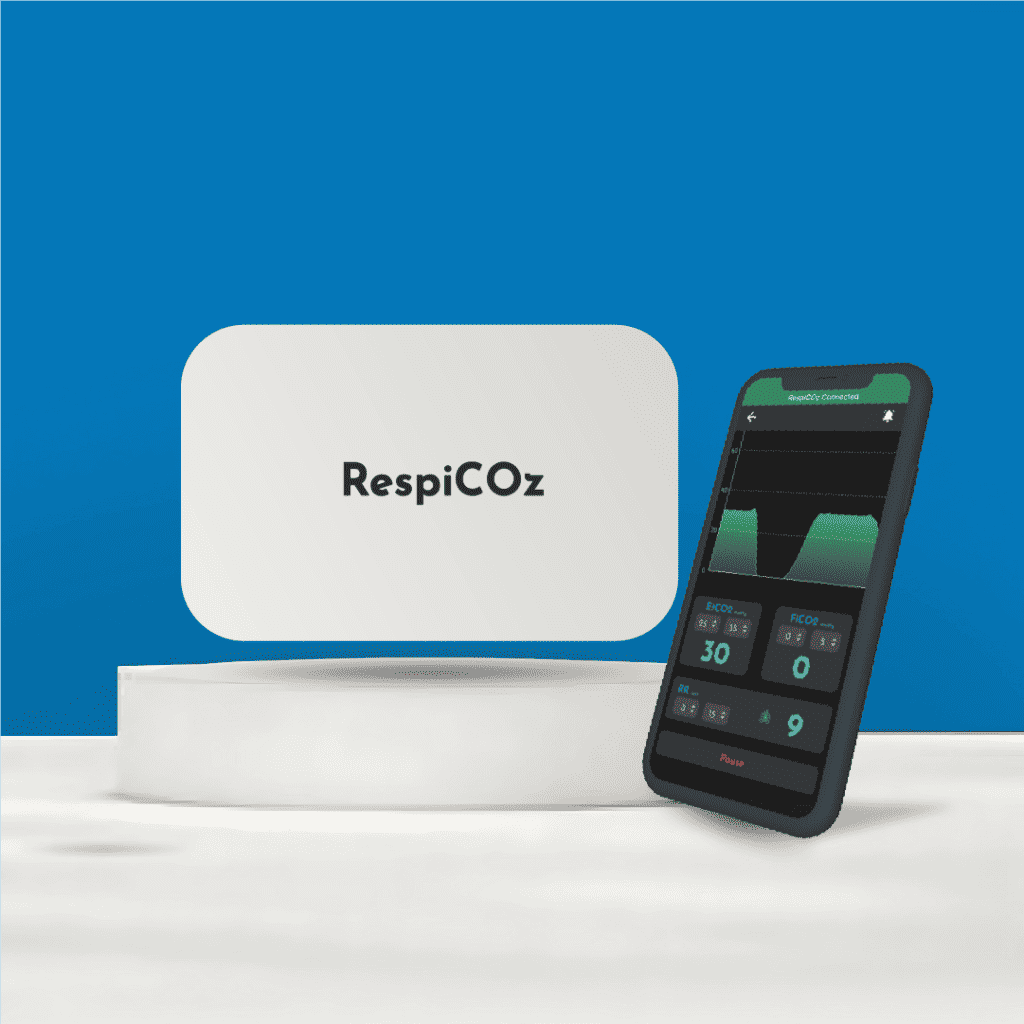
A larger display and an updatable platform. RespiCOz shows the waveform on a companion app, which gives a larger, higher-resolution view than a small onboard LCD, on a device most clinicians already carry, and allows software updates over time.
The display question, honestly
This is a genuine trade-off, and it runs in the CA10M’s favour for some settings.
The CA10M shows everything on its own onboard screen. That is simpler, needs nothing else, and is better where a phone is unavailable or impractical.
RespiCOz displays through a companion app, which gives a bigger, clearer waveform and an updatable platform, but requires a paired device to be present and charged.
Which suits you depends on where you work. For a setting where a phone is always at hand, the app approach gives a better view. For a bare, self-contained unit, the onboard screen wins. Be honest about which you are. For the same trade-off against the imported premium option, see RespiCOz vs Masimo EMMA.
The real decision: price against value
This comparison comes down to a clear question, because the price gap is large.
The CA10M is roughly a third of the price of RespiCOz. That is a real difference, and for a buyer whose only criterion is the lowest upfront cost, it matters.
But a patient monitor is bought on more than its sticker. The gap between the two buys FiCO2 monitoring, an accuracy specification that holds across the range, CDSCO approval, a stated two-year warranty, and a dedicated local service team with spares in the country. Over five years, warranty and service and approval affect both the real cost and whether the device can be used and supported at all in an accredited setting. See capnograph cost of ownership and capnograph price in India.
So the honest framing is not “which is cheaper”. It is “what does your setting need”. If you need the lowest upfront price and nothing more, the CA10M answers that. If you need FiCO2, stated approval and warranty, consistent accuracy and local support, RespiCOz is built for that, and the price reflects it.
Which should you choose
Choose the Contec CA10M if the lowest upfront price is the deciding factor, you want a fully self-contained device with an onboard screen and AAA batteries, and you have independently confirmed its regulatory approval, warranty and service for your setting.
Choose RespiCOz if you want FiCO2 monitoring, CDSCO approval, a stated two-year warranty, a consistent accuracy specification and dedicated Indian service, and you judge the device on value over its life rather than the sticker alone.
Either works for the fundamentals of mainstream capnography: confirming a tube and monitoring ventilation in an airway-secured patient.
Where RespiCOz fits
RespiCOz is built for the hospital that wants mainstream capnography with the features, approval and support that make a patient monitor dependable, at a made-in-India price.
It measures EtCO2, FiCO2 and respiratory rate, shows the waveform on a companion app, and places the sensor at the airway for a fast reading with no sampling line to block. It is CDSCO approved, made in India, and backed by a two-year device warranty, a one-year sensor warranty and a dedicated technical team. It is priced at ₹99,990.
Like the CA10M, it is a focused monitor for airway-secured patients. A free-breathing patient on a nasal cannula needs sidestream or microstream sampling instead. For a wider comparison across portable devices, see the best handheld EtCO2 monitor guide.
Want to compare in your own setting? Request a quote or a demonstration here.
Frequently asked questions
Is RespiCOz an alternative to the Contec CA10M? Yes, in category. Both are portable mainstream capnographs for airway-secured patients, measuring EtCO2 and respiratory rate with no sampling line. They differ in FiCO2, accuracy specification, display, warranty, approval, origin and price.
Does the Contec CA10M measure FiCO2? Contec’s published parameters for the CA10M list EtCO2 and respiratory rate. They do not list FiCO2. RespiCOz additionally monitors FiCO2, which warns of rebreathing from an exhausted absorber or a failed valve.
Is the Contec CA10M accurate? Contec’s own published specification is ±2 mmHg from 0 to 40 mmHg, then a percentage of the reading above that: ±5% to 70 mmHg, ±8% to 100, and ±10% to 150. So its stated accuracy becomes range-dependent at higher CO2 levels. RespiCOz states ±2 mmHg.
Why is the Contec CA10M cheaper than RespiCOz? It is a budget device, around a third of the price. The difference reflects FiCO2 monitoring, CDSCO approval, a stated two-year warranty, a consistent accuracy specification and dedicated local service, which the lower-priced device does not all state.
Which is better for an Indian hospital? It depends on the criterion. For the lowest upfront price, the CA10M is cheaper. For stated CDSCO approval, warranty, FiCO2 and local service, which an accredited hospital and a tender will ask for, RespiCOz has the advantage.
Conclusion
RespiCOz vs Contec CA10M is a comparison between a budget, self-contained capnograph and a mid-priced one with more features and support. Both are mainstream devices doing the same core job, and the CA10M does it at a notably lower price, with an onboard screen and AAA batteries that suit some settings well.
What the higher price of RespiCOz buys is specific: FiCO2 monitoring, a consistent accuracy specification, CDSCO approval, a stated two-year warranty, and dedicated Indian service. Decide which of those your setting needs. If it is the lowest sticker price, the CA10M answers that. If it is features, approval and support you can hold a manufacturer to, RespiCOz is built for it.
To weigh the full cost rather than the sticker, see capnograph cost of ownership.
Competitor specifications and prices in this comparison are drawn from publicly available information at the time of writing and are indicative only. They change, and some details are not publicly stated. Verify current details directly with each manufacturer before purchase.
References
- Contec CA10M Mainstream EtCO2 Capnograph, published specifications. Contec Medical Systems. contechealth.com
- Contec CA10M Capnograph (mainstream), product listing and indicative India price. IndiaMART. indiamart.com
- Central Drugs Standard Control Organisation (CDSCO), Government of India. Medical Devices Rules, 2017. cdsco.gov.in