This capnography glossary defines the terms you meet when you work with carbon dioxide monitoring, in plain clinical English. Capnography has a vocabulary of its own, and the words are easy to confuse: capnography, capnometry and capnogram sound alike but mean different things, and a handful of abbreviations carry most of the meaning.
Use it as a quick reference. The terms are listed alphabetically, and where a term has a fuller guide of its own, it is linked.
Key takeaways
- EtCO2 is the number. Capnography is the technique. The capnogram is the waveform.
- Normal EtCO2 is 35 to 45 mmHg, and it normally sits 2 to 5 mmHg below the arterial value.
- The waveform has four phases, and its shape often matters more than the number.
- FiCO2 is inspired CO2, and a rise warns of rebreathing.
- Mainstream and sidestream describe where the sensor sits, not how it measures.
A
Alpha angle. The angle between the rising expiratory upstroke (phase II) and the alveolar plateau (phase III) of the capnogram. It normally sits around 100 to 110 degrees. It widens in airway obstruction, which is part of what produces the shark-fin shape. See capnography waveforms.
Alveolar plateau. Phase III of the capnogram, the near-flat section representing gas from the alveoli, where CO2 is at its highest. Its slope and shape carry much of the diagnostic information. A sloping plateau suggests uneven emptying of the lungs, as in asthma or COPD.
Apnoea. The absence of breathing. On a capnogram it shows as a sudden loss of the waveform to a flat line. A capnograph detects apnoea within seconds, before oxygen saturation falls.
(a-ET)CO2 difference / a-ET gradient. The difference between the arterial CO2 (PaCO2) and the end-tidal CO2 (EtCO2). Normally 2 to 5 mmHg, with the end-tidal value lower. The gap widens when alveolar dead space increases, as in shock, pulmonary embolism and trauma, and narrows, sometimes reversing, in pregnancy.
B
Baseline. Phase I of the capnogram, the flat section at the start of expiration representing CO2-free gas from the airways. It should sit at zero. A baseline that does not return to zero indicates rebreathing.
Beer-Lambert law. The physical principle underlying infrared CO2 measurement: the amount of infrared light absorbed is proportional to the concentration of the absorbing gas. It is how a capnograph converts absorbed light into a CO2 value.
C
Capnogram. The waveform itself, the graphical display of CO2 concentration over time (or over volume). Reading its shape is central to capnography. See capnography waveforms.
Capnograph. The device that measures CO2 continuously and displays it as a waveform with a numerical value.
Capnography. The continuous measurement and waveform display of carbon dioxide in respiratory gases. The technique, as distinct from the number (EtCO2) or the device (capnograph).
Capnometry. The measurement of CO2 as a number only, without a waveform. A capnometer gives the value; a capnograph gives the value and the trace.
Cardiogenic oscillations. Small ripples at the end of the expiratory plateau, caused by the beating heart transmitting an impulse to the airway. Seen at low respiratory rates and in small patients. Usually benign.
Colorimetric detector. A disposable device with a pH-sensitive chemical indicator that changes colour in the presence of CO2. It gives a qualitative yes-or-no answer, not a number or waveform, and can be fooled by acidity. See colorimetric vs waveform capnography.
Curare cleft. A notch in the alveolar plateau, appearing as a muscle relaxant wears off and the patient makes a small spontaneous breath against the ventilator. A clinical sign, not a fault.
D
Dead space. The volume of each breath that does not take part in gas exchange. Anatomical dead space is the conducting airways; alveolar dead space is ventilated lung that is not perfused; apparatus dead space is added by equipment such as adapters. Increased dead space widens the a-ET gradient and lowers the measured EtCO2.
E
End-tidal (ET). The end of exhalation. The end-tidal point is where the exhaled gas best reflects alveolar, and therefore arterial, CO2.
EtCO2 (end-tidal carbon dioxide). The concentration of CO2 at the end of exhalation, the headline number in capnography. Normally 35 to 45 mmHg in a healthy adult. See what is EtCO2 and the normal EtCO2 range.
F
FiCO2 (fraction of inspired carbon dioxide). The amount of CO2 the patient breathes back in. It should be near zero. A rise means rebreathing, most often from an exhausted soda lime absorber or a failed valve.
H
Hypercapnia. A high CO2 level, an EtCO2 above 45 mmHg. Caused by hypoventilation, raised CO2 production, or rebreathing. See what does high EtCO2 mean.
Hypocapnia. A low CO2 level, an EtCO2 below 35 mmHg. Caused by hyperventilation, falling perfusion, or a lost airway. See what does low EtCO2 mean.
M
Mainstream. A capnograph design in which the sensor sits directly in the breathing circuit at the airway, reading the breath in place. Fast, with no sampling line. See mainstream vs sidestream capnography.
Microstream. A low-flow form of sidestream sampling, drawing a very small gas sample. Suited to small patients such as neonates.
N
NDIR (non-dispersive infrared). The standard technology for measuring CO2 in capnography. CO2 absorbs infrared light at 4.26 microns, and the sensor measures that absorption. See how NDIR capnography sensors work.
Normocapnia. A normal CO2 level, an EtCO2 of 35 to 45 mmHg in a healthy adult.
P
PaCO2. The partial pressure of carbon dioxide in arterial blood, measured by a blood gas. The reference standard that EtCO2 approximates non-invasively.
PETCO2. Another notation for end-tidal CO2, the partial pressure of end-tidal carbon dioxide. The same measurement as EtCO2.
Permissive hypercapnia. Deliberately allowing CO2 to rise, as in lung-protective ventilation for ARDS, to avoid injuring the lungs with excessive pressure and volume. A high reading that is intended rather than alarming.
Phases (I-IV). The segments of a time capnogram: phase I is the baseline, phase II the expiratory upstroke, phase III the alveolar plateau, and phase IV the inspiratory downstroke as the next breath begins.
R
Rebreathing. Inhaling previously exhaled CO2, shown by a baseline that does not return to zero and a rising FiCO2. Caused by an exhausted absorber, a failed valve or inadequate fresh gas flow. See how soda lime affects the capnograph.
Respiratory rate (RR). The number of breaths per minute, read directly from the capnogram by counting waveforms.
Rise time. How quickly the sensor responds to a change in CO2, usually measured from 10% to 90% of a step change. A faster rise time tracks a sharp waveform more faithfully. See capnography response time.
S
Shark-fin. The sloping capnogram of expiratory airway obstruction, as in asthma or COPD, where the upstroke slopes and the alpha angle opens. See capnography in asthma and COPD.
Sidestream. A capnograph design in which a pump draws a gas sample through a line to a sensor inside the monitor. Allows sampling from a nasal cannula, so it suits awake patients, at the cost of a transit delay and a water trap.
Soda lime. The carbon dioxide absorbent in an anaesthesia circle system. When exhausted, it causes rebreathing, seen as a rising baseline.
T
Transit time. In a sidestream device, the time for the gas sample to travel down the sampling line to the sensor. It adds a delay to the reading. Mainstream devices have none.
Transcutaneous CO2 (tcpCO2). Measurement of CO2 through the skin using a heated sensor, rather than from the breath. Used for trend monitoring, especially in neonates.
V
Volume capnography. Plotting CO2 against exhaled volume rather than time, which allows dead space and the volume of CO2 eliminated to be calculated. Used mainly in intensive care ventilation.
W
Waveform capnography. Capnography that displays the full capnogram, as opposed to a number alone. The waveform shape often reveals the cause of a problem the number only hints at. See what causes a rising or falling EtCO2 trend.
Water trap. A reservoir on a sidestream device that collects moisture from the sampled gas to protect the sensor. It must be emptied, and a full trap degrades the reading.
A note on the device
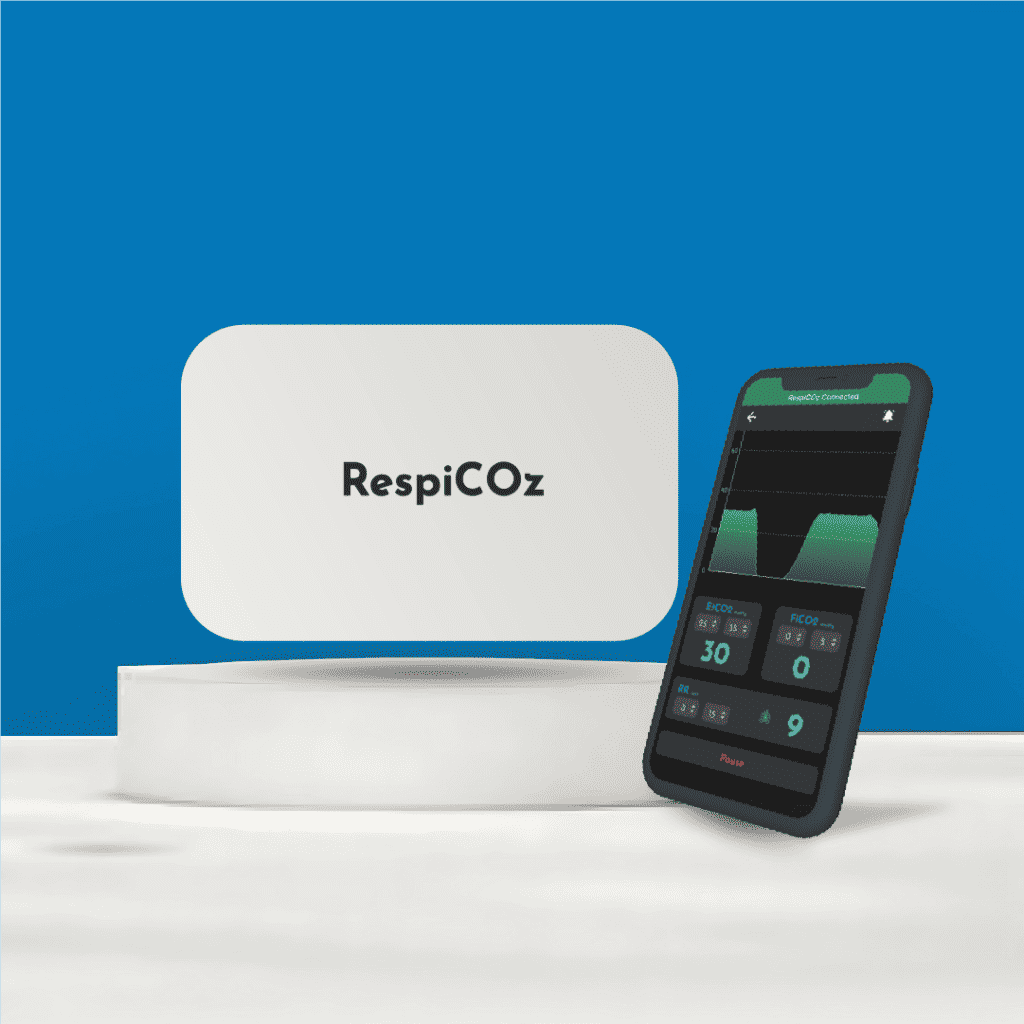
This glossary is published by Brainiac Healthcare, makers of RespiCOz, a portable mainstream capnograph. It is a reference, and every term above is standard. If you would like to see capnography in use, start with what is EtCO2, or see the best handheld EtCO2 monitor guide.
Frequently asked questions
What is the difference between capnography, capnometry and a capnogram? Capnography is the technique of measuring and displaying CO2 as a waveform. Capnometry is measuring the number without a waveform. The capnogram is the waveform itself.
What is the difference between EtCO2 and PETCO2? They are the same measurement, the carbon dioxide at the end of exhalation. PETCO2 is the partial pressure of end-tidal CO2, and EtCO2 is the common shorthand for it.
What is EtCO2 versus PaCO2? EtCO2 is the end-tidal CO2 from the breath, measured non-invasively. PaCO2 is the arterial CO2 from a blood gas. EtCO2 normally sits 2 to 5 mmHg below PaCO2, a gap that widens in shock and trauma.
What does FiCO2 mean? The fraction of inspired carbon dioxide, the CO2 the patient breathes back in. It should be near zero, and a rise indicates rebreathing.
What are the phases of a capnogram? Four: phase I the baseline, phase II the expiratory upstroke, phase III the alveolar plateau, and phase IV the inspiratory downstroke.
Conclusion
Capnography rewards a clear vocabulary, because the terms are precise and easily confused. Keep the three core distinctions straight, capnography the technique, capnometry the number, the capnogram the waveform, and the rest of the vocabulary falls into place around them.
Bookmark this glossary as a reference, and follow the links for the fuller guide to any term you want to go deeper on. To start from the beginning, see what is EtCO2.
References
- Capnography terminology and physiology. Capnography.com, Bhavani Shankar Kodali. capnography.com
- Capnography. StatPearls, NCBI Bookshelf. Definitions and clinical use. ncbi.nlm.nih.gov