


The essential equipment for intensivists is not really a shopping list. It is a set of jobs.
Intensive care does two things. It supports organs that are failing, and it tells you whether that support is working. Every device in the unit serves one of those two purposes, and the five below cover the ground that matters most.
The Indian Society of Critical Care Medicine sets out what a unit needs in its consensus statement on ICU planning and designing, guidance adopted across India and by NABH. What follows is the working version of that: five devices, what each one is for, and where each one leaves a gap.
Key takeaways
- A ventilator supports the breathing. It cannot tell you the tube is still in the right place.
- A multiparameter monitor watches the vital signs, but is fixed to the bed space.
- A capnograph confirms the airway and ventilation in seconds, and it must travel with the patient.
- Infusion pumps deliver drugs with a precision that matters at ICU doses.
- Point-of-care ultrasound answers questions at the bedside that would otherwise need a trip to radiology.
1. A mechanical ventilator
Its job: breathe for the patient.
The ventilator is the defining machine of intensive care. It takes over the work of breathing for a patient who cannot manage it, and modern units do far more than push air. They deliver controlled tidal volumes, positive end-expiratory pressure and precise oxygen concentrations, and they support weaning as the patient recovers.
Lung-protective ventilation is the standard of care in ARDS: small tidal volumes to avoid injuring the lung, accepting a rising carbon dioxide as the trade-off. That deliberate rise is called permissive hypercapnia, and it is one of the situations where a high reading is intended rather than alarming. See what does high EtCO2 mean.
Its blind spot: a ventilator reports what it is delivering, not what the patient is receiving. It cannot confirm the tube is in the trachea, and a disconnected or displaced tube can still show plausible-looking numbers on the screen.
2. A multiparameter monitor
Its job: watch the vital signs, continuously.
The bedside monitor is the ICU’s standing observation. ECG, pulse oximetry, non-invasive blood pressure and temperature, with invasive arterial and central venous pressures where required. It runs without being asked and alarms when something moves.
It is the reason a deteriorating patient in intensive care is noticed in seconds rather than at the next set of observations.
Its blind spot, and it is two-fold. First, pulse oximetry is a late warning for breathing problems. Oxygen reserves, especially on supplemental oxygen, keep the saturation looking normal for minutes after ventilation has failed. See capnography vs pulse oximetry.
Second, and more practically, it is fixed to the bed space. The moment the patient leaves for CT, MRI, theatre or another unit, the monitor stays behind.
3. A capnograph
Its job: confirm the airway and the ventilation, within one breath.
This is the device that closes the gap left by the first two. Capnography measures carbon dioxide in every exhaled breath and displays it as a waveform, which makes it the fastest confirmation available that air is genuinely moving.
In an ICU it does several jobs at once. It confirms the endotracheal tube at intubation and keeps confirming it afterwards. It shows a disconnection or a displaced tube as an immediate flat line. It tracks ventilation continuously, so the effect of every ventilator change is visible. And it carries diagnostic information: a falling reading can mean falling cardiac output, and in sepsis, EtCO2 falls as lactate rises. See endotracheal tube confirmation and EtCO2 in sepsis.
The audit evidence is the part worth taking seriously. The National Audit Project 4 from the Royal College of Anaesthetists and the Difficult Airway Society found that airway deaths outside the operating theatre, many of them in intensive care, frequently occurred where capnography was not in use, and concluded that a substantial share could have been prevented by it.
Its blind spot: it measures ventilation, not oxygenation, and not circulation directly. It is one signal, and a fast one.
The practical problem: capnography is frequently available at the ICU bed and frequently lost the moment the patient moves. Intra-hospital transport is exactly when a tube is most likely to displace, and it is when monitoring is thinnest. See EtCO2 monitoring during transport.
4. Infusion and syringe pumps
Its job: deliver drugs at a rate you can trust.
Intensive care runs on continuous infusions. Vasopressors, sedatives, analgesics, insulin, anticoagulants and inotropes are all given as controlled rates rather than boluses, and at these doses small errors are not small.
A syringe pump titrating noradrenaline is holding a patient’s blood pressure within a window. Precision, alarm handling and occlusion detection are clinical features, not conveniences. Indian ICU standards typically specify syringe pumps at close to one hundred percent of functional beds, which reflects how central they are.
Its blind spot: a pump delivers accurately. It has no idea whether the dose is right for the patient. That judgement comes from the monitors and from you.
5. Point-of-care ultrasound
Its job: see inside the patient, at the bedside.
Bedside ultrasound has moved from a specialist skill to a core intensivist competency, and for good reason. It answers questions in minutes that would otherwise need imaging in another department.
In shock it distinguishes hypovolaemic, cardiogenic, obstructive and distributive causes by scanning the heart, inferior vena cava, lungs and abdomen, which changes management immediately. Lung ultrasound identifies pneumothorax, effusion, consolidation and pulmonary oedema. It guides central line and drain insertion, reducing complications.
The international recommendations for point-of-care lung ultrasound reflect a substantial evidence base, and the European Society of Intensive Care Medicine has published consensus recommendations on the basic ultrasound skills intensivists should hold. Its practical advantages are real too: fewer chest X-rays and CT scans, less radiation, and crucially fewer journeys for an unstable patient.
Its blind spot: it is operator-dependent. A scan is only as good as the person holding the probe, which makes training part of the purchase.
Five devices, five blind spots
| Device | Its job | What it cannot tell you |
|---|---|---|
| Ventilator | Breathe for the patient | Whether the tube is still in the trachea |
| Multiparameter monitor | Watch vital signs continuously | Ventilation failure early, and it does not travel |
| Capnograph | Confirm airway and ventilation in seconds | Oxygenation, and circulation directly |
| Infusion pumps | Deliver drugs precisely | Whether the dose is right |
| Point-of-care ultrasound | See inside at the bedside | Anything, without a trained operator |
Read down the last column and the case for owning all five makes itself. The gaps do not overlap.
The gap most units still have
Four of these five are usually present in an Indian ICU. The one that is patchy is portable capnography.
Capnography at the bedside is often a module inside the multiparameter monitor, which means it is tied to that monitor and that bed. When the patient goes to CT, to theatre, or to another hospital, the capnography frequently does not go with them. That is precisely the window in which tubes migrate, circuits disconnect and hand-bagging replaces controlled ventilation.
International guidance is that continuous capnography should be a standard of monitoring for mechanically ventilated ICU patients during transport, and transfer guidance requires monitoring to be continuous throughout the journey with the display visible to the team. A monitor that stays behind cannot meet that.
The fix is a dedicated portable capnograph that belongs to the patient rather than to the room. For how a focused device compares with a full monitor, see portable capnograph or multiparameter monitor.
Where RespiCOz fits
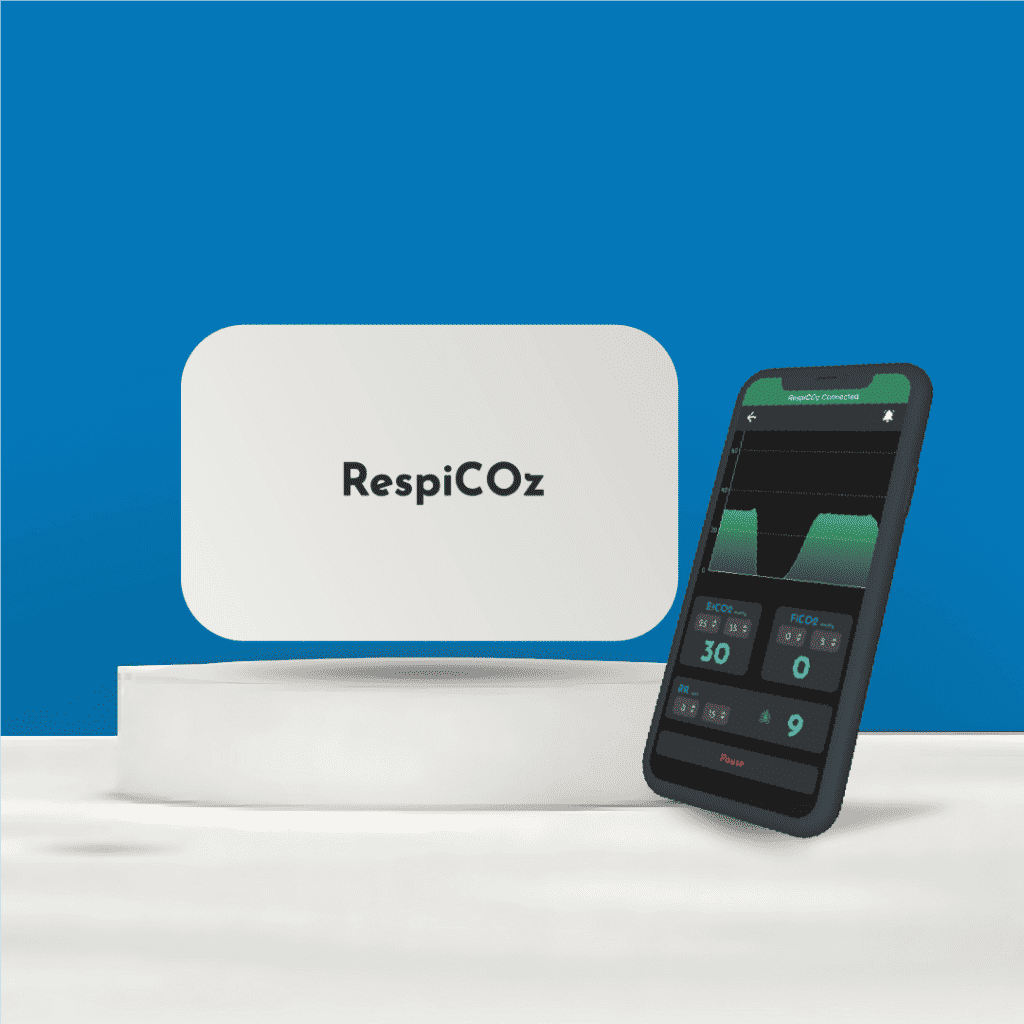
For the capnography slot, RespiCOz is built for the intensive care reality: the patient who is ventilated, and who moves.
ICU patients have a secured airway, so the mainstream sensor sits exactly where it should, at the airway adapter in the circuit. The reading is fast and direct, with no sampling line to block with secretions and no water trap to fill, which matters in humidified circuits and in a moving trolley. It shows the EtCO2 value, the waveform and FiCO2 together, so rebreathing in a circuit is caught directly.
It runs on battery and is light enough to travel from the bed to CT and back, or into an ambulance for an inter-hospital transfer, so the airway stays confirmed the whole way rather than being handed over and lost.
It is CDSCO-approved, made in India, carries a two-year device warranty with a dedicated technical team, and is priced in the value middle at ₹60,000 to ₹1,00,000, which makes it realistic to keep one per transport trolley rather than one per unit. Because it is a mainstream device, there are no sampling lines or water traps to buy again, which keeps the running cost low. See capnograph cost of ownership.
To be clear about its scope: RespiCOz is a focused mainstream monitor for airway-secured patients. A spontaneously breathing patient on a nasal cannula needs sidestream or microstream sampling instead. For ventilated intensive care and transport, it is a strong and honest fit.
For how it compares with other portable units, see the best handheld EtCO2 monitor guide.
Ready to buy? Request a quote for your unit here.
Frequently asked questions
What equipment does an intensivist need most? At a working minimum: a ventilator to support breathing, a multiparameter monitor for continuous vital signs, a capnograph to confirm the airway and ventilation, infusion pumps for precise drug delivery, and point-of-care ultrasound for bedside diagnosis.
Why does an ICU need a capnograph if the monitor already shows oxygen saturation? Because they measure different things. Pulse oximetry measures oxygen and warns late, particularly on supplemental oxygen. Capnography measures ventilation and shows a displaced tube or a disconnection within seconds.
Is capnography required during ICU patient transport? For ventilated patients, continuous capnography is recommended as a standard of monitoring during transport, and transfer guidance requires monitoring to be continuous throughout the journey. This is difficult to achieve with a monitor fixed to the bed space.
Why is point-of-care ultrasound considered essential now? Because it answers questions at the bedside in minutes, particularly the cause of shock, and it reduces the need for chest X-rays, CT scans and moving an unstable patient to another department.
Can one portable capnograph serve a whole ICU? It depends on how often patients are transferred. Many units keep one per transport trolley rather than one per unit, since the highest-risk moments are the journeys to imaging, theatre and other hospitals.
Conclusion
The essential equipment for intensivists comes down to five jobs, not five brands. Support the breathing. Watch the vital signs. Confirm the airway and the ventilation. Deliver the drugs precisely. See inside the patient without moving them.
Each device is blind exactly where another one sees, which is why the list is five and not two. And the gap most units still carry is the third one, because capnography built into a bedside monitor stays at the bedside, while the patient does not.
Close that gap, and the riskiest moments in intensive care stop being the unmonitored ones.
To go deeper on the transport problem, see EtCO2 monitoring during transport.
References
- Indian Society of Critical Care Medicine Experts Committee Consensus Statement on ICU Planning and Designing, 2020. Indian Journal of Critical Care Medicine. pubmed.ncbi.nlm.nih.gov
- International evidence-based recommendations for point-of-care lung ultrasound. Intensive Care Medicine. link.springer.com
- Intrahospital Transport of Critically Ill Patients: Safety First. NCBI PMC. Continuous monitoring during transport. pmc.ncbi.nlm.nih.gov




1 thought on “5 Devices Every Intensivist Must Have”
Pingback: Hospital Equipment List India: The Safe, Essential Guide