

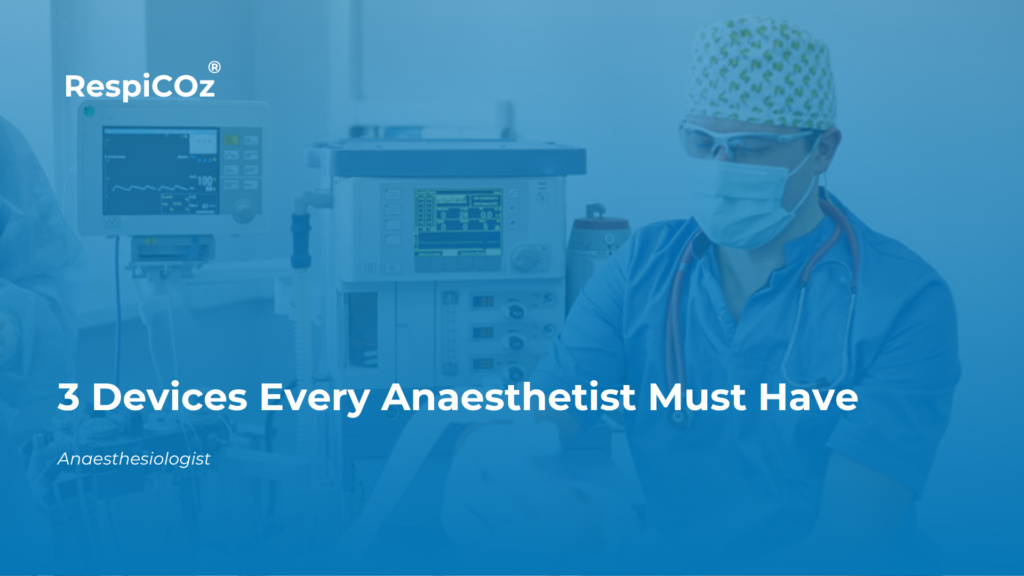
The essential equipment for anaesthesiologists is not a long list. Strip away everything that is nice to have, and three monitors remain, because each one answers a question the other two cannot.
Is the patient ventilating? Is the patient oxygenated? And will the patient be able to breathe on their own when you take the tube out?
Three questions. Three different failure modes. Three devices. Miss any one of them and you are relying on luck for something that should be measured. Here is the case for each.
Key takeaways
- Three monitors cover the three ways a patient’s breathing fails under anaesthesia.
- A capnograph answers whether the patient is ventilating, within one breath.
- A pulse oximeter answers whether they are oxygenated, but it warns late.
- A quantitative neuromuscular monitor answers whether they can breathe unaided after extubation.
- Each one is blind to what the other two see. That is why all three are standard.
1. A capnograph
The question it answers: is the patient ventilating, right now?
Capnography measures the carbon dioxide in every exhaled breath and shows it as a waveform. It is the only monitor that tells you, breath by breath, that air is actually moving.
It does three jobs at once. It confirms the tube is in the trachea and keeps confirming it. It tracks ventilation continuously, so a disconnection, an obstruction or a failing ventilator shows within seconds. And it is frequently the first sign of an emergency, from a circuit disconnection to malignant hyperthermia, where a rising EtCO2 appears long before the temperature does.
This is why it is not optional. The American Society of Anesthesiologists makes continuous monitoring of exhaled carbon dioxide a standard for every patient under general anaesthesia. The Association of Anaesthetists lists it alongside ECG, pulse oximetry and blood pressure as minimum monitoring, from before induction through to recovery. The World Health Organization and the World Federation of Societies of Anaesthesiologists, in their International Standards for a Safe Practice of Anesthesia, make continuous waveform capnography highly recommended, which is their term for essential.
Its blind spot: it tells you about ventilation, not oxygenation. A patient can be moving air beautifully and still be hypoxic from a shunt or a pneumonia.
See capnography during anaesthesia and endotracheal tube confirmation.
2. A pulse oximeter
The question it answers: is the patient oxygenated?
The pulse oximeter is the other mandatory monitor, and it earns its place because oxygenation and ventilation are genuinely different things. Pneumonia, a shunt, a ventilation-perfusion mismatch or a low inspired oxygen level can all drop the saturation while breathing looks entirely normal. Only the oximeter sees that.
It is also cheap, non-invasive, universally available and needs almost no training to interpret.
Its blind spot, and it is a serious one: it is a late warning for breathing problems. Oxygen is held in reserve in the lungs and blood, so the saturation stays reassuring for minutes after ventilation has already failed. Add supplemental oxygen, which most anaesthetised patients receive, and that delay stretches further. A patient can be apnoeic with a comfortable-looking oximeter reading.
This is precisely why the two devices are a pair, not alternatives. See capnography vs pulse oximetry.
3. A quantitative neuromuscular monitor
The question it answers: can the patient breathe on their own once you extubate?
This is the one most often missing, and the evidence on it has shifted decisively.
If a muscle relaxant has not fully worn off, the patient is extubated weak. Residual neuromuscular blockade causes airway obstruction, poor cough, reintubation, atelectasis and pneumonia. It is common. Reported incidence at the end of surgery or in recovery runs as high as 64% without objective monitoring, and it is invisible to the eye: a patient can look awake, lift their head and still be significantly weak.
The old method was subjective, a visual or tactile check of the train-of-four twitches. That is no longer considered adequate. The 2023 ASA Practice Guidelines for Monitoring and Antagonism of Neuromuscular Blockade recommend quantitative neuromuscular monitoring at the adductor pollicis, and confirmation of a train-of-four ratio of 0.9 or above before extubation. The European guidance mirrors it.
A quantitative monitor gives you that number objectively. A subjective twitch check does not.
Its blind spot: it says nothing about ventilation or oxygenation during the case. It answers one question, at one moment, extremely well.
See post-operative capnography, where residual paralysis is one of the main reasons recovery is a high-risk period.
Three monitors, three blind spots
| Capnograph | Pulse oximeter | Neuromuscular monitor | |
|---|---|---|---|
| Answers | Is the patient ventilating? | Is the patient oxygenated? | Can they breathe unaided? |
| Speed of warning | Seconds | Minutes, delayed | At the moment of testing |
| Confirms the airway | Yes | No | No |
| Affected by supplemental oxygen | No | Yes, masks deterioration | No |
| Blind to | Oxygenation problems | Ventilation failure, early | Everything during the case |
Read the table across and the logic becomes obvious. Each device is blind exactly where another one sees. Own one and you have a partial picture. Own all three and the common ways a patient’s breathing fails are all covered.
Why the third one is so often missing
Capnography and pulse oximetry are usually built into the anaesthesia machine or the theatre monitor, so they come with the room. Quantitative neuromuscular monitoring is a separate purchase, and it is frequently skipped in favour of a subjective twitch check.
That is the gap worth closing. It is also worth noting that portability is a real issue for the first item. Capnography is standard in theatre, but anaesthesia does not only happen in theatre. It happens in imaging, in endoscopy suites, in day-care units and in remote sites, and it continues through transfer and recovery. A monitor bolted to a theatre wall does not follow the patient. See capnography for small clinics.
Where RespiCOz fits
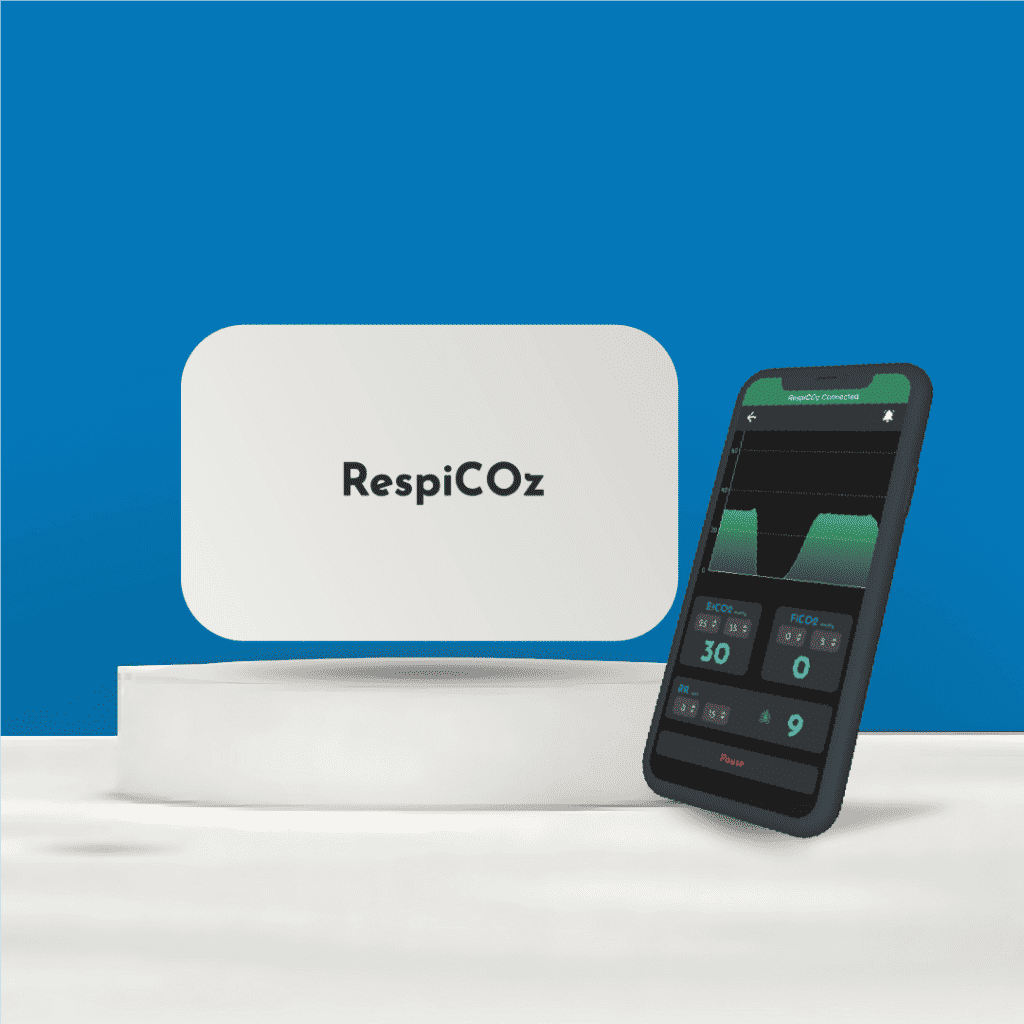
For the capnography slot, RespiCOz is built for the anaesthesiologist who needs the monitor to travel.
It is a portable mainstream capnograph, so the sensor sits at the airway adapter in the circuit, which is exactly right for an intubated, ventilated patient. The reading is fast and direct, with no sampling line to block and no water trap to fill. It shows the EtCO2 value, the waveform and FiCO2 together, so rebreathing from an exhausted soda lime absorber is caught directly rather than inferred.
It runs on battery and is light enough to go from theatre to recovery to the ward, which covers the transitions where monitoring usually thins out. It is CDSCO-approved, made in India, carries a two-year device warranty with a dedicated technical team, and is priced in the value middle at ₹60,000 to ₹1,00,000, which makes it a realistic second unit rather than a capital project.
To be clear about its scope: RespiCOz is a focused mainstream monitor for airway-secured patients. A free-breathing patient on a nasal cannula needs sidestream or microstream sampling instead. Within anaesthesia, where the airway is secured, it is a strong and honest fit.
For how it compares with other portable units, see the best handheld EtCO2 monitor guide.
Ready to buy? Request a quote for your hospital here.
Frequently asked questions
What equipment does every anaesthesiologist need? At minimum, three monitors: a capnograph to confirm ventilation and the airway, a pulse oximeter to confirm oxygenation, and a quantitative neuromuscular monitor to confirm recovery from muscle relaxants before extubation.
Is capnography mandatory during general anaesthesia? Yes. The ASA and the Association of Anaesthetists make continuous capnography a minimum monitoring standard for every patient under general anaesthesia, and the WHO-WFSA international standards make continuous waveform capnography highly recommended.
Why is a pulse oximeter not enough on its own? Because it measures oxygen, not breathing. Oxygen reserves, especially with supplemental oxygen, keep the saturation normal for minutes after ventilation has failed. Capnography detects the problem within seconds.
Do I need a quantitative neuromuscular monitor, or is a twitch check enough? The 2023 ASA guidelines recommend quantitative monitoring and state that subjective assessment should not be the sole method. They advise confirming a train-of-four ratio of 0.9 or above at the adductor pollicis before extubation.
Can one portable capnograph cover several rooms? Yes. A handheld, battery-powered capnograph moves between theatre, recovery, day-care and remote anaesthesia sites, so a department can often cover several settings with one or two units rather than fitting a monitor to every room.
Conclusion
The essential equipment for anaesthesiologists is short, and it is short for a reason. Three monitors, three questions, three blind spots that cancel each other out.
The capnograph tells you the patient is ventilating, and it tells you first. The pulse oximeter tells you they are oxygenated, which is a different question with a slower answer. The neuromuscular monitor tells you they can breathe unaided once the tube comes out, which nothing else measures objectively.
Own all three, use them together, and the common ways a patient’s breathing fails under anaesthesia are all visible before they become emergencies. That is the whole point of monitoring.
To go deeper on the first of the three, start with capnography during anaesthesia.
References
- International Standards for a Safe Practice of Anesthesia. World Health Organization and World Federation of Societies of Anaesthesiologists (WHO-WFSA). Continuous waveform capnography as highly recommended. wfsahq.org
- Practice Guidelines for Monitoring and Antagonism of Neuromuscular Blockade. Anesthesiology. 2023;138:13–41. American Society of Anesthesiologists. Quantitative monitoring and train-of-four ratio of 0.9 before extubation. asahq.org
- New Practice Guidelines for Neuromuscular Blockade. Anesthesia Patient Safety Foundation (APSF). Incidence of residual blockade and associated complications. apsf.org


2 thoughts on “3 Devices Every Anaesthesiologist Must Have”
Pingback: Operation Theatre Equipment List: What Every OT Needs - Brainiac Healthcare - The World's First Smart Capnometer
Pingback: Hospital Equipment List India: The Safe, Essential Guide